|

installation by head–genève envisions post-anthropocene landscapes at milan design week

2084: A Diorama of The Future at Milan Design Week 2024

Designed by MAIA students of the Department of Interior Architecture, HEAD – Genève, 2084, Diorama of the Future is an architectural speculation on the challenges of the post-Anthropocene era. The scenario deals with the reconstruction of a near future in which some cities are submerged, while others endure extreme conditions, direct consequences of the climate emergency. Amidst this turbulence, a diverse group of human and non-human explorers parachutes into 2084, facing the challenge of survival and reconstruction.

Showcased at Milan Design Week 2024, the installation transforms parts of the historic annexes of Villa Bagatti Valsecchi into a dynamic and performative diorama inviting visitors to reflect on contemporary environmental and societal dilemmas. While 19th-century dioramas presented romanticized visions of exotic natures behind glass screens that detached visitors from their complexities, Diorama of the Future inserts visitors right in front of damaged environments, calling for new ecosystemic actions. Within this large device, students take on the role of inhabitants of this changing vivarium, whose evolution problematizes the relationship between representation, agency, and climate change.
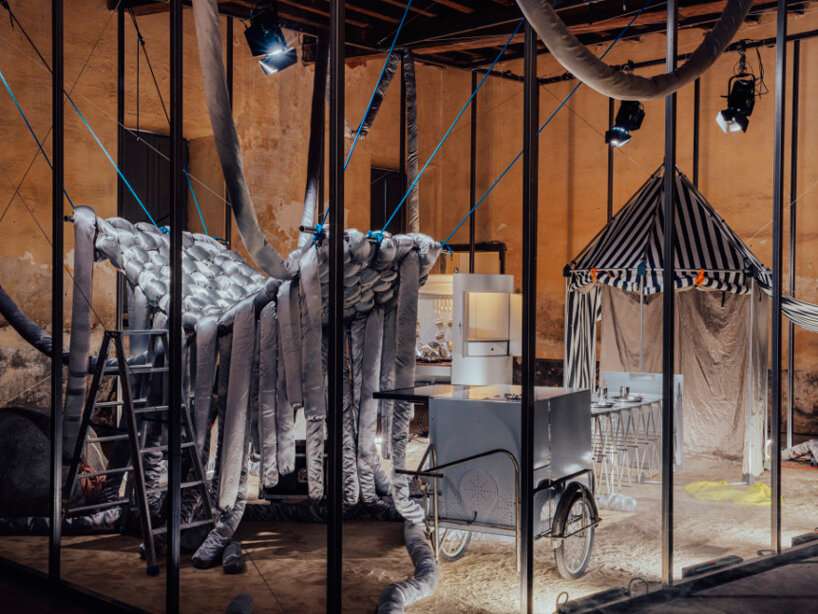
2084 diorama of the future installation milan design week 2024
all images by Raphaelle Mueller

The camp, the Nap, and the Treat outline 2084’s scenery

Three projects developed by MAIA students of the Department of Interior Architecture, HEAD – Genève, inhabit the installation.

First, the Camp. The torrential rain, the increased exposure to various waves, and, above all, the scorching sun forced them to come up with a tent that was as protective as it was transportable. A ‘Swiss Army knife’ box unfolds into a space dedicated to celebration. A multi-purpose shape conceals the long table on which glasses, plates, and tools clash. The tent is made from shaped anodized aluminum tubes, with a two-layer fabric: aluminum to protect against waves, and black and white striped fabric to protect against water and rain. The trolley is based on a hijacked bicycle trolley, body in heat-welded aluminum, CNC cut, solar panel.

Second, the Nap. A large nomadic bed that could withstand the scorching rays of the sun during the day and sleep anywhere at night. The Nap is a succession of sheaths made from anti-radiation fabric filled with cotton insulation, spherical polycarbonate lamps, ropes, and steel tubes.

Last, the Treat. This ironic rocket was thought up as a kitchen drone by the food giants of the 2080s under the title ‘The Pleasure of Giving.’ The Treat comprises of a cupboard made from solid-stained MDF, covered with anodized aluminum sheets, chromed steel legs, marble, oak, and a hob.

2084 diorama of the future installation milan design week 2024
2084: A Diorama of the Future by MAIA students of HEAD – Genève was presented at Milan Design Week 2024

2084 diorama of the future installation milan design week 2024
the installation explores post-Anthropocene challenges such as climate-induced extreme conditions

installation by head–genève envisions post-anthropocene landscapes at milan design week
the Treat, an ironic kitchen drone, was designed as a futuristic cooking device by 2080s food giants

installation by head–genève envisions post-anthropocene landscapes at milan design week
the Treat features a combination of solid-stained MDF, anodized aluminum, chromed steel, marble, and oak

Similar Posts

  • The Fieldhouse

    Built for family and friends as a space for sport and gathering, the Fieldhouse is a simple, functional structure. Like the immersion of nature and recreation in the development of state and national parks of the early 20th century, this family wanted a structure where friends, family, and neighbors could gather, play sport, celebrate and relax in the country. The Fieldhouse feels distant and secluded, located on a mostly undeveloped seven-acre site, surrounded by a meadow of natural grasses, a fruit orchard, wetland ponds and a maintained field for sporting. As long time natives of the Pacific Northwest, the family was keen to convey a specific sense of place and longevity. The architecture responds to those ideas in its simplicity and versatility, and in its construction from durable, local materials. Inspiration was taken from vernacular stone and timber structures built across the country in the 1930s by the Civilian Conservation Corps. The architects and clients channeled their own recollections of summers spent in Seattle’s waterfront parks and their simple elegant structures, often by early 20th century Seattle architect Ellsworth Storey. The 1,664-square-foot structure consists of a covered outdoor patio flanked by two, offset and enclosed spaces housing a sun room and inglenook to the west, and a kitchen, grill and two bathrooms to the east. Designed to accommodate almost any situation, the Fieldhouse can shelter four as comfortably as it can 60, hosting sleepovers, family sports tournaments, reunions and outdoor dining with ease. The structure employs a gradient of enclosure and structural qualities from the immersive intimate inglenook to the ever thinning shed roof structure, gently lifting off above the central patio. The building can be shutdown to weather storms, or opened wide to allow light, air and activity to pass through freely. The structure provides a straight-forward and visibly-constructed language of materials. It progressively lightens from a solid stone base, to thick timber columns, to pairs of rafters and thinner yet pairs of purlins, supporting the single-plane shed roof. The timber is all Douglas fir and cedar harvested and salvaged from the Pacific Northwest. The stone is taken from a quarry on nearby Vancouver Island and the early, factory-style steel casement doors and windows are West Coast built. This timeless assembly of materials and method of construction suggest that this is a building about its surroundings and a stalwart of the region it resides in, functioning as well today as it will in 100 years. Hoedemaker Pfeiffer design team
    Steve Hoedemaker, co-founder and partner
    Justin Oldenhuis Project team
    Hoedemaker Pfeiffer (Architecture)
    Hoedemaker Pfeiffer (Interior Design)
    Joseph McKinstry Construction Company (Contractor)
    Swenson Say Faget (Structural Engineer)
    Kenneth Philp Landscape Architects (Landscape Architect) Photography
    Andrew Giammarco