|

robots and AI help humans exist in future cities at the venice architecture biennale 2025

Robots and AI at the venice architecture biennale 2025

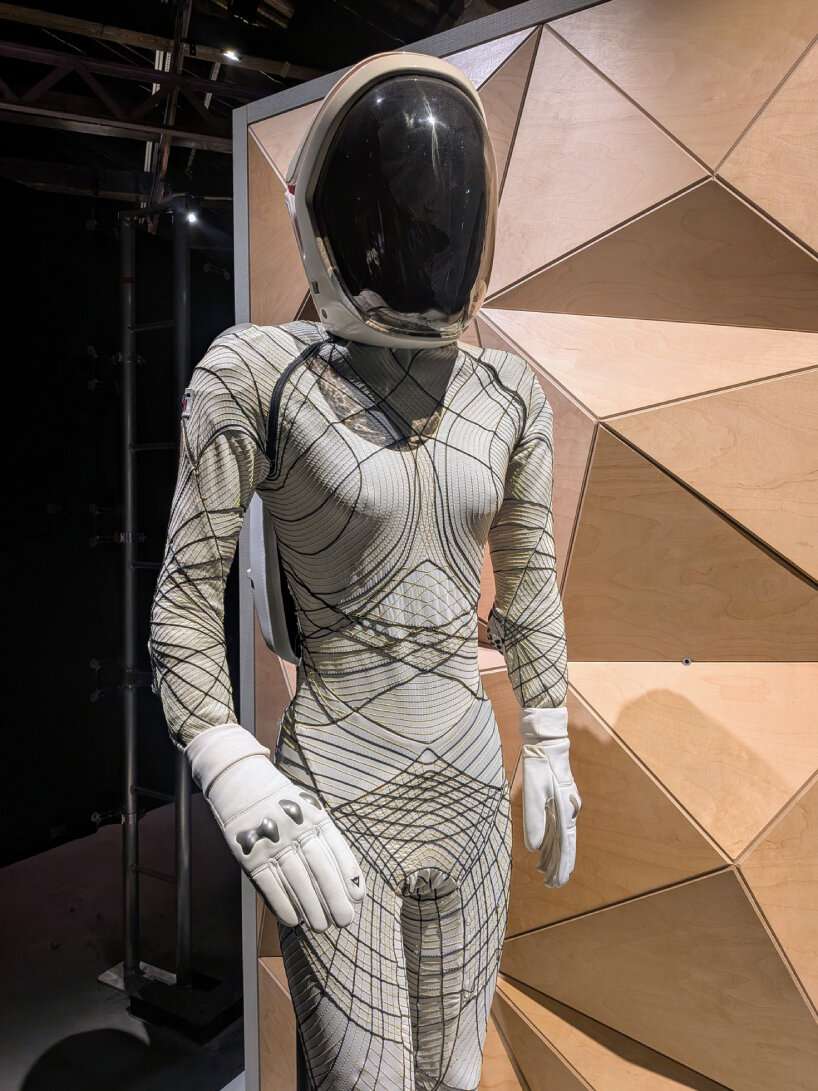
At the Arsenale of the Venice Architecture Biennale 2025, robots and AI exist for and with humans, a glimpse at everyday life in future cities. These humanoids and robotics at the international exhibition, which runs until November 23rd, display their growing role in reshaping how structures and wearables are designed, built, and used, both on Earth and in space. They support human exploration and survival out of Earth, form part of construction tasks, and bear systems that allow them to adapt to the environment and collaborate with humans to perform different tasks. Take the BioSuit by Dava Newman and Guillermo Trotti. It’s a 3D textile framework built with computational design and fiber integration, tailored to everyone’s body dimensions. It has wearable sensors and actuators, thermal protection, radiation shielding, and active materials for compression.

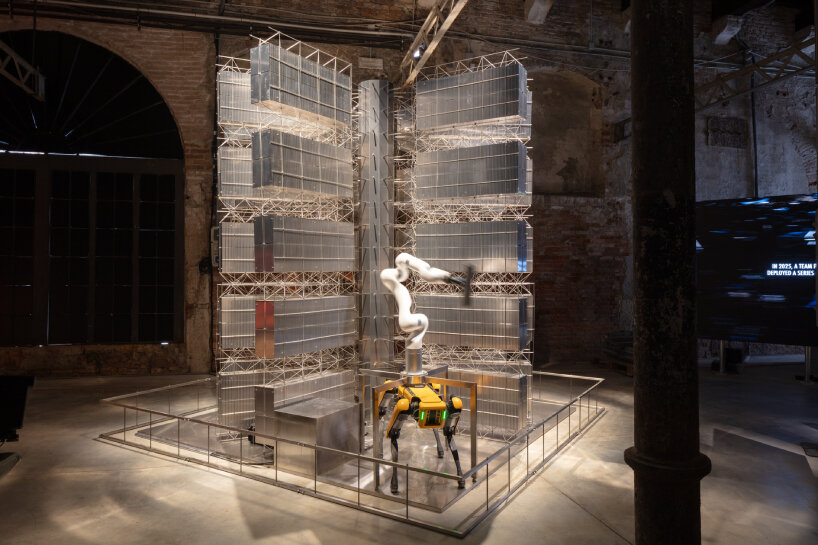
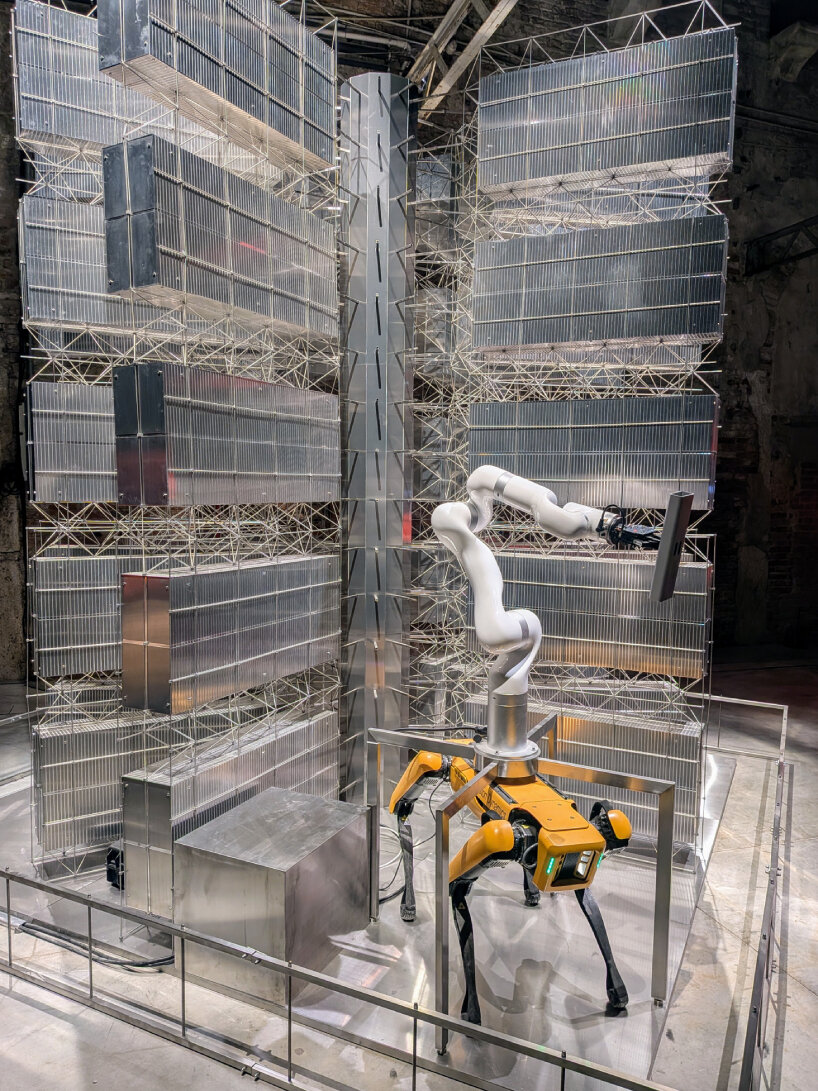
The suit is designed to support astronaut activity on the Moon and Mars. It even comes with real-time mission planning and metabolic monitoring to combine astronaut data with environmental inputs and guide the astronauts with their exploration. Positioned next to this suit at the Arsenale, visitors see the Lunar Ark by IVAAIU City. Another application of robotics in space development, it depicts a data center on the Moon using robotic systems. The goal is to mitigate risks related to climate change on Earth by storing critical data off-planet. The robots come in by assembling the archive infrastructure and carry out the system updates using optical laser communication. For the exhibition, the design team places a robot arm on top of Boston Dynamics’ robot dog, Spot.
robots ai venice biennale
BioSuit by Dava Newman and Guillermo Trotti | image © designboom

Machines ‘help’ humans, not replace them

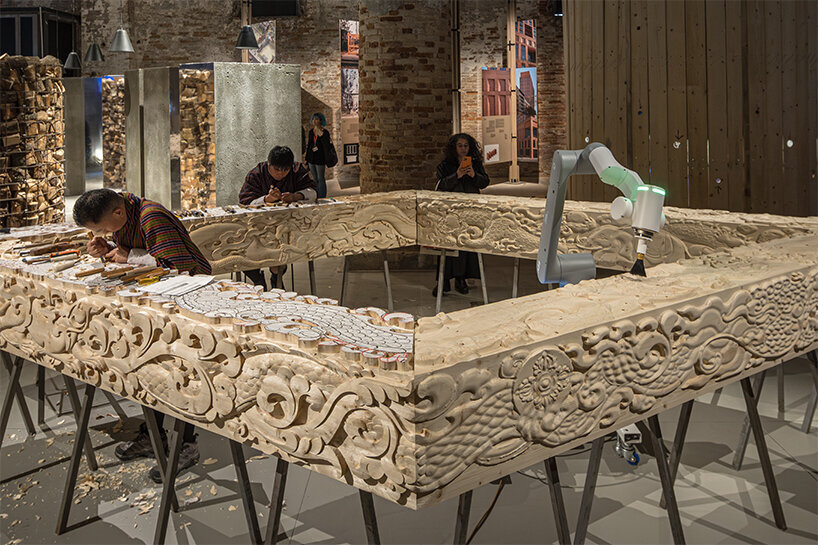
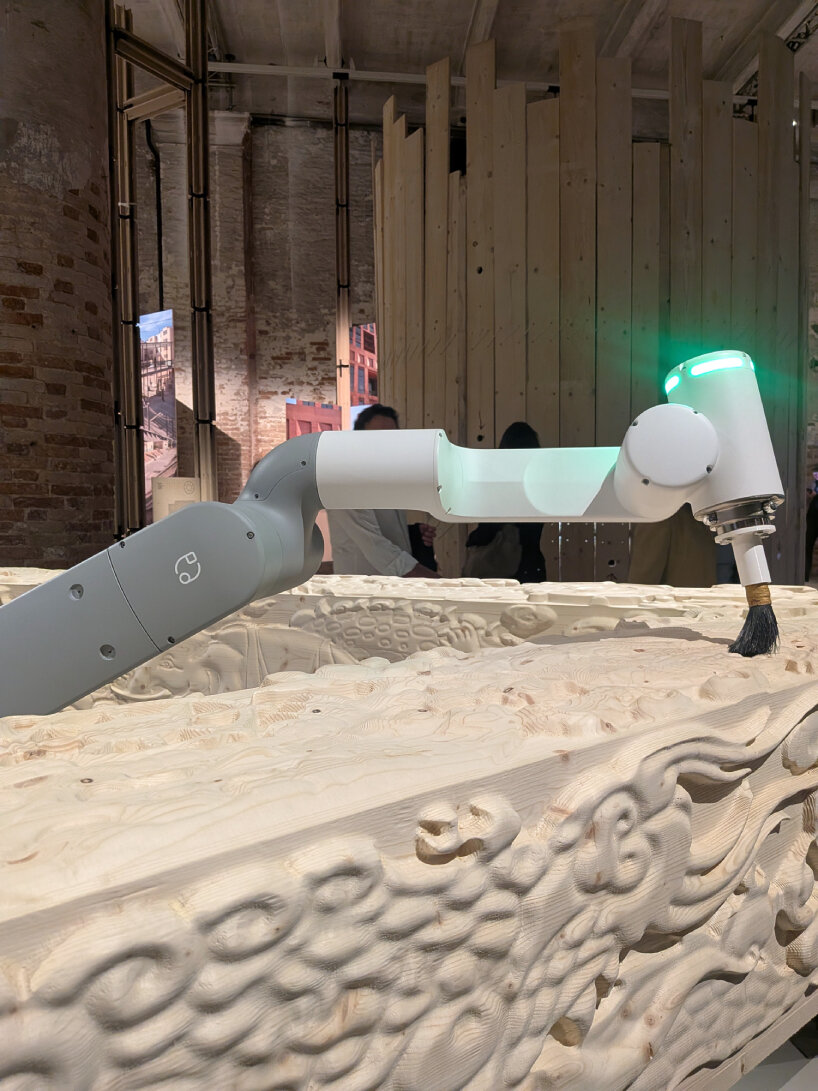
Robots and AI only take up a part of the Arsenale at the Venice Architecture Biennale 2025, but it’s enough to announce and remind people of their growing presence in people’s lives and the architecture industry. Bjarke Ingels Group, Laurian Ghinitolu, and Arata Mori, for example, present an installation where traditional Bhutanese woodworking is helped by a robotic arm. This six-meter, diamond-shaped wooden beam is partially carved by a human and partially by a robot using AI. The case isn’t to show that robots will replace humans. Instead, the installation demonstrates how we can fire up the robots for help, shouldering some of our workload. 

There’s another pair of robots and AI at the Venice Architecture Biennale 2025 that exhibits how machines and humans can work together. That’s CO-POIESIS by Philip F. Yuan and Bin He. Here, the duo built a temporary pavilion for the two robots, made from salvaged timber and with robotic fabrication. The large structure hosts two wired robots with sensors: the one at the front plays the steelpan drum, while the one behind dances. Outside the installation, there’s another steelpan drum that visitors play. Once they do, the robot hits the same drum that the visitors strike, and soon enough, the second robot begins to dance.
robots ai venice biennale
Lunar Ark by IVAAIU City | image courtesy of IVAAIU City

Humanoids can gain self-awareness over time

Can robots and AI gain self-awareness? During the Venice Architecture Biennale 2025, the installation Am I A Strange Loop? by Takashi Ikegami and Luc Steels attempts to answer the question. It features a humanoid robot called Alter3. It doesn’t have skin around its body, but the machine has a face and two hands, sculpted from clay-like material. The design team installs systems for perception, motion control, memory, and language processing. 

This means that Alter3 can converse with visitors and move its hands and head as it talks using language models. There’s also Machine Mosaic by Daniela Rus, demonstrating the use of a humanoid robot in bricklaying and mosaic assembly. It has a computer vision system that enables the robot to sense and interpret its surroundings. Because of this, it can translate what it sees into action, mimicking it even. During the exhibition, the robot repeatedly assembles and dismantles components, showing how robotics can perform structured building tasks.
robots ai venice biennale
the installation significantly depicts a data center on the Moon using robotic systems | image © designboom

The experiment looks into robotic self-awareness. Researchers believe can develop when feedback loops connect a robot’s outputs to its inputs, creating a recursive cycle. These robots and AI at the Venice Architecture Biennale 2025 still mirror the already growing sphere of the machinery in space, architecture, Earth, and human lives. 

Whether helping astronaut performance, constructing lunar facilities, assisting with craftsmanship, or testing theories of consciousness, robotics, and the people behind them, try to expand the boundaries of design, construction, and space exploration. These machines take on more functions in both land and extraterrestrial environments, and the international exhibition, which runs until November 23rd, 2025, spotlights the relationship between human activity and robotic support that’s becoming interdependent. 
robots ai venice biennale
Ancient Future: Bridging Bhutan’s Tradition and Innovation by Bjarke Ingels Group, Laurian Ghinitolu, and Arata Mori | image courtesy of BIG
robots ai venice biennale
traditional Bhutanese woodworking evidently helped by a robotic arm | image © designboom
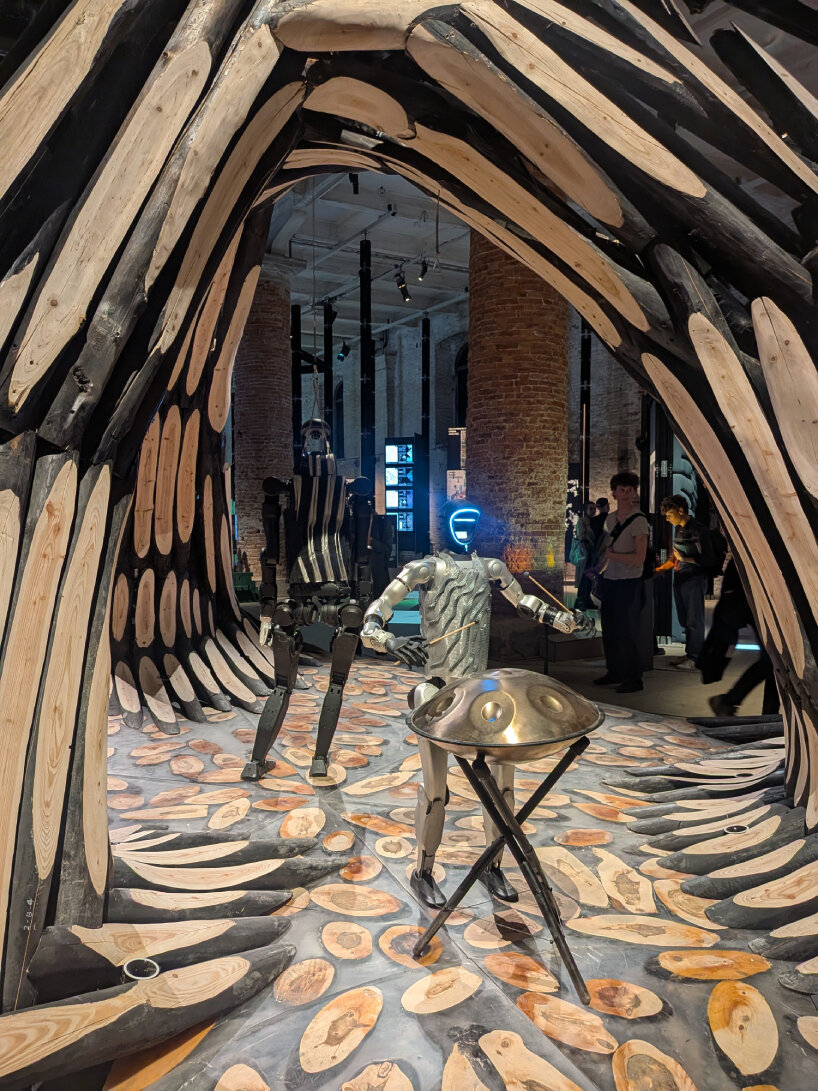
CO-POIESIS by Philip F. Yuan and Bin He | image © designboom
Similar Posts

  • Villa Pizzorusso

    One of the most remarkable Puglia villa rentals available, this restored 16th-century masseria (fortified farmhouse) stands proudly on the ancient Appian Way. If you are looking for a luxurious holiday retreat brimming with character and history, this stunning property is for you. Deep in the countryside and surrounded by olive groves, Villa Pizzorusso is the ideal place to get away from it all. The secluded gardens, filled with orange trees and aromatic herbs, are wonderfully private, and you’ll love the magnificent 80 ft (25 m) swimming pool. Enjoy a morning coffee or early evening aperitif on the extensive first-floor terrace and take in the views across the peaceful landscape. The character of the grand old masseria is still in evidence throughout. Enter the interior through the arched portal and step into a world of barrel-vaulted ceilings, stone arches and a wealth of period details that wouldn’t look out of place on a film set. Different parts of the building date from different eras: the main wing, complete with five cupolas and frescoed ceilings, was added in the 18th century, while the main living area – including an open-plan kitchen – is located within the 17th-century stables. There’s plenty of space to accommodate up to twelve guests. Each bedroom is air-conditioned and simply furnished with neutral tones and traditional wood furniture, while the bathrooms feature striking contemporary fixtures. Four of the bedrooms are located in the main villa with the two upstairs bedrooms having private entrances and secluded access from the ground floor, while two more are located in a smaller stone building in the courtyard. There is much to see and do in the area – from the beaches of the Ionian and Adriatic coasts, to the whimsical conical architecture of the local trulli dwellings. Gourmet travelers should stop at the charming local market town of Mesagne, with its bakeries, wine co-ops and cheese shops (the fresh mozzarella and ricotta are made daily). Puglia is also rich in picturesque medieval cities, such as Ostuni and Otranto, their atmospheric narrow streets lined with an abundance of restaurants specializing in the delectable local cuisine.

  • Messner: A childhood dream comes true

    At the foot of the Sciliar, in the picturesque area of Alpe di Siusi (Bolzano), the spirit
    of a barn is reborn as a home. The project, realised by noa* (network of architecture), has
    at its core, the South Tyrolean tradition combined with surprising features internally,
    resulting from design of visionary and unexpected spaces. An almost magical ambience is
    created, inspired by childhood memories. Keep tradition in mind, but at the same time move away so as to create an original
    identity, a new way of living, a different structuring of the domestic space, and to search
    inspiration from a childhood passed in the mountains. This, in summary, was the challenge
    faced by noa* in the project to construct a new home at Siusi in Sciliar, a construction to
    take the place of a deserted house in the centre of the village, with the original
    structure dating back to 1850. The job, completed in 2017, needs to be understood in its complex and delicate context. We
    are talking about South Tyrol, and a project executed at a height of 1100 a.s.l. at the
    foot of Alpe di Siusi, a part of the Dolomites recognised as a Unesco World Heritage due to
    its outstanding natural beauty. It was therefore extremely important to respect the
    parameters of the original structure and the urban planning requirements and regulations of
    the village. For Stefan Rier, founder, together with Lukas Rungger of the noa* studio, and
    in this instance ‘his own client’, the project was an opportunity to give a personal
    footprint to his own property. In this sense there was a move away from the traditional
    principles of spatial distribution, this being achieved in part by recalling memories of a
    childhood spent in the mountains. “We wanted the project to respect the aesthetics and the urban aspects of the village, a
    village where wooden barns alternate with plaster-fronted houses destined for farmers and
    the keeping of cattle.”, explains architect Rier. “With this in mind, we finished the
    exterior structure with a ‘coating’ in keeping with tradition: a wooden grid on all 4
    sides, just as is used for alpine barns. However, as far as the interior is concerned, I
    decided to leave tradition behind me, and thereby free the design from any preconceived
    limitations. In this way I was able to look forward…but also a little back in time to the
    beautiful years of my childhood”. The outcome of the project is a dwelling, having two aspects which confront each other in
    their style. The exterior represents the traditional alpine location, splendidly immersed
    in the local topography, whilst the interior boasts the visionary impulse, the surprise of
    a space freed from the general scheme of things, almost permeable, osmotic, and certainly
    innovative. On the ground floor there is a common area which spreads out almost in a ‘piazza’ fashion
    for (habitational)and interactional use: there is a dining table to enjoy with friends, an
    ample sized kitchen to accommodate more than one cook! The rest of the house develops in a
    vertical way and instead of the classical room division there are what can be described as
    ‘hanging boxes’, which are positioned at different heights and interconnected by stairs and
    walkways – they giving the sensation of walking up a mountain path towards the peak. The
    hallways are carefully designed so that, apart from their connecting function, they
    accommodate other essential areas such as the library and open ‘bathroom’ areas with tubs
    and showers (only the WC are closed in). The entire structure is conceived in a way that
    the further one goes up the level of privacy and intimacy is heightened. The highest ‘box’
    which features a sauna opens out to the splendid view of the Santner mountain. The revolutionary distribution of the interior spaces can be noted also from the exterior,
    and a sort of counterpoint is created with the traditional presentation of the exterior
    itself. To the north the two boxes of the bedrooms, finished in bronze, can be seen behind
    the wooden trellis shell, and as a result the material contrast is evident, while to the
    south it is sauna box which protrudes the glass facade. It is an architectural concept, both extremely innovative and courageous in nature, but
    which also has the value of being able to evoke an atmosphere of time past. Viewing the
    structure from a distance, the larch framework which supports the hanging boxes with its
    roof supported by 12 metre high wooden columns, seems to be the outline of an old barn. “Thinking about it, I spent a lot of my childhood playing in barns”, underlines Stefan
    Rier, “and one of my lasting and favourite memories is of when I used to climb high up in
    the barns and then throw myself down into the hay. Maybe if I had not had that experience,
    I would never have come to design this house …”. THE STRUCTURE: A DIALOGUE BETWEEN TIME PAST AND TIME PRESENT
    The house mirrors the construction type of the location’s rural buildings. On the stone
    foundation (10x8m), is a wooden structure in larch on three levels, and which supports the
    gable roof, typical of the village’s dwellings. A wooden trellis covers the whole house in
    a shell-like manner, screening the light and heat of the sun in the hotter periods, and as
    a whole it is suggestive of the typical structures of alpine barns. Two boxes, one in
    bronze and one a glass structure ‘peak out’ from the trellis, to the north and south
    respectively, and so revealing to the exterior that there is something complex to the
    interior layout. To the south there is a glass facade and a terrace which opens out to the
    magnificent view over the landscape of the Dolomites, a view which is dominated by the
    splendid sight of the Sciliar massif. THE INTERIOR SPACES: A STATIC CHALLENGE
    Inside the house, the distribution of spaces and functions is really unusual. The ‘boxes’
    which house the three bedrooms are supported by the wooden beam structure, visible in its
    totality (12 metres high). The bedrooms are designed as micro-homes, each one having its
    own particular design, these boxes seem to almost ‘hang’ in the ample volume of the
    interior (1,100 cubic metres). One gains access via a staircase and a walkway system, which
    as well as having a connecting function, accommodate the ‘bathroom’ areas with tubs and
    showers (only the WC are closed in). On the last floor, a box plays host to the sauna with
    a panoramic view, extending out of the southern front. Preceding the sauna, there is a
    book-lounge with an antique majolica stove, which has been taken from the pre-existing
    building. The library together with a cloakroom area complete the private spaces on the
    higher levels.
    The ground floor is a large open space with three diverse ‘island’ functions: the
    relaxation area, the dining area, and the kitchen, resolved with a large working surface
    feature in natural brass, and decorated on the sides with artisan earthenware tiles. MATERIALS
    As well as incorporating materials having a local tradition – wood and stone – the project
    introduces others of a more contemporary nature, in some cases recalling a Mediterranean
    style. The floor resin, giving uniformity to the ground floor appearance, alternates
    between baked clay and sea-blue tiles, the same as used for the side covering of the
    kitchen’s work surface. The brass gives brilliant warm tones to the furniture details and
    to the work surface which also incorporates the cooking essentials and sink. The staircase,
    in finely worked steel recalls the grates of Arabian tradition, creating a chiaroscuro
    effect which is extremely unusual for the Alpine environment. Furniture and Cloth
    The furniture has all been produced to design specification, adhering to a zero-kilometre
    regime. Attention to detail has been scrupulous, as has the search for original solutions
    from both a formal and functional stance. Cloth chosen plays an intricate game with wood in creating an atmosphere almost theatrical
    in kind. Flowing blue drapes act almost as stage curtains in enclosing various spaces and
    giving different and new perspectives. There has also been a coming together of texture and
    décor for the box-like bedrooms, this evident even in the wallpaper in blue tones, and so
    creating a functional soundproofing barrier. Light
    The project strives to make the most of natural light: to the south the facade is a
    complete glass construction, the light being filtered by the external wooden grid
    positioned at 2.5 metres from the principal structure, whilst the jutting out roof shades
    protect the interior from the extreme heat of the summer months. On the roof, a skylight
    opens to the east providing another source of light. To the north there are windows.
    As for internal lighting, in the very high living area, there are suspension lights to
    guarantee sufficient light and in particular for the specific functional areas (dining and
    kitchen areas). Many of the lamps in the house have been design created.