|

Subterranean Natural History Museum Is Draped With Landscaped Ribbons That Blend Into the Forest

Hungarian Natural History Museum by BIGHungarian Natural History Museum by BIG

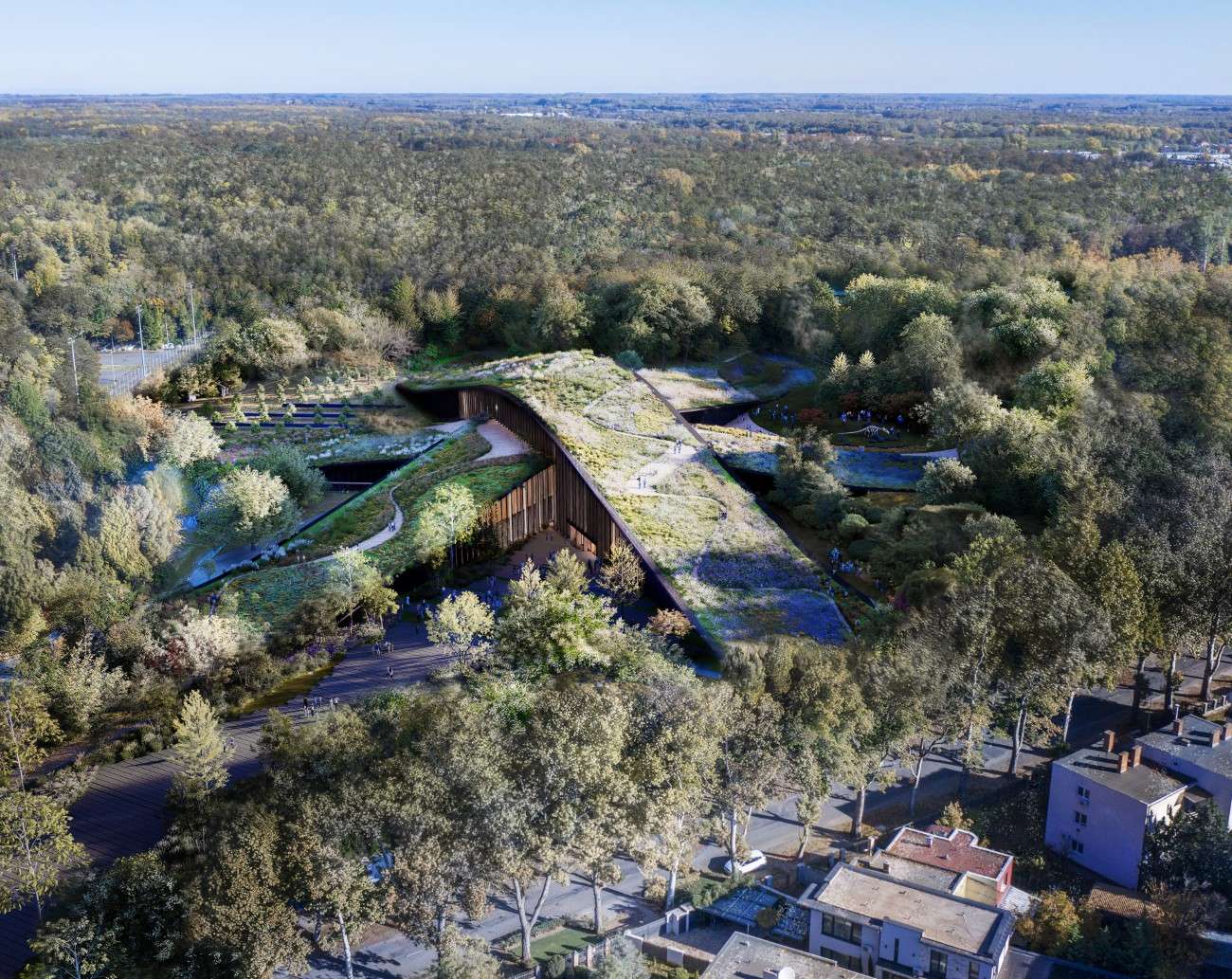
Whether designing a baseball stadium, ballet theater, or museum, BIG (Bjarke Ingels Group) always has something up its sleeve. The Hungarian Natural History Museum is no exception. BIG won an international competition to design the 23,000-square-meter institution thanks to its innovative concept that sees three landscaped ribbons creating a new space for science.

Set in the Great Forest of Hungary’s second-largest city, Debrecen, the future museum will rise from the forest floor. With its green roofs and charred timber facade, the museum will blend into its environment while providing light and bright exhibition halls for the permanent collection.

In a way, the museum, which is designed as partially sunken underground, will become a fundamental part of the landscape; it’s fitting given the function of a natural history museum. Accessible on all sides and filled with open plazas and winding forest paths, it will open up new community spaces. And in doing so, it will allow visitors to see the connection between science, architecture, and nature.

“We envisioned the Hungarian Natural History Museum as an integrated part of its environment, both shaped by and shaping the landscape around it,” shares BIG Partner Hanna Johansson. “Constructed from mass timber, the building features a facade of locally sourced charred timber panels that emerge from the ground, blurring the lines between architecture and wilderness.”

Inside, the spacious exhibition areas formed by the ribbons are the perfect setting for magnificent displays of dinosaur fossils and other natural materials. In addition to five permanent galleries and a temporary exhibition space, the museum will have a library and restaurant offering views into the forest canopy, while below, a learning hub hosts workshops, play spaces, and research labs for students, families, and staff.

While no official construction timeline has been given, it should be open by 2030, as it’s part of a wider plan to position Debrecen as a hub for education and culture by that time.

BIG has won an international competition to design the Hungarian Natural History Museum.

Hungarian Natural History Museum by BIGHungarian Natural History Museum by BIG

The museum, which is partially sunken into the ground, features a charred timber facade and landscaped roofs.

Hungarian Natural History Museum by BIGHungarian Natural History Museum by BIG

The ribbon-like roofs create light, airy exhibition halls befitting of a natural history museum.

Hungarian Natural History Museum by BIGHungarian Natural History Museum by BIG

By emerging from the forest floor, the museum becomes an integral part of the landscape.

Hungarian Natural History Museum by BIGHungarian Natural History Museum by BIG

Bjarke Ingels Group (BIG): Website | Facebook | Instagram 

My Modern Met granted permission to feature photos by BIG.

Related Articles:

BIG Drapes an Undulating “Veil” Over Kosovo’s Ballet and Opera Theater

Museum of Paper Cleverly Designed With a Roof That Looks Like a Sheet of Folded Paper

New Gelephu International Airport Is a Celebration of Bhutanese Culture and Heritage

Cutting Edge Ballpark Design Is Inspired by an Armadillo To Help It Beat the Las Vegas Heat

Similar Posts

  • Small Modern Industrial Apartment Captivates with Remarkable Textural Contrast

    Forgotten industrial buildings built in the last century, old warehouses that have not been in use for a while now and dilapidated structures needing an urgent intervention have been some of the reasons for the resurgence of modern industrial style. In an attempt to provide efficient, cost-effective and suitable housing, architects have transformed many industrial […]

    You’re reading Small Modern Industrial Apartment Captivates with Remarkable Textural Contrast, originally posted on Decoist. If you enjoyed this post, be sure to follow Decoist on Twitter, Facebook and Pinterest.

  • Jungalow

    The project aims in creating an economically modest built form for an agriculturist and his family. Abstraction of urban farming could be seen in both exterior and interior spaces. The design uses the natural light and the built form to its advantage. The site abuts access way on the south and other two sides by adjoining structures. Its location is peculiar as the site is located in the city fringes. The surrounding dwelling unit comprises of peculiar semi urban row houses. South facade has the main entry and is flanked by a series of balconies and stepped terrace on each floor. Activities are distributed on various levels- semi private spaces on ground floor while private spaces on upper floors. The heart of the structure is the double heighted courtyard which is embellished with creepers and climbers. The green curtain cuts the direct entry of west sunlight inside the house and creates a buffer. The view from the spaces offers a glance of voluminous courtyard. The shape of the temple is evolved from the form of Shikhara – a feature of Hindu temple architecture. Temple with triple height factor acts as a wind tunnel with mechanical exhaust fan. Circular windows in bedroom, out looking the landscape serves as a natural picture frame. The basic building materials are kept to its natural form and texture to comprehend the naturality of flora.