inside the spiral
Before I visited Robert Smithson’s Spiral Jetty back in 2017, I thought I knew it well. The earthwork has been photographed from above for more than half a century, with its 1,500-foot coil of basalt and earth dotting Utah’s Great Salt Lake.
That familiar image disappeared once I stepped onto the simple open-air labyrinth. I was surrounded by an endless stretch of earth and uninterrupted sky, and each curve was followed by another reach of pale salt. The pathway had a single route, which kept turning as the landscape continued to repeat itself.
Spiral Jetty’s only destination is its own center (or exit), and by then you lose all sense of direction or scale. Smithson wrote that scale at Spiral Jetty operates through uncertainty, something that can only really be felt by walking it. The center offers no view, just the same expanse of blankness, before the path calls for you to turn around and do the whole thing again in reverse.
Within this work of land art, the visitor is truly removing themselves from reality, dedicating their time to experience absolute nothingness, just mud, salt crystals, rocks, water.
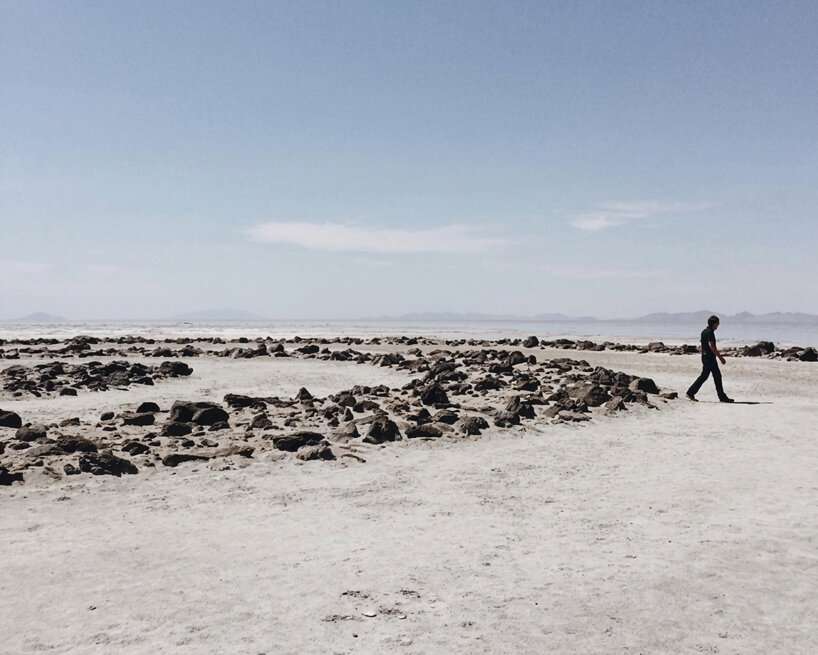
Spiral Jetty, Great Salt Lake, Utah, 2017 | image © designboom
the joy of the unnecessary route
While the job of the corridor is to efficiently deliver us between rooms, the labyrinth inverts that logic of streamlined connection. It expands circulation until movement itself becomes the program. What could be a short distance is drawn out into a meandering network, with the destination becoming secondary to the walk.
Here’s where the labyrinth becomes a space for play: it’s a place to spend time freely, to remove one’s self from serious work. It’s a temporary world where ordinary progress is irrelevant, and it asks the visitor to enter without any promise of usefulness. The play comes through the indirect route itself, through the strange freedom of moving toward a destination that offers little beyond the chance to ultimately reverse course and head out.
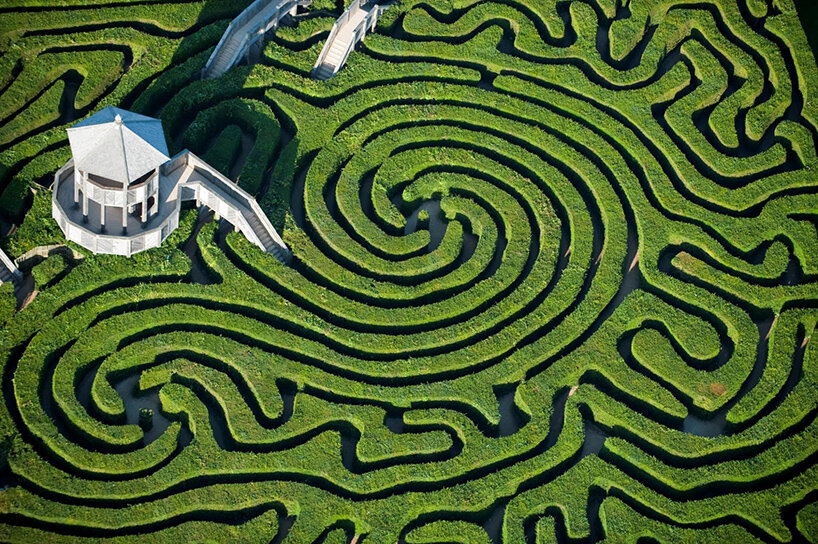
Longleat Hedge Maze, Wiltshire, England, longest hedge maze in the world | image © Jason Hawkes/PA
a maze is a puzzle, a labyrinth is spare time
What many don’t realize it that the terms maze and labyrinth have two very different meanings. A maze branches and offers choices and dead ends along the way. Its play comes through uncertainty. You make decisions, take wrong turns, retrace your steps, and keep testing the plan against your own memory of where you have been. Getting lost is part of the thrill, and finding the exit brings the satisfaction of having solved the space.
Meanwhile, a classical labyrinth follows one continuous path into the center and back out again. There are no decisions to make and no wrong turns to correct. The 19th century Austrian painter Hermann Kern described it as a choreographed pattern of movement.
With all decision-making removed, the walker must move leisurely and without strategy. The experience becomes rhythmic and meditative, allowing ordinary time to gradually suspend. The maze invites play through choice, while the labyrinth invites it through surrender.
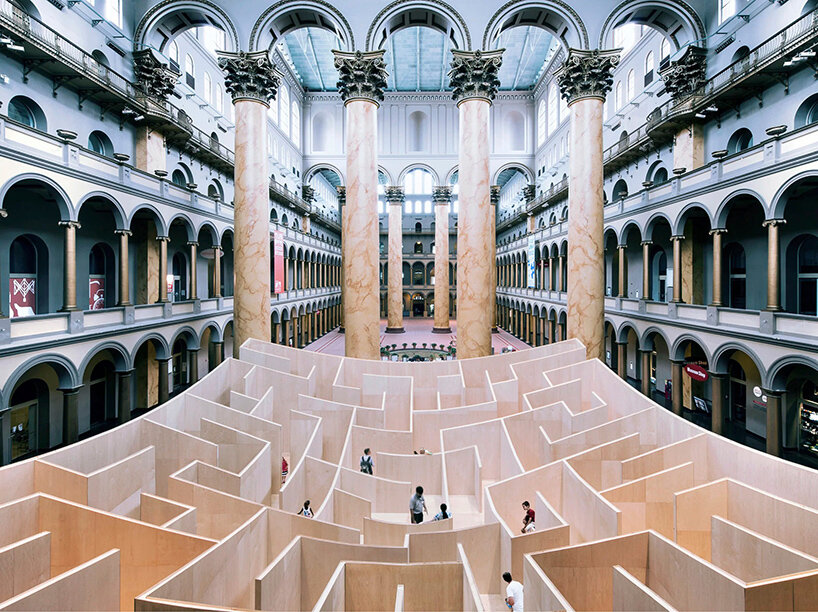
The BIG Maze, Bjarke Ingels Group, National Building Museum, Washington D.C., 2014 | image courtesy BIG
from sacred geometry to modern art
The labyrinth reaches back thousands of years, from the Ancient Egyptians to the myth of the Minotaur, and reappearing across ancient coins and Roman mosaics. During the Middle Ages, the winding geometries were set into cathedral floors and walked as a form of ritual, before branching hedge mazes turned the idea into aristocratic garden entertainment.
By the early 1970s, Alice Aycock and Robert Morris brought the labyrinth into contemporary art. Aycock and Morris, pioneers in post-minimalism and land art, pulled the labyrinth from the flatness of the diagram and built it around the visitor’s body.
Aycock’s Maze of 1972 formed five concentric wooden rings in a Pennsylvania field. With this work, she actually hoped to create a moment of panic in which escape became the walker’s sole concern. Two years later, Morris raised a modified Chartres labyrinth into eight-foot walls for Untitled (Labyrinth), replacing the gallery’s open circulation with a winding route experienced step by step and in real time.
In both works, sculpture is no longer encountered all at once, as the art becomes the meandering journey itself, together with the sensations of moving and losing perspective. Their version of play holds an edge of unease, but it still depends on a voluntary decision to enter a temporary world where ordinary progress had been suspended.
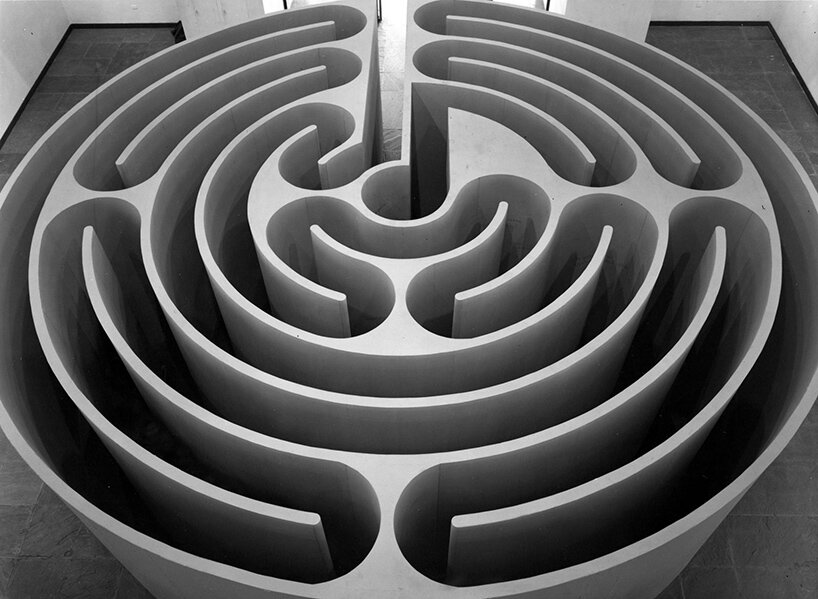
Philadelphia Labyrinth, Robert Morris, 1974 | image via Wikiart
borges: a new labyrinth completes in venice
This brings us to the present day where, in Venice, the Borges Labyrinth has reopened following an extensive restoration. That slippage between maze and labyrinth continues here, because despite its name, Randoll Coate’s boxwood garden is technically a maze (a distinction Borges himself might have enjoyed).
Seen from above, the design reads as an open book, with the writer’s name woven through a larger pattern of symbols and branching lines. Once inside, that complete image disappears into more than a kilometer of green corridors. The visitor can only see the route immediately ahead, exchanging the certainty of the plan for the pleasure of moving through it.
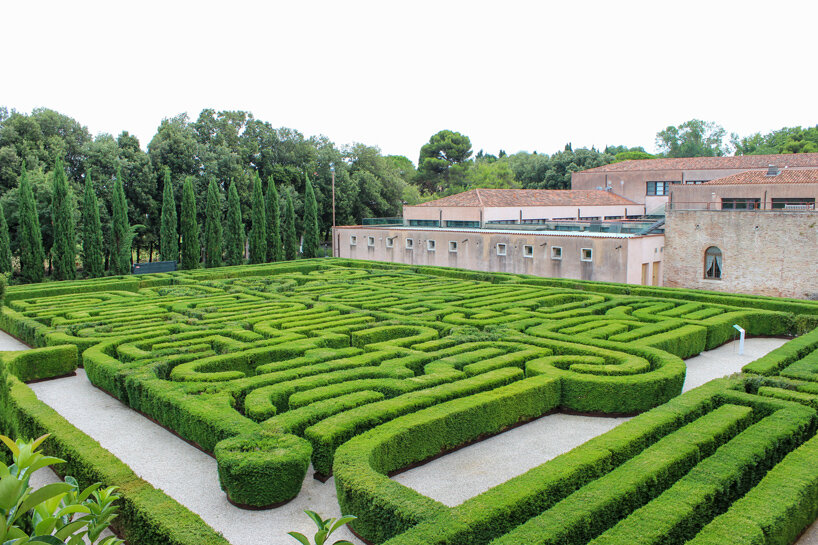
Borges Labyrinth, Venice, Italy, 2026 | image courtesy Fondazione Giorgio Cini
Labirinto della Masone
Over a decade before its restoration, Borges helped inspire Franco Maria Ricci’s Labirinto della Masone near Fontanellato, where some 300,000 bamboo plants rise between three and fifteen meters around a star-shaped plan. Ricci promised Borges in 1977 that he would build a vast labyrinth in the surrounding fields, and the cultural park eventually opened in May 2015.
Crossroads and dead ends make this one a true maze, while a pyramid chapel occupies its heart. Ricci’s 2014 book Labyrinths: The Art of the Maze documented the project as it was taking shape, turning the dense bamboo corridors into a sequence of dark photographs before visitors could walk them. (Read designboom’s 2001 interview with Franco Maria Ricci here.)