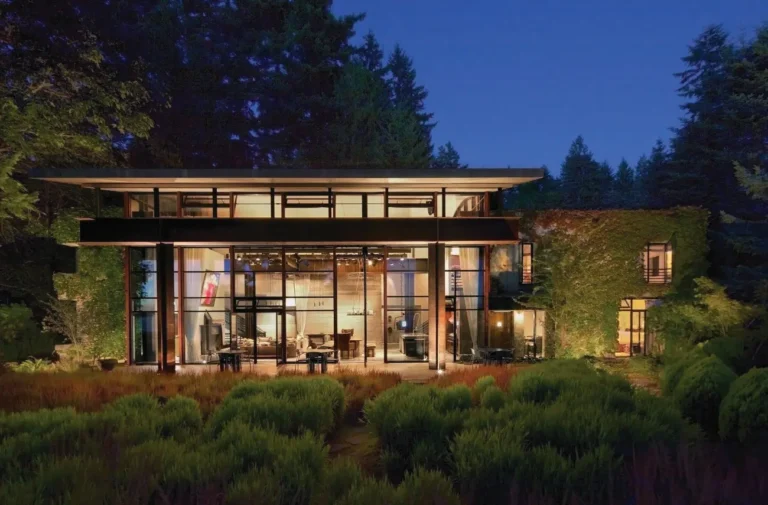
Bruno & Michèle is a minimalist residence located in Bolton-Ouest, Québec, designed by Atelier II I7. The steep terrain of Mont Foster presented both challenge and opportunity – a precipitous site where rocky outcroppings emerge from high grasses, overlooking the Sutton mountains. Rather than imposing a structure onto this dramatic landscape, Atelier II I7 conceived the house as two distinct volumes that respond to the topography with geological logic. A concrete plinth carved into the hillside supports a timber volume that hovers among the trees, creating a composition that reads as both anchored and elevated.
The architectural language emerges directly from site conditions. Board-formed concrete echoes the exposed bedrock, its rough-textured surface carrying the grain pattern of formwork that mirrors the vertical rhythm of surrounding trees. This material choice transforms the lower volume into what appears as an extension of the mountain itself – a man-made geology that respects the existing grade through minimal excavation. The concrete mass houses a flexible ground-floor space functioning as both dormitory and office, punctuated by timber-framed openings that are subtracted from the plinth rather than applied to it.
Above this mineral base, the timber volume cantilevers into the slope. Clad in wood that will weather to match the forest grays and browns, this upper level contains the primary living spaces. The facade treatment demonstrates restraint – a few full-height vertical openings puncture the volume to establish rhythm and admit southern light, while a continuous minimalist window system at the projection level frames the exceptional landscape. These apertures are carefully calibrated to create distinct pictorial compositions throughout the day, inviting contemplation of seasonal transformations visible across the valley.
The interior spatial organization reflects the compact, discreet, warm intentions that guided the design. Built-in millwork defines transitions between rooms while maintaining visual connections through the plan. The ground floor ceiling employs a system of wood panels and battens that establishes horizontal rhythm, contrasting with a wood and metal screen that weaves through the vertical circulation. This latticed filter articulates the relationship between levels without creating hard separation, allowing the staircase to function as both connector and spatial divider.