Black Concrete and Wooden Cladding Take Center Stage in the Black House

The Black House is a modern residence designed on a typical terrain in the small mountains of Córdoba, Argentina, reflecting a continuous pursuit of breaking tradition. The concept revolves directly around the choice of exposed concrete as the protagonist in every aspect. The house unfolds on two levels, comprised of two parallel overlapping volumes.

The ground floor, nestled into the terrain, offers an experiential journey that introduces the project and frames the suggested views. On the same level, in an open-concept layout, the social area is concentrated, spatially uniting the kitchen, dining room, and living room. The interior and exterior seamlessly blend thanks to the permeability achieved through glass surfaces, with French doors connecting the interior space to a large gallery with a pool, greenery, and views. The upper floor stands out from the ground at the observer’s level, presenting itself as a linear and solid volume, imposing from any viewpoint. The brutalism of black concrete is paired with the restrained cladding of kiri wood. Here, private activities converge: sleeping and resting, always with a view of the city.

The staircase is one of the main elements. It is suspended on a concrete wall, with the idea of expressing a sensation of lightness over robustness. Situated in a double-height space where the emphasis is on the volume, the staircase allows for a unique and striking entry of natural light.

Credits:

Name: Back House / Casa Negra
Location: La Pankana, La Calera, Córdoba; Argentina
Architects: AR Arquitectos
Area: 550 m²
Year: 2022
Photography: Arq. Gonzalo Viramonte

0:00 – Back House / Casa Negra
0:31 – Entrance
2:12 – Staircase
2:31 – Open-concept
2:50 – Pool / garden
3:13 – Upper floor
5:01 – Garage
6:50 – Drawings

Similar Posts

  • The Fieldhouse

    Built for family and friends as a space for sport and gathering, the Fieldhouse is a simple, functional structure. Like the immersion of nature and recreation in the development of state and national parks of the early 20th century, this family wanted a structure where friends, family, and neighbors could gather, play sport, celebrate and relax in the country. The Fieldhouse feels distant and secluded, located on a mostly undeveloped seven-acre site, surrounded by a meadow of natural grasses, a fruit orchard, wetland ponds and a maintained field for sporting. As long time natives of the Pacific Northwest, the family was keen to convey a specific sense of place and longevity. The architecture responds to those ideas in its simplicity and versatility, and in its construction from durable, local materials. Inspiration was taken from vernacular stone and timber structures built across the country in the 1930s by the Civilian Conservation Corps. The architects and clients channeled their own recollections of summers spent in Seattle’s waterfront parks and their simple elegant structures, often by early 20th century Seattle architect Ellsworth Storey. The 1,664-square-foot structure consists of a covered outdoor patio flanked by two, offset and enclosed spaces housing a sun room and inglenook to the west, and a kitchen, grill and two bathrooms to the east. Designed to accommodate almost any situation, the Fieldhouse can shelter four as comfortably as it can 60, hosting sleepovers, family sports tournaments, reunions and outdoor dining with ease. The structure employs a gradient of enclosure and structural qualities from the immersive intimate inglenook to the ever thinning shed roof structure, gently lifting off above the central patio. The building can be shutdown to weather storms, or opened wide to allow light, air and activity to pass through freely. The structure provides a straight-forward and visibly-constructed language of materials. It progressively lightens from a solid stone base, to thick timber columns, to pairs of rafters and thinner yet pairs of purlins, supporting the single-plane shed roof. The timber is all Douglas fir and cedar harvested and salvaged from the Pacific Northwest. The stone is taken from a quarry on nearby Vancouver Island and the early, factory-style steel casement doors and windows are West Coast built. This timeless assembly of materials and method of construction suggest that this is a building about its surroundings and a stalwart of the region it resides in, functioning as well today as it will in 100 years. Hoedemaker Pfeiffer design team
    Steve Hoedemaker, co-founder and partner
    Justin Oldenhuis Project team
    Hoedemaker Pfeiffer (Architecture)
    Hoedemaker Pfeiffer (Interior Design)
    Joseph McKinstry Construction Company (Contractor)
    Swenson Say Faget (Structural Engineer)
    Kenneth Philp Landscape Architects (Landscape Architect) Photography
    Andrew Giammarco

  • The Invisible Order of Daily Life

    This is an old apartment with 40 years of history. The designer rotated the original axis and redesigned the structure in order to integrate the confusing flow line. There was only a single side of light in this space, after the rearrangement, the three sides of light, air and natural were introduced into the space giving the old house a new look. The designer tried to expose the original beams in the open space and colored the lowest beams with grey, which goes with the façade, so as to weaken the protruding beams. Also showing the natural beauty of the original structure within the space. On the other hand, there is no over-decorated design in the bedroom and the other rooms, only using the simple point-line-plan structure and non-chromatic to create a balanced picture. On the flow line planning, the designer integrated the main entrances of five rooms into one hallway. Using spray painting, wallpaper, secret doors, and sliding doors on the aisle space, which used to be confusing at the first place, to hide the appearance but also maintain its function. The design enlarged the space and made it return to the original strength and essence.

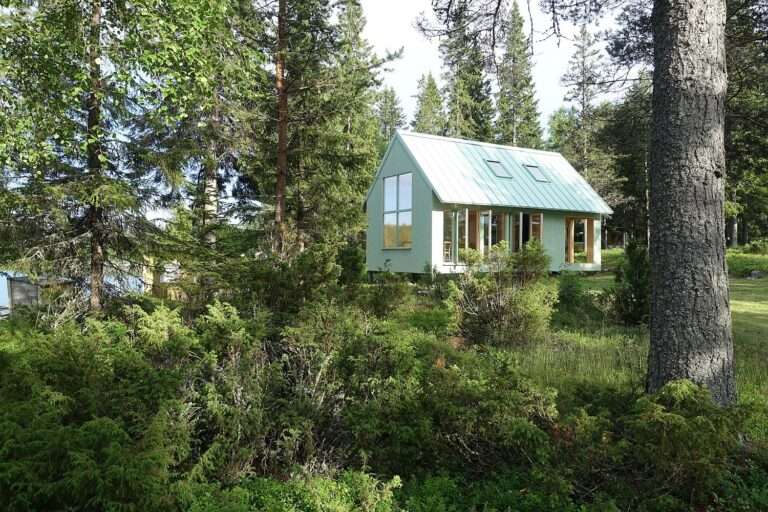
  • Tiny Light Green Wooden Summer Cottage in Sweden is an Efficient Showstopper

    A cabin in the woods that you can enjoy in warmer summer months is one that we all dream of. It is the perfect getaway that not only takes you far from the rush of daily life, but also brings everyone in the family together. The lovely and minimal Granholmen Summer Cottage in Luleå Ö, […]

    You’re reading Tiny Light Green Wooden Summer Cottage in Sweden is an Efficient Showstopper, originally posted on Decoist. If you enjoyed this post, be sure to follow Decoist on Twitter, Facebook and Pinterest.