DRIFT celebrates LACMA’s gallery opening with a glowing swarm of dancing drones

lacma’s David Geffen Galleries debut in L.A.

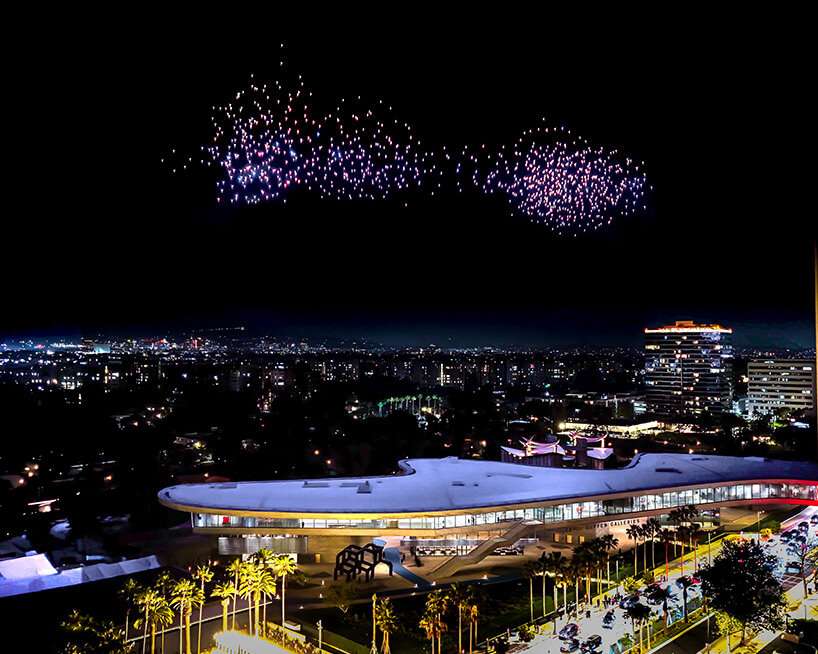
DRIFT has released Franchise Freedom, its illuminated flock of dancing drones, over the Los Angeles County Museum of Art (LACMA), to mark the opening of the Peter Zumthor-designed David Geffen Galleries in Los Angeles.

Set along Wilshire Boulevard, the event placed two systems into conversation. The David Geffen Galleries extend horizontally in sand-toned concrete, forming a continuous elevated plane across the site. Above it, DRIFT’s formation of illuminated drones moved through the evening air, shifting in density and direction. One holds its position through mass and structure, the other through motion and coordination.
drift lacma
images © Pablo Garcia, Albert Azouz, Bo Bridges, Complex Aerial, Davis Huber, Dillon Harmon, Elias Posada, Jake Howard, Joshua Ewalt, Mark Christian, Patrick Coyne, Pedro Castro, Sammie Saing, William Teets

drift learns from starling murmurations

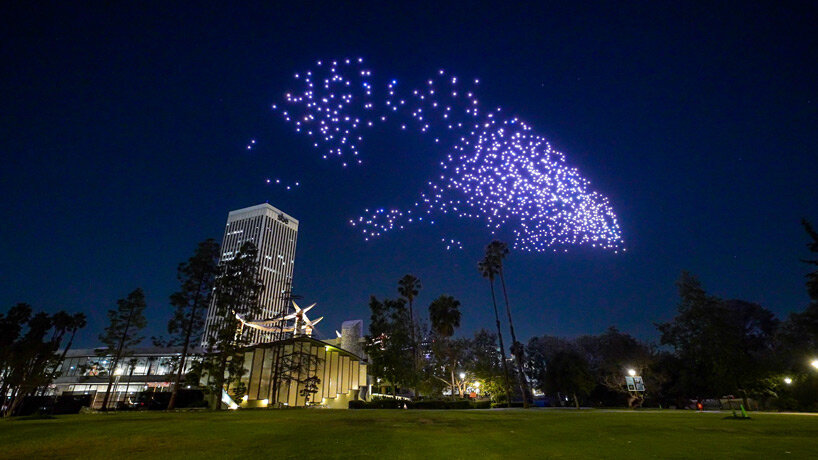
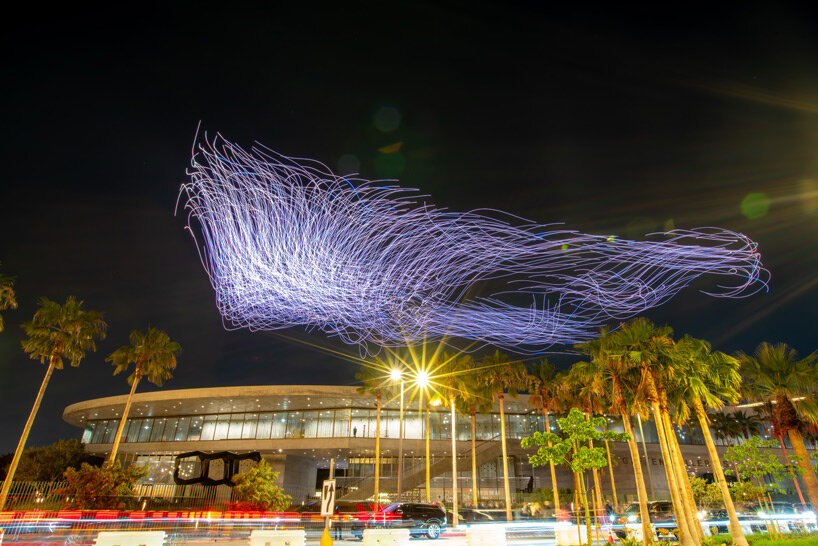
Franchise Freedom, which showed over LACMA this past weekend, builds on more than two decades of research by DRIFT into starling murmurations. Each drone responds to its neighbors through a shared set of behavioral rules, producing patterns that remain fluid yet legible. The formation expands, compresses, and redirects, creating a field that is constantly reorganizing itself without a fixed center.

This logic finds a parallel in the architecture below. The David Geffen Galleries propose a horizontal organization where curatorial departments occupy a continuous plane. Circulation flows across the building without a dominant axis, distributing attention evenly across exhibitions. Spatial hierarchy gives way to adjacency, and the building operates as a network rather than a sequence.
drift lacma
the drone formation moves as a coordinated field of light above the museum

shared intelligence by over 1,000 drones

The alignment between the installation by DRIFT and the new LACMA galleries becomes clear in how each defines structure. In DRIFT’s work, no single drone directs the composition. Form emerges through proximity and response, with each unit maintaining awareness of the group. The visual effect depends on this shared intelligence, where cohesion is maintained without central control.

The galleries apply a similar principle at an architectural scale. By flattening the institutional layout, the design places different collections in direct relation. Movement across the building is continuous, allowing visitors to construct their own paths. The spatial experience is shaped through connections rather than thresholds.
drift lacma
the performance draws from research into starling murmurations

project info:

name: Franchise Freedom

artist: DRIFT | @studio.drift (Lonneke Gordijn & Ralph Nauta)

museum: LACMA | @lacma

location: Los Angeles, California

date: April 18th, 2026

photography, video: Pablo Garcia, Albert Azouz, Bo Bridges, Complex Aerial, Davis Huber, Dillon Harmon, Elias Posada, Jake Howard, Joshua Ewalt, Mark Christian, Patrick Coyne, Pedro Castro, Sammie Saing, William Teets

Similar Posts

  • Ravoli Drive Residence

    Sited on a site slightly under an acre in the heart of the Pacific Palisades area of Los Angeles, the site for this estate residence descends over thirty feet from top to bottom. Narrow at the street and widening toward the rear, the building was designed to appear as a very private single story structure from the street and expand as the house moves into the site. At just under 14,000 sq. ft. the house was conceived of as a California Modernist Estate the building utilizes the site slope and widening to create a wing typology each reaching into the site to capture garden spaces, set up views and account for service amenities. Designed for peak privacy to the street, there are a series of site walls and fencing that define the property edge. After passing through the gate, the entry to the house is through a descending Entry Garden with water feature with a view through the house to the slopes of Will Rodgers State Park beyond. Shaped as a modified T, the wings of the house extend into the landscape creating separate wings dedicated to the elaborate programming of the building. Containing formal spaces for Entry, Living and Dining the house also offers a large entertainment style kitchen, Large Family Room, Library, 16 person Theater, Wine Cellar, Gym with Spa Bath including Sauna and Steam Room, secondary winter closets, dedicated two bedroom Guest House as well as six bedrooms including a Master Suite over 1,500 square feet with his and hers baths and closets as well as a garage for seven plus additional carport parking for three. All of this is balanced with a series of large exterior decks, patios and pool all wrapping around the stately eighty-foot tall Eucalyptus tree, which served as the aesthetic basis for the materiality of the building. Balancing the solidity of the extensive board form concrete walls is an expansive use of glass and the warmth of stained wood siding throughout the building. The remainder of the building is wrapped in integral colored steel troweled stucco. This palette is based on the colors and tones of the tree that is the center of the garden. Passing materials from the interior to the exterior, doors disappearing into internal pockets and flooring extending onto the decks and patios all help to create a seamless relationship for the interior to the exterior, house to land. This relationship realizes a full use of the site for its entire acre site.

  • Pia Residence

    Pia residence is located in an irregular land, in el Uro, N,L. The project consists in two main volumes, each by a series of alternated courtyards. The frontal volume is single leveled with a double height element that highlights the main entrance, and it is accessed through a series of a triangular concrete prints that provides a sense of continuity through the street and the sidewalk. The volume in the back has two levels and is separated from de frontal volume by a patio that functions as an extension of the social area, kitchen and studio situated in the lower level, also provides ventilation, views and sunlight to the area. The courtyard is divided a staircase enclosed in a glass volume that links the vertical and horizontal connections of the building. The posterior patio has two garden areas that unites the laundry and service areas providing a sense of visual continuity to the area. Concrete was used as the main material of the project; as an apparent formwork on the façade as polished floors and some colored cement on details. Also important is the use of the custom steel work on windows gates, doors and stairs. The landscaping consisted on low maintenance, regional plants. Pia residence is the result of the transformation of a country house to a suburban house without losing the relation between the building and the exterior, preserving, nevertheless the privacy of the interior areas. It is a reinterpretation of the Mexican architecture of the second half of the twentieth century with a new formal character. Name of the Project: Pia Residence Location: Gated community El Refugio, El Uro, Nuevo León, México Area: 200 M2 Autor: Ar. José García Toledo Collaborators: PE. Eduardo Vásquez Velásquez Ar. Fernanda Roiz Silva ID. Andrea García Aragón ID. Luis Carlos Rodríguez González ID. Sinuhé Machuca Esquivel Ar. Krizia Nasser Ar. Christian López Photography: Ar. Francisco Martín Alvarez de la Vega / The Raws Human scales: Patricio Betteo