Telling time on other planets with mechanical clock
Chronova Engineering builds an interplanetary clock, a mechanical device that can tell what time it is on other planets using rotating discs. It tells the time by copying how each planet spins, as each planet has its own dial, and each dial is connected to the gears. Since every planet spins at a different speed, the gears are built with different ratios: Earth takes about 24 hours to spin once, Mars takes about 24.6 hours, Jupiter spins much faster, and Saturn spins fast too. Because of this, each dial shows the real day cycle of that planet, so the clock doesn’t calculate time digitally. Instead, it copies planetary spin, uses gear ratios, and shows day and night through rotation.
In this case, viewers see time on other planets by watching how their dials turn, just like the real planets do. The mechanical clock that tells other planets’ time stands on a wooden base and rises in a vertical line. Different gears hold a set of round dials, which represent a planet. The user makes the mechanical clock work by rotating the lever at the back, and after that, time is told across planets through the rotation and using the markers around the dial as well as the mini steel arrows pointing at them. The clock has 131 parts, and all of them move through mechanical movement. There is no screen. There are no electronic parts. The system depends on gears to control rotation speed.
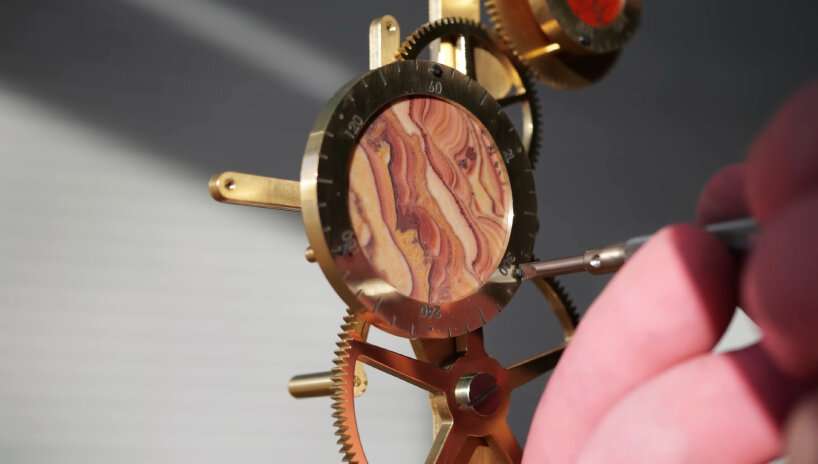
all images courtesy of Chronova Engineering
Chronova Engineering builds an interplanetary device
Each stone sits inside a gold-like ring with markings that show the longitude. On Earth, longitude starts at the prime meridian, and the same logic applies here for Mars. The model uses known reference systems to define rotation. The design of Chronova Engineering’s mechanical clock, which tells other planets’ time, shows axial spin, a motion that creates day and night on each planet. It is because of this that the object can answer what time it is outside of Earth. The counter tracks Earth days. Instead of linking directly to Earth, the system links the counter to Saturn, and the gear ratio then matches Saturn’s motion to Earth’s day count.
Each planet sits on a dial made from stone, which is cut and shaped to match planetary surfaces. Earth and Mars connect directly to their gears, while Jupiter and Saturn use a support system between dial and gear. Around each dial on the mechanical clock that tells the other planets’ time, three pointers show sunrise, noon, and sunset, moving with the planet. The user reads time by aligning longitude with the pointer, which is sitting just outside the circular dials. The user reads the clock by setting a day count and a longitude. For example, if a Mars colony wants to call Earth at sunset, the user rotates Mars to the correct longitude, and the Earth dial then shows the time of day for the same moment. Through gear ratios and physical motion, the team translates astronomical data into visible movement, allowing users to see how days and time unfold across planets through a mechanical clock.
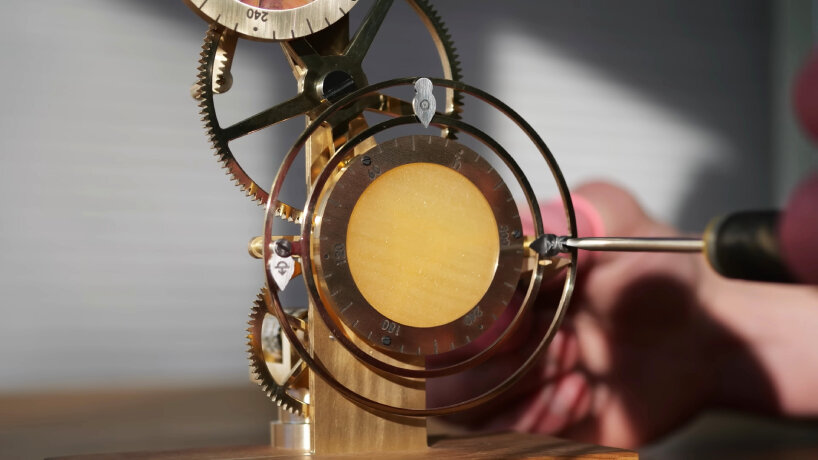
it tells the time by copying how each planet spins, as each planet has its own dial
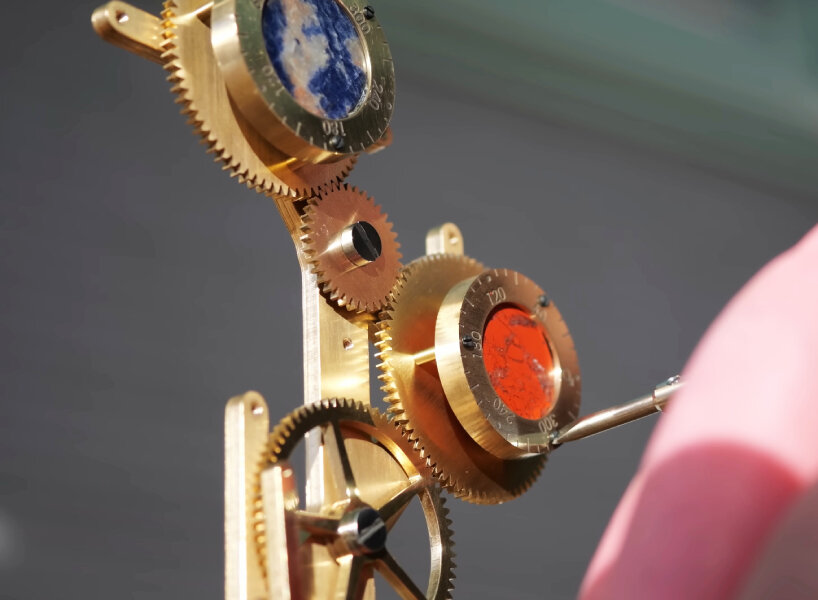
since every planet spins at a different speed, the gears are built with different ratios
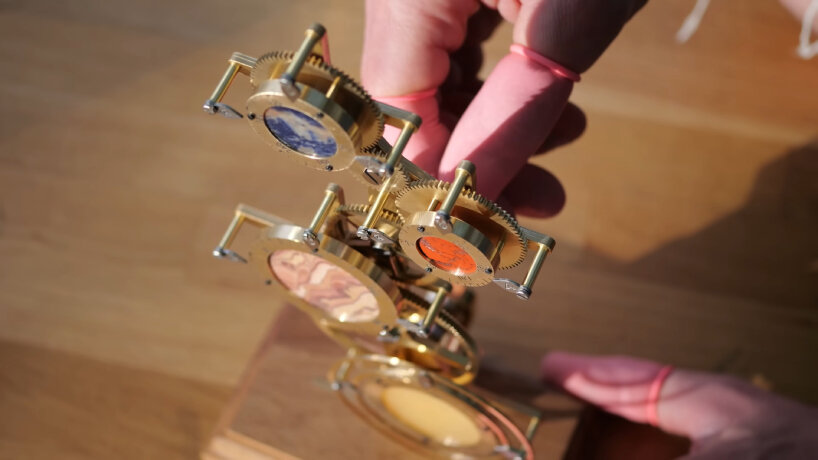
each dial shows the real day cycle of that planet, so the clock doesn’t calculate time digitally
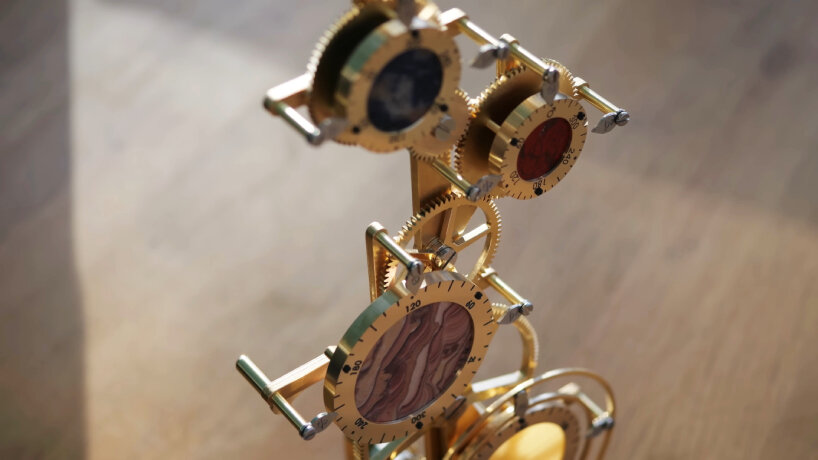
the dials copy planetary spin, which then show the planets’ day and night through rotation
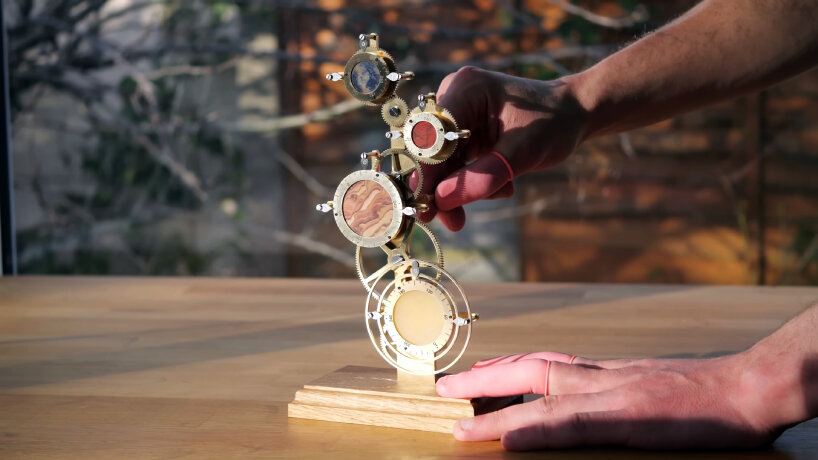
users manually turn the dials using the handle at the back


