|

point supreme brings minimalist intervention to rugged stone farmhouse in greece

peloponnese farmhouse sees contemporary renovation

The Peloponnese House by Point Supreme Architects is a renovated farmhouse in southern Greece that reimagines how a traditional rural dwelling can support contemporary family life. The two-story stone building, once a farmhouse and stable, was adapted to accommodate a couple and their two children, with the living areas placed upstairs and the children’s bedrooms integrated into the vaulted ground floor.

Through a series of thoughtfully-considered insertions, the architects introduce fluid connections between the previously disconnected levels to create new circulation routes, functional additions, and built-in furniture that make the house work as a unified whole.
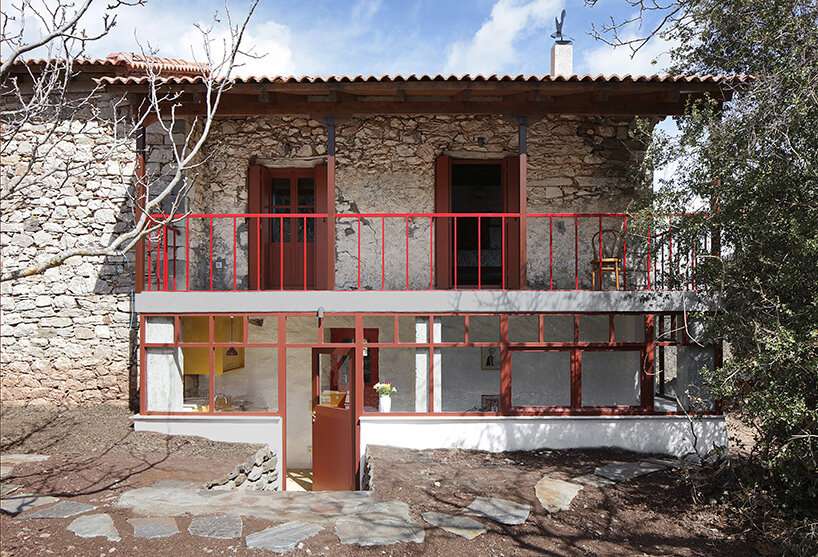
peloponnese house point supreme
Point Supreme renovates a farmhouse in Peloponnese, Greece | image © Filip Dujardin

point supreme architects Reworks a rural layout

With its renovation of the Peloponnese House, the team at Point Supreme Architects organizes the upper floor to house the family’s shared spaces and the parents’ bedroom. Below, the former stable with its original stone vaults was preserved, each adapted into a child’s bedroom. Timber platforms were added to provide storage and space for extra mattresses, while heavy curtains allow the sleeping areas to be separated from a central open room that serves as circulation and gathering space.

At the heart of this lower level, the bathroom is reduced to its essentials to free space for a multi-use passage room. This open configuration allows the once utilitarian ground floor to act as both circulation and gathering space, reflecting a contemporary way of inhabiting the old stone shell.
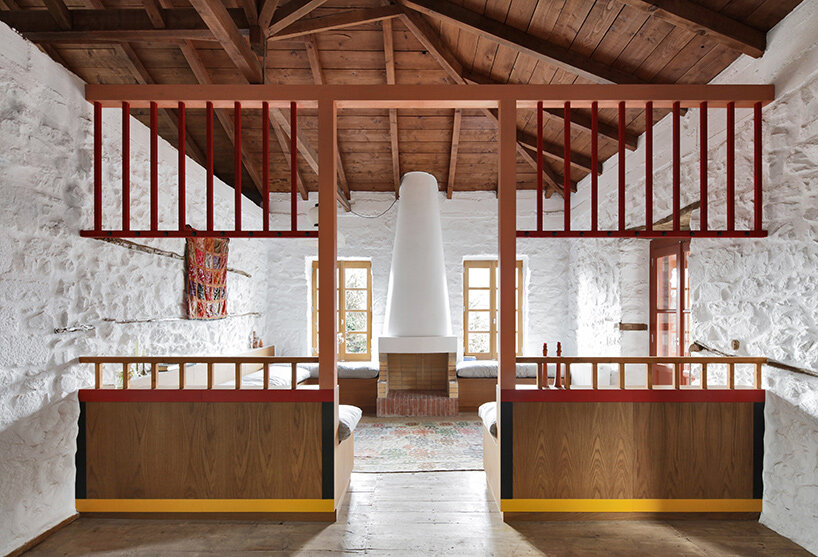
peloponnese house point supreme
the architects reorganize the upper level with new programming | image © Filip Dujardin

inserting new programming into a stone shell

A new internal wooden staircase by Point Supreme anchors the new plan of the Peloponnese House, its base doubling as a seating tribune with concealed storage. On the garden-facing side of the house, the narrow gap beneath the veranda was enclosed to form a sunroom, or liakoto. This addition is programmed with a kitchenette, a daybed, and a small study corner, creating a threshold between indoor living and the surrounding landscape. On the opposite side, a former storeroom has been adapted into a practical workshop.

Upstairs, the architects introduced a reconstructed wooden interior facade, known as an ontas, to define the living room and fireplace. The facing built-in seating continues the rural tradition of convivial gathering spaces. A cutout in the timber floor creates a direct link between levels, offering a second access point downstairs through a discreet trap door.
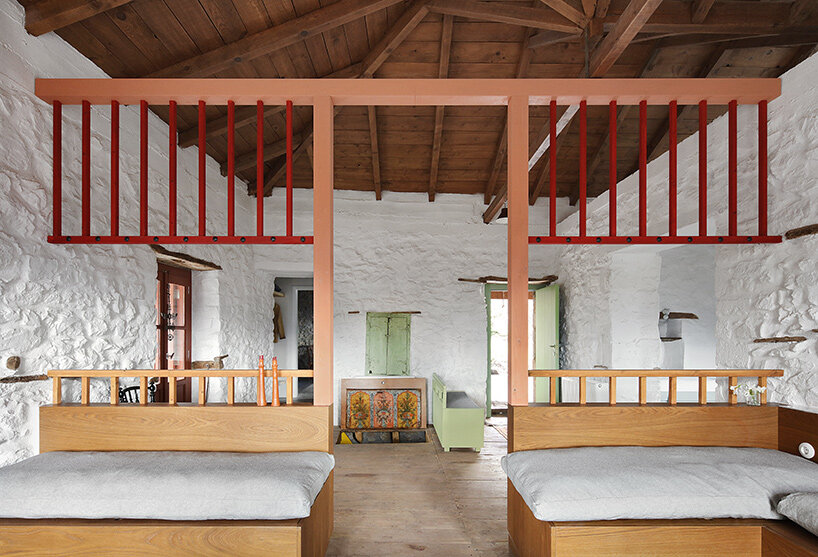
peloponnese house point supreme
minimalist timber interventions contrast with the rusticated stone shell | image © Filip Dujardin

PointSupreme approaches the renovation of Peloponnese House with the care of an excavation. Hidden materials, uncovered during the process, were preserved wherever possible: stone walls patched with rough concrete, original window frames in shades of mustard, pistachio, and ceramic red, and the corrugated aluminum roof weighed down with stones. These gestures respect the spontaneous, utilitarian choices of the original builders while bringing them into dialogue with the new additions.

New traditional features were introduced in contemporary form. In the kitchen, for example, a built-in daybed recalls the krevata, a familiar element in Greek domestic interiors, extending the communal character of the room. Across the project, old and new elements are intertwined, producing a house that feels both rooted and adaptable.
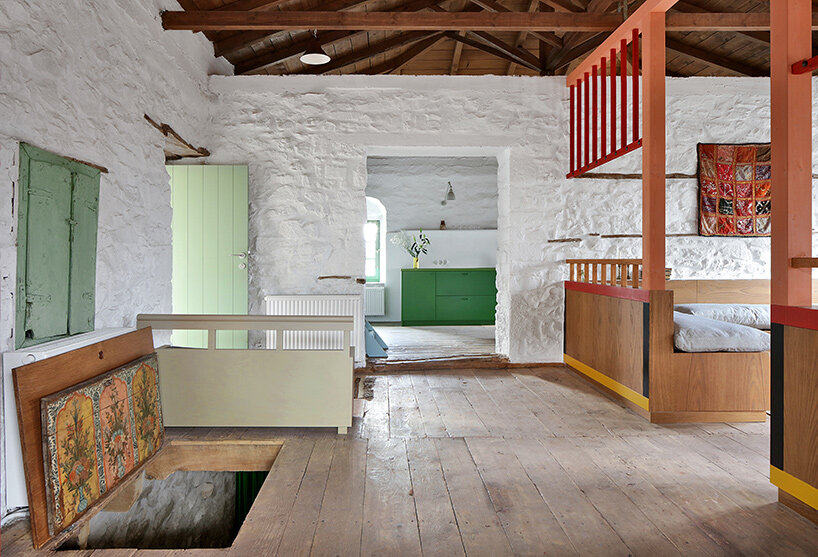
peloponnese house point supreme
a new wooden stair doubles as a seating tribune with concealed storage | image © Filip Dujardin
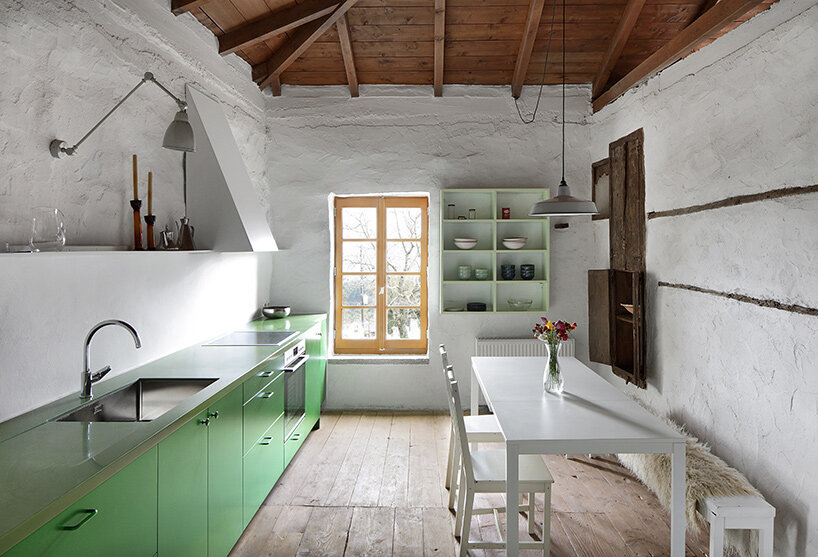
peloponnese house point supreme
original textures and colors are preserved alongside new details | image © Filip Dujardin

Similar Posts

  • 1110 apartment

    Measuring just 62m2, the apartment is located in a new building in Hanoi. Every unit of this building is small and is designed for young families. The original plan contains two bedrooms with compressed functions. The whole space is divided into small rooms. The renovated concept is to break the stifling sensation of closed rooms to create a new space where functions intertwine softly, flexibly and the natural light can enter the deepest corners. In the new design, a bedroom is removed to expand living space. A bathroom is converted into the washing room and storage. The balcony became a green space, connecting living space and bedroom. Finishing materials and furniture aim for simplicity, natural and rustication. Furniture are made to serve their very purposes, and not to put pressure on the space. Many old wooden parts have been reconfigured into two tables. Glass is used to show the structure of the tables and to avoid casting shadows on the wooden floor. The indigo plywood cabinet and the yellow cement wall cover the kitchen and are the highlight of the living space. With a small area, good quality of life can be achieved just by balancing the functions in a harmonious way; accepting to abandon some needs and to change our lifestyle.

  • Hillside Sanctuary

    The owner of this property came to Hoedemaker Pfeiffer looking for a personal retreat inspired by a home lost to fire decades earlier in the hills of Appalachia. The firm’s task was not to recreate that home but rather to give its spirit new form in the Pacific Northwest. Taking inspiration from its remote site in the San Juan Islands, our team envisioned a series of simple stone volumes. From that concept emerged the main house and a guest house, each responding to its own unique location on the site. Together they provide friends and family with comfortable accommodation while offering a sanctuary for the owner at the main home. Taking full advantage of sweeping views of Puget Sound, the main home is sited on a small plateau high on top of a steeply-sloping hillside. With a view on one side and a road on the other, the site suggested a stone plinth and stone wall to form the base and rear of the house. A pair of stone fireplace volumes support the concept, rising together to form the boundaries of a central stone staircase that separates the main level into public and private realms. Atop the low stone base then perches a light-filled wood structure. Its simple shed roof tips low in front to protect from the summer sun while offering space for a photovoltaic array above. Winter light in turn penetrates deep into the main living spaces through a wall of glass running continuously across building’s south elevation. The relative height difference between this wood pavilion and that of the adjacent stone volume also allows consistent north light to flood into the primary living spaces via a series of clerestory windows, which release warm air high on the leeward side of the structure. The site for the guest house came with more significant technical challenges. The concept begins with a stone tower set near the center of the small circular parcel. Rising high above steeply-sloping grade, it acts as a three-dimensional datum through which feature program elements are allowed to puncture. The main entry offers ease of access to the project’s public spaces through a simple, full-height opening cut into the stone volume’s north elevation. The stair, comprised of a concrete base below large casement windows, allows natural light to fill the main stairway as it leads guests toward the bedrooms located at the home’s lower level. Opposite the entry, the view deck extends from the great room, cantilevering far above grade. The dining room, finally, was conceived as a three-sided glass object floating in a forest of trees. Two steel beams carry its entire weight and extend deep into the floor system. To enhance the concept, our team preserved trees only a few feet from the dining room by developing custom retaining walls capable of avoiding critical root zones. Project Team: Hoedemaker Pfeiffer (Architecture) ​Schuchart Dow​ (Contractor ​Randy Allworth, Allworth Design​ (Landscape Architect) ​Malsam Tsang​ (Structural Engineer) ​LPD Engineering​ (Civil Engineer) Nelson Geotechnical Associates, Inc. (Geotechnical Engineer) Island Tree Doctor (Arborist) ​Kevin Scott​ (Photographer)