|

ricardo bofill’s fragmented monumentality defines upcoming royal arts complex in riyadh

a cultural landmark at the core of a park

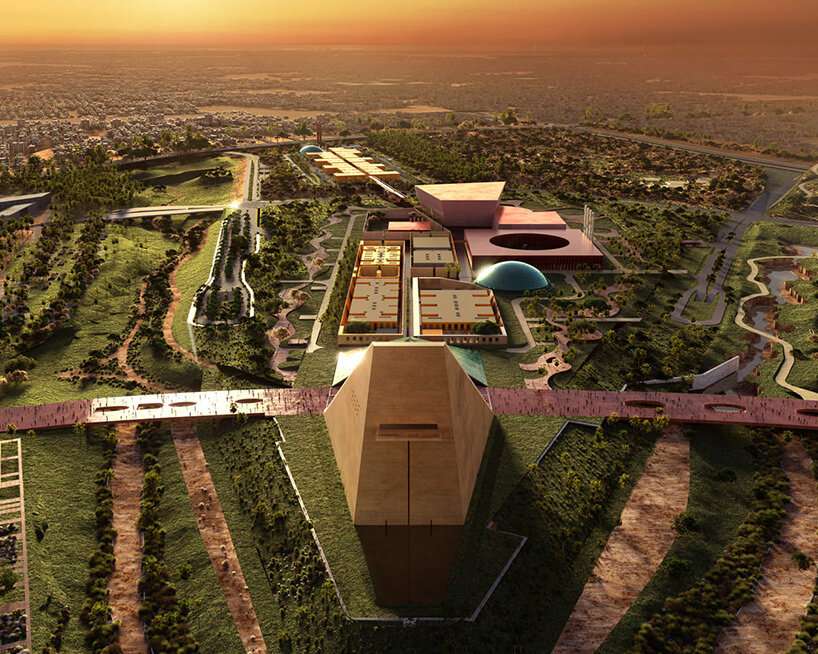
Barcelona-based architecture studio Ricardo Bofill Taller de Arquitectura unveils a masterplan for the Royal Arts Complex (RAC) in Riyadh, introducing a bold architectural anchor within King Salman Park — an initiative that reimagines the former military airport with a vast green urban center. The RAC, currently under construction, is emerging as a constellation of cultural venues stretched along a 1.5-kilometer central boulevard. This axis acts as a connective thread between city and park, delineating a threshold where urban density begins to unravel into the open expanse of desert.

The strategy fragments the Royal Arts Complex into thirteen distinct components, each designed to support a different facet of cultural life. The ensemble includes a National Theatre, smaller theaters, an amphitheater, a cinema hall, and a Museum of Civilizations — each interlinked yet independent, forming a self-sufficient cultural ecosystem. Artist studios, master-craft workshops, and academies for music and visual arts further extend the program, reinforcing the site’s pedagogical role alongside its exhibitionary one.
ricardo bofill riyadh
Ricardo Bofill Taller de Arquitectura designs the RAC for Riyadh’s King Salman Park | visualization courtesy KSP

ricardo bofill taller de arquitectura plans for riyadh desert

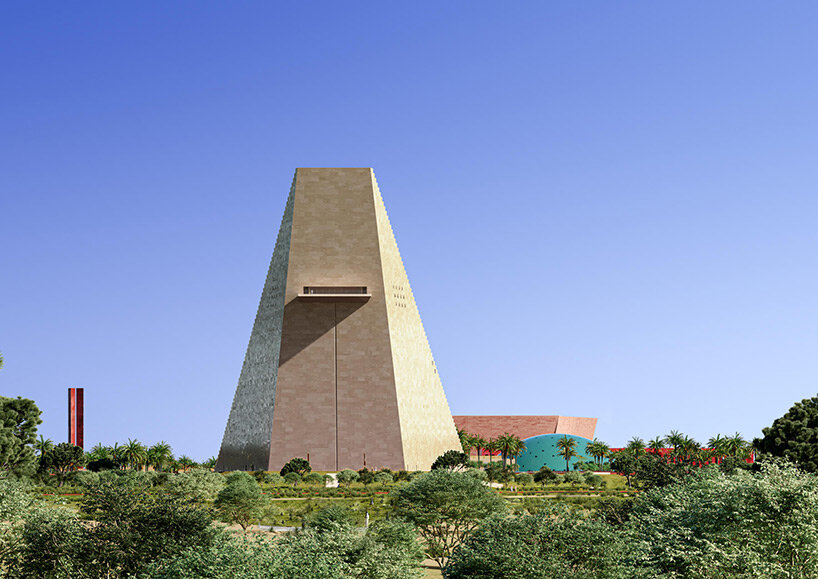
The team at Ricardo Bofill Taller de Arquitectura responds to the climate of Riyadh through the Royal Arts Complex’s material palette, which favors warm desert tones that absorb and reflect the landscape surrounding King Salman Park. Buildings are carefully calibrated to balance mass and void, casting deep shadows while allowing light to penetrate public squares and patios. This approach tempers the sun’s intensity while creating a tactile connection between architecture and terrain, rooting each structure in its arid context without overt mimicry.

Landscape design articulates three concentric zones that transition from the city’s edge into the park’s interior. The outermost plateau retains a raw, desert-like quality populated with native vegetation. Closer in, the sculptural garden provides a curated field of public artworks and architectural fragments. At the core lies the boulevard itself, animated by mineral surfaces, shaded walkways, and clusters of greenery that soften the spatial rhythm between buildings.
ricardo bofill riyadh
thirteen cultural venues are linked by a fifteen-kilometer central boulevard | visualization courtesy KSP

monumentality in fragments

Ricardo Bofill Taller de Arquitectura integrates the Royal Arts Complex into Riyadh’s urban fabric through its proximity to the Loop, a new transportation system that orbits the entire 16-square-kilometer park. Positioned at the Loop’s western edge, the RAC becomes an access point, or cultural hinge, between the park’s interior and the broader metropolis. The placement suggests continuity over isolation, encouraging movement between programmed venues and the surrounding green space.

The architectural language in Riyadh resists monolithic gestures in favor of spatial diversity. The thirteen volumes of the complex vary in scale and character, some austere and orthogonal, others more sculptural and expressive. This fragmented monumentality offers both a sense of civic grandeur and an accessible rhythm of public spaces. The design invites exploration, walking, and lingering — an urban promenade as much as a cultural destination.
ricardo bofill riyadh
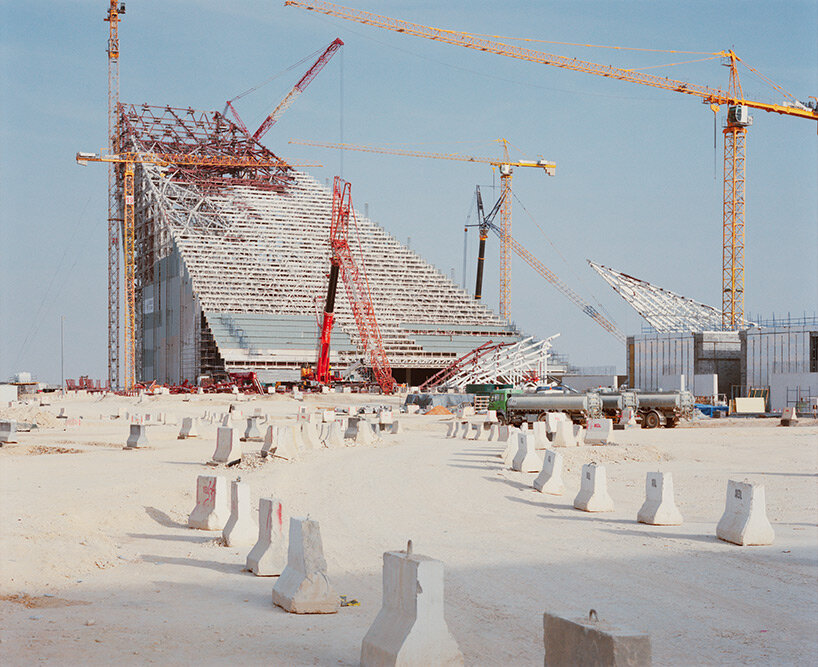
performance spaces, museums, and academies unite within a unified masterplan | image © Gregori Civera

The architects treat the main boulevard of Riyadh’s Royal Arts Complex as a performative spine. The boulevard links theaters, museums, and studios while serving as a public stage in its own right — hosting events, installations, and informal gatherings. Five squares punctuate the route, each with its own microclimate and spatial identity, offering rhythm and pause in an otherwise linear experience.

The Spanish studio’s work in Riyadh reflects a sensitivity to context that transcends stylistic mimicry. The RAC is not a pastiche of tradition, nor a purely globalized statement — it occupies a middle ground, drawing from desert typologies, local materials, and the logic of the oasis without becoming nostalgic. The project positions itself as a contemporary heritage site, one that aligns architecture with environmental and cultural continuity.
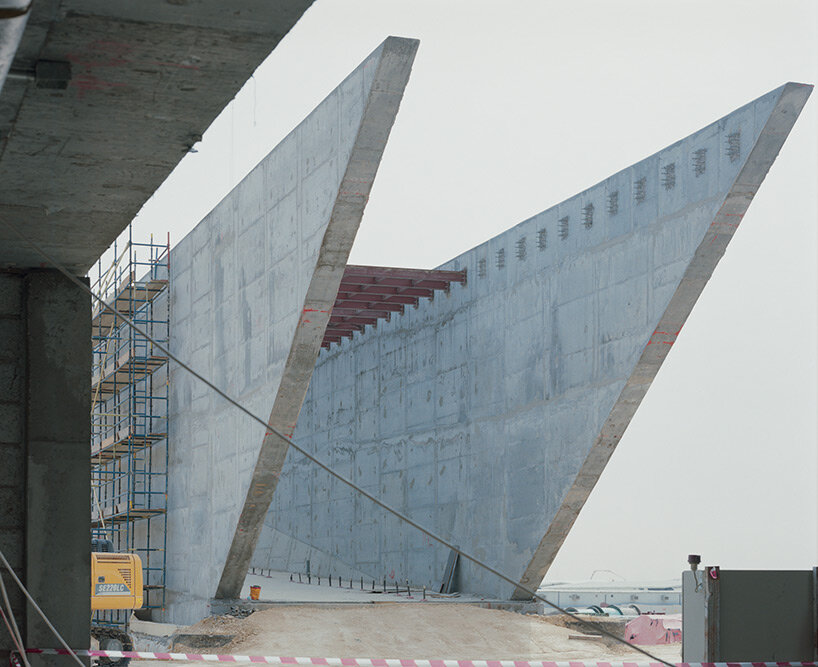
ricardo bofill riyadh
the landscape design features three concentric layers, from desert plateau to inner gardens | image © Gregori Civera
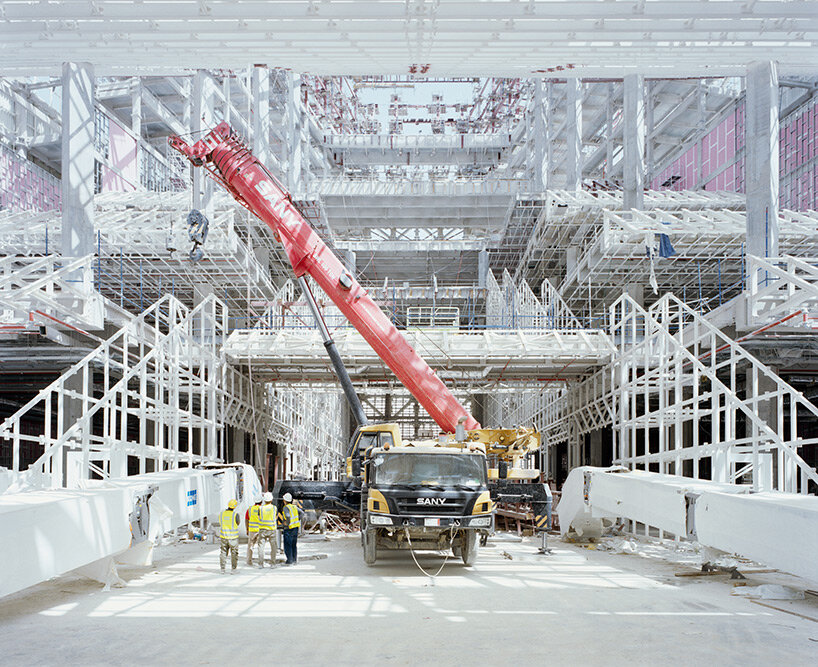
ricardo bofill riyadh
warm desert tones will root the architecture in the climate of Riyadh | image © Gregori Civera

Similar Posts

  • Maullin Lodge

    This lodge is a 120m2 house located in a rural scene in a southern region of Chile. The brief was to design a house with two bedrooms and two bathrooms with a main shared space, interpreting an old small traditional southern Chilean dwelling. The challenge of the proposal was to get that traditional southern look, which implies very opaque facades, but with a full translucent side where the landscape and light can get inside the building, creating its own private world. The house is placed between a forest of native trees, giving its back to the main street. So, the house is oriented to the north and west to get the most of sunlight, which this south down is much appreciated. The concept of the design is organized based on 3 contrast between old and new:
    1- Removing non-structural walls and floors: the main structural shape and volume are maintained the same as the old traditional house, but the interior is liberated from any non-structural dividing element, which helped to create a clean and continuous space.
    2- Concentrating the apertures: The main source of light is the north façade, keeping the other free opaque as a traditional southern house would have, so the proportion of void and mass was not lost.
    3- Material contrast: Big floor to ceiling windows in contrast to recycled traditional timber shingles, an evident contrast between old and new. The distribution of the house is developed in an almost square plan, divided into three volumes:
    The main one has the public areas of the house: kitchen, dining room, sitting room and mezzanine.
    The east one, the widest, has sleeping rooms and bathrooms with the main access of the house.
    And the west one is 1.5m wide acting as a corridor and informal dining room adjacent to the public areas of the main volume. The mezzanine is an opportunity to use the roof space, with a lot of light and natural heating, having control over the main space.

  • Staggered Cabin

    Staggered Cabin is a minimalist residence located in South Lake Tahoe, California, designed by Mork-Ulnes Architects….

  • The CVC House

    The CVC House is generated from the articulation of the garden´s exterior spaces, terraces and the central patio with the spaces that were required by the client, as a way to generate a dialogue between the built space and the open space. In addition to a sequence of open spaces with varying degrees of intimacy, that allow to pass gradually from the large space of the street to the green space at the back of the plot. Inside a 3x3x3 grid, 10 volumes are distributed around a central patio. This way, the project intertwines two units that can be inhabited independently. A compact program within a porous massing, allows the interior spaces to have optimal conditions of sunlight and views without compromising the privacy of its occupants and without reducing the open areas (patios and gardens of the house). The use of red pigmented concrete as a structural and finishes system and allows to generate pergolas, slabs, beams and homogeneous walls, that emphasizes the integral nature of the project.

  • Pia Residence

    Pia residence is located in an irregular land, in el Uro, N,L. The project consists in two main volumes, each by a series of alternated courtyards. The frontal volume is single leveled with a double height element that highlights the main entrance, and it is accessed through a series of a triangular concrete prints that provides a sense of continuity through the street and the sidewalk. The volume in the back has two levels and is separated from de frontal volume by a patio that functions as an extension of the social area, kitchen and studio situated in the lower level, also provides ventilation, views and sunlight to the area. The courtyard is divided a staircase enclosed in a glass volume that links the vertical and horizontal connections of the building. The posterior patio has two garden areas that unites the laundry and service areas providing a sense of visual continuity to the area. Concrete was used as the main material of the project; as an apparent formwork on the façade as polished floors and some colored cement on details. Also important is the use of the custom steel work on windows gates, doors and stairs. The landscaping consisted on low maintenance, regional plants. Pia residence is the result of the transformation of a country house to a suburban house without losing the relation between the building and the exterior, preserving, nevertheless the privacy of the interior areas. It is a reinterpretation of the Mexican architecture of the second half of the twentieth century with a new formal character. Name of the Project: Pia Residence Location: Gated community El Refugio, El Uro, Nuevo León, México Area: 200 M2 Autor: Ar. José García Toledo Collaborators: PE. Eduardo Vásquez Velásquez Ar. Fernanda Roiz Silva ID. Andrea García Aragón ID. Luis Carlos Rodríguez González ID. Sinuhé Machuca Esquivel Ar. Krizia Nasser Ar. Christian López Photography: Ar. Francisco Martín Alvarez de la Vega / The Raws Human scales: Patricio Betteo