meet the RUF rodeo during monterey car week
The first production RUF Rodeo was presented at The Quail, during Monterey Car Week 2025. Unveiled in Jordan Black with white centerlock wheels, the ultra-custom off-road sports car represents the German manufacturer’s step from prototype to production, delivered directly to its first customer during Monterey Car Week. The Rodeo is a culmination of the German company’s long history, translating the firm’s precision-engineered sports cars into a machine designed for terrain as much as speed. Constructed on a carbon-fiber monocoque, it is the only off-road vehicle of its kind to carry a VIN number, combining structural rigor with mechanical adaptability.
Nearly a century before this year’s Rodeo unveiling, RUF Automobile was founded in 1939 as a family business. Aloisa Ruf — a motorhead, artist, and photographer — is now part of the third generation of the family working for the company. designboom met with Aloisa at the Quail to learn more about the newly unveiled production vehicle.
‘To be less emotional for a second, this car is the only carbon fiber monocoque off-road car in the world with its own VIN number,’ she tells designboom. ‘It has a six-cylinder RUF engine, with 3.6 liters and 610 horsepower.’ Her emphasis on structure, material, and detail frames the Rodeo as a ground-up project with a focus on design and engineering together. See designboom’s coverage of the Rodeo when it was first unveiled in 2020 as a concept car here.
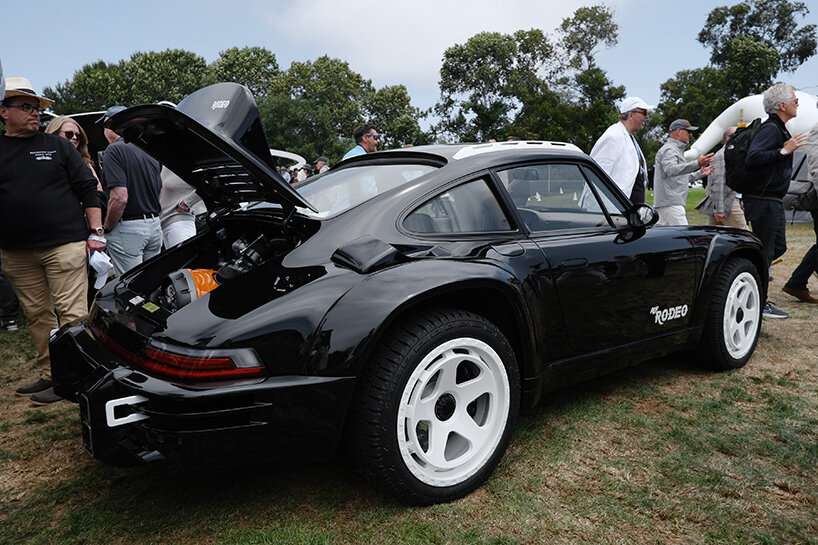
image © designboom
a love letter to the wild west
For Aloisa Ruf, the Rodeo is an emotional project. ‘We were inspired by the Wild West because my parents met in Oklahoma. All of our projects are very personal. This one is a love story to the summers I spent with my family there,’ she tells us.
This intimacy finds expression in the cabin. The interior is lined with saddle leather, sourced and worked in-house, alongside patterned textiles referencing Cherokee and Navajo traditions. ‘The interiors were inspired by the Cherokee and Navajo Native patterns, and the leather that we use is actually real saddle leather, that was used in saddle-making for the Wild West,’ Aloisa continues. With these details, the cabin brings a tactile environment, a surprising contrast to the carbon shell that encloses it.
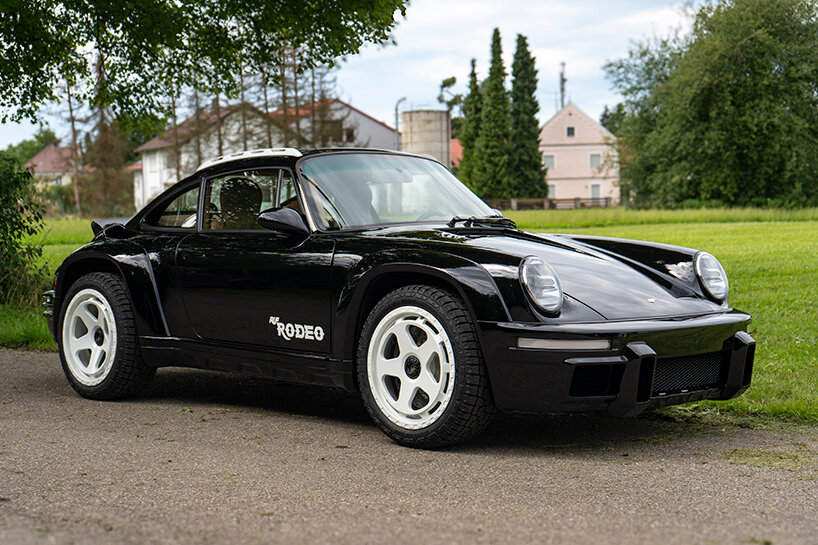
image © RUF Automobile
continuing ruf’s engineering legacy
The RUF Rodeo’s exterior balances solidity and detail. Enlarged fenders accommodate the widened track, while integrated bash bars at the front and rear create a layered, protective outline. Quad-stacked exhausts are recessed neatly into the rear bumper, and roof rails finished in white draw the eye upward, giving the body mass both visual and functional grounding.
Beneath these design cues lies a suspension system engineered with architectural clarity: pushrod-actuated dampers and adjustable ride height, raised nearly ten inches over RUF’s SCR model. It is a composition that addresses terrain as a spatial challenge, treating clearance, balance, and load as integral to the design.
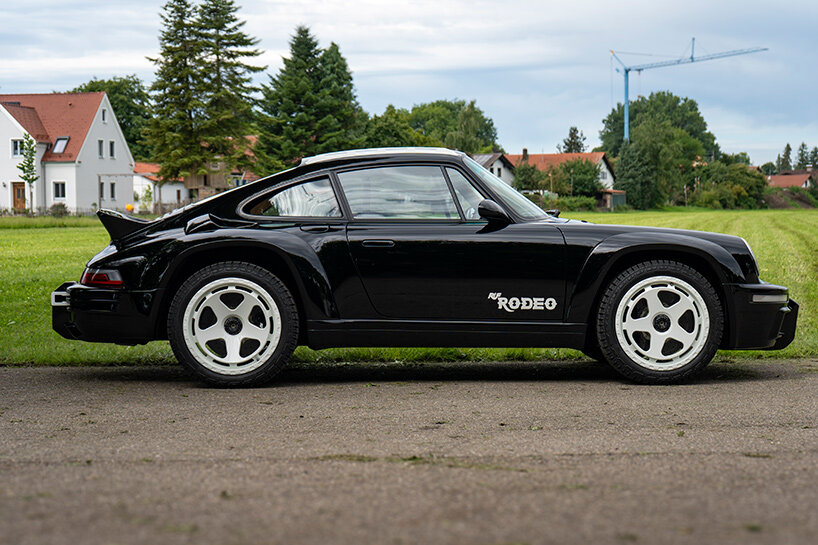
image © RUF Automobile
Although the Rodeo looks westward in its narrative, it remains tied to RUF’s long lineage of experimentation. ‘We brought out the concept last year as a running prototype. We call it the Rodeo because it was a full Safari, but we have never driven our cars in Africa so the name didn’t fit,’ Aloisa says. Instead, the name recalls RUF’s own history of off-road racing, including early Pike’s Peak entries.
The delivery at The Quail was joined by two other RUF models: the CTR3 EVO and the Tribute. Of course, the Rodeo stood apart with its one-off balance of utility and craft. For Aloisa, the project expands RUF’s design vocabulary. ‘Everything is done in-house, and most of our leathers are sourced from Europe,’ she adds, emphasizing the same attention to process that runs through the company’s engineering work.
To celebrate its first delivery, Aloisa has hand-sewn and hand-painted a capsule collection of Rodeo jeans, each individually numbered. These carry forward the project’s connection between personal history and craft, and bring a wearable translation of the car’s Western references.
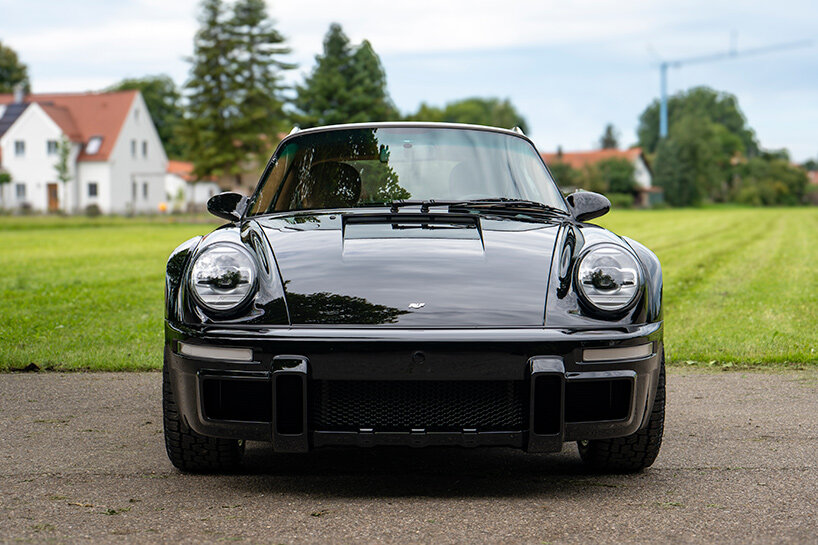
image © RUF Automobile
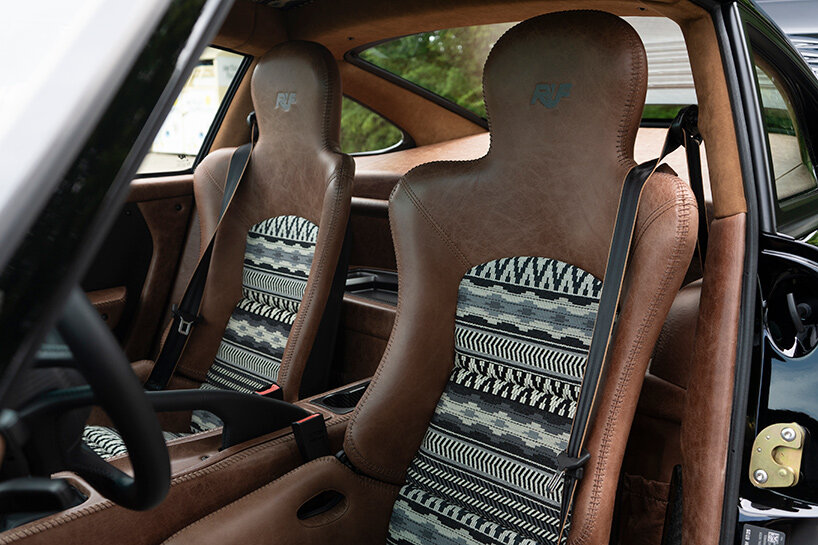
image © RUF Automobile