Saddle Peak Residence

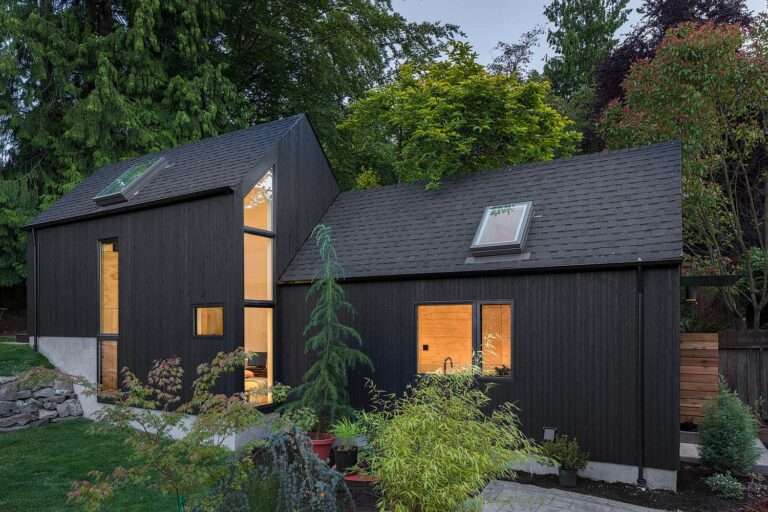
A completely transformative renovation opened this former tract home up to views, light, and its stunning outdoor setting. It's all about the views, but this residence wasn't always this way. What is now a metal and cedar stunner situated on a private, hilly enclave above Calabasas, was once a darkly lit 1960s-era generic single family home. A two-year renovation made a total overhaul for an entrepreneur and his wife, empty nesters with kids living nearby. The architect, Brian Wickersham of AUX Architecture in Los Angeles, didn't change a thing in terms of the home’s footprint and rooflines; he couldn't. “We initially looked at building a new home, but quickly learned that because of an ancient paleolithic landslide, that the county requirements for restraining the hill would be cost prohibitive and time-consuming—potentially five or more years,” says Wickersham. “Instead, we devised a plan to work within the existing house footprint and building envelope for a project that would be classified as a renovation.” In addition to these parameters, the homeowners tasked him with throwing out all of the old—down to the last salad fork—and bringing in everything new—all the while designing something where they could entertain a growing gaggle of grandkids. The result is a modern home that transitions from indoors to outdoors with the ease this property was intended for. “It’s about striking a balance between modest down-to-earth people and helping them realize they can be living a luxurious lifestyle,” says Wickersham. It’s about them living at a higher level of luxury." A composition of dark standing seam metal and vertical grain cedar give the appearance of three cut pieces, shifted side-to-side, the wood being the cut face. The cedar siding also carries from outside to in, bringing warmth to the home and reinforcing the inside-outside connection. Solar panels, thermal panels to heat the pool, and a thermally coupled HVAC system enable the home to largely function off-the-grid.

Saddle Peak Residence by AUX Architecture

See more on Dwell.com: Saddle Peak Residence by AUX Architecture – Calabasas, California

Homes near Calabasas, California

  • Tareco Contemporary
  • Abraham Shapiro, AIA, Architect
  • Los Feliz Residence

Similar Posts

  • Miner Road

    The clients are a couple of environmental scientists who, along with their two sons, relocated from the Oakland Hills to the warmer climate of Orinda. Their commitment to sustainability, including a request for net-zero energy performance annually, was evident in their thinking throughout the design process. A three-bedroom program began as a remodel of a 1954 ranch house at the foot of a hill next to a seasonal creek.  After finding the existing structure and soils to be unsuitable, the direction settled on reusing the existing footprint under the shade of a Valley Oak that had grown up close to the original house. The surviving portion of the original house is the fireplace which was wrapped in concrete and utilized for structural support. This made additional grading unnecessary and allowed the new house to maintain the same intimate relation to the old oak.  The family desired an open living layout that connected directly to the landscape. A mezzanine plan evolved with a double height family space nested with a master bedroom and study stacked above the kitchen and nook. A screened pacing deck for long phone calls shades the upper level from afternoon summer sun. Downstairs, secondary bedrooms along an extendable hallway, wrap an outdoor dining area situated between the kitchen and family room.  Construction materials and methods were considered in balance between first and lifecycle costs. The Corten steel rain screen for the exterior skin and interior wood were chosen to take advantage of zero annual maintenance cost and a shotcrete foundation allowed formwork to be repurposed for wood framing.  Single use material selections such as the Corten steel and shotcrete foundation reduced complexity in detailing and labor costs allowing a larger portion of the budget to be reallocated for upgraded mechanical, insulation, and glazing systems. The same attitude for interior finishes produced acoustically insulated, unfinished oak ceilings and walls. The sum total of the limited and landscape-driven materials presents a relaxed and quiet built environment that allows the senses to focus on the natural environment. A haptic connection to the rhythms of our planet is evident.  A 14-gauge Corten rain screen provides a no-maintenance skin. High levels of insulation and glazing efficiency reduce heating and cooling loads. An 8.1kW photovoltaic system provides on-site renewable energy and produced more electrical energy than the house used the first year. Rainwater is collected via a waterfall from the roof at the end of the hallway. Buried tanks store water for use in toilets and laundry. Greywater is collected separately and reused for irrigation. Electronically commutated motors and variable speed heat pumps are used to further limit energy use and control heating and cooling. An energy recovery ventilator is used to provide fresh air.