|

Subterranean Natural History Museum Is Draped With Landscaped Ribbons That Blend Into the Forest

Hungarian Natural History Museum by BIGHungarian Natural History Museum by BIG

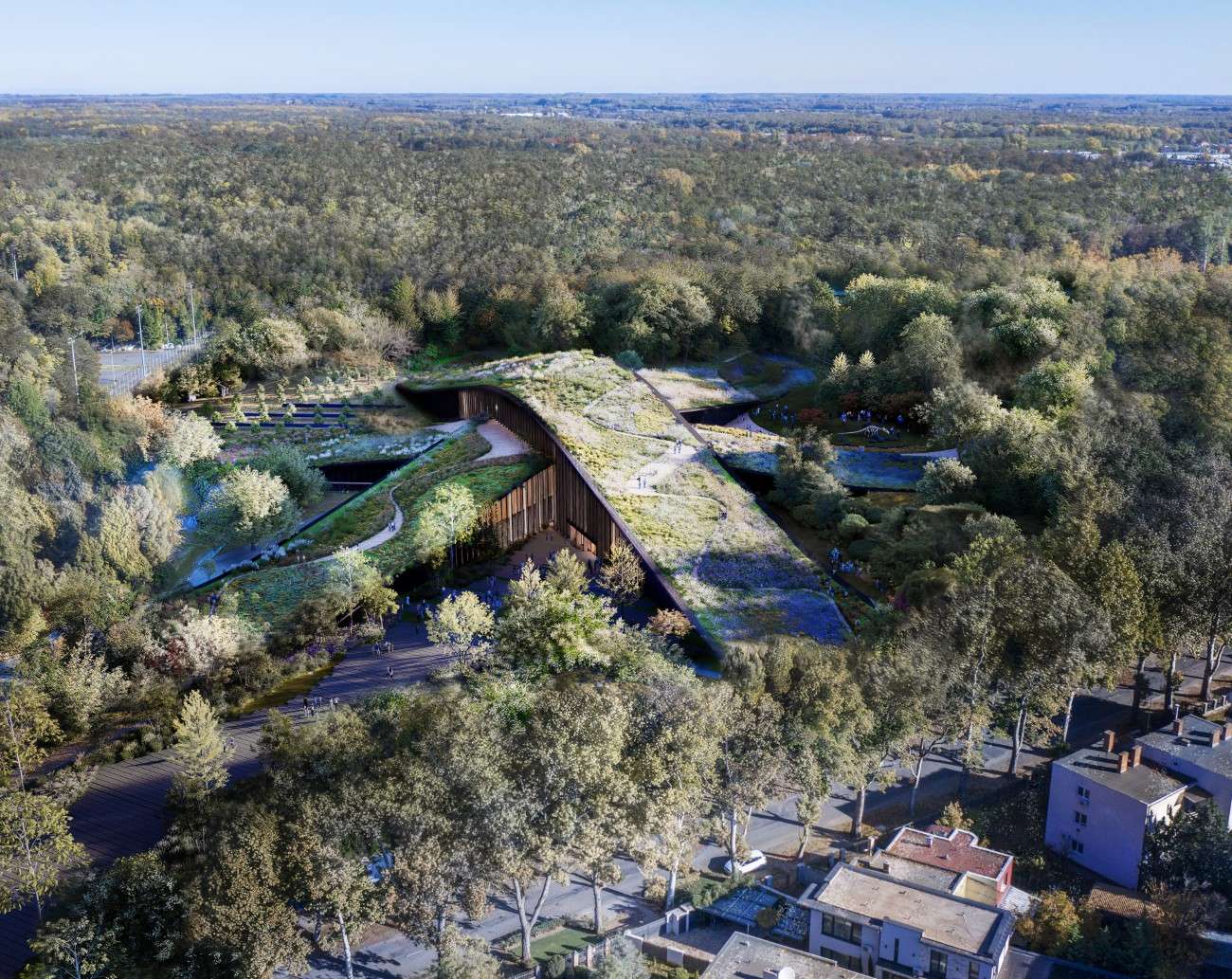
Whether designing a baseball stadium, ballet theater, or museum, BIG (Bjarke Ingels Group) always has something up its sleeve. The Hungarian Natural History Museum is no exception. BIG won an international competition to design the 23,000-square-meter institution thanks to its innovative concept that sees three landscaped ribbons creating a new space for science.

Set in the Great Forest of Hungary’s second-largest city, Debrecen, the future museum will rise from the forest floor. With its green roofs and charred timber facade, the museum will blend into its environment while providing light and bright exhibition halls for the permanent collection.

In a way, the museum, which is designed as partially sunken underground, will become a fundamental part of the landscape; it’s fitting given the function of a natural history museum. Accessible on all sides and filled with open plazas and winding forest paths, it will open up new community spaces. And in doing so, it will allow visitors to see the connection between science, architecture, and nature.

“We envisioned the Hungarian Natural History Museum as an integrated part of its environment, both shaped by and shaping the landscape around it,” shares BIG Partner Hanna Johansson. “Constructed from mass timber, the building features a facade of locally sourced charred timber panels that emerge from the ground, blurring the lines between architecture and wilderness.”

Inside, the spacious exhibition areas formed by the ribbons are the perfect setting for magnificent displays of dinosaur fossils and other natural materials. In addition to five permanent galleries and a temporary exhibition space, the museum will have a library and restaurant offering views into the forest canopy, while below, a learning hub hosts workshops, play spaces, and research labs for students, families, and staff.

While no official construction timeline has been given, it should be open by 2030, as it’s part of a wider plan to position Debrecen as a hub for education and culture by that time.

BIG has won an international competition to design the Hungarian Natural History Museum.

Hungarian Natural History Museum by BIGHungarian Natural History Museum by BIG

The museum, which is partially sunken into the ground, features a charred timber facade and landscaped roofs.

Hungarian Natural History Museum by BIGHungarian Natural History Museum by BIG

The ribbon-like roofs create light, airy exhibition halls befitting of a natural history museum.

Hungarian Natural History Museum by BIGHungarian Natural History Museum by BIG

By emerging from the forest floor, the museum becomes an integral part of the landscape.

Hungarian Natural History Museum by BIGHungarian Natural History Museum by BIG

Bjarke Ingels Group (BIG): Website | Facebook | Instagram 

My Modern Met granted permission to feature photos by BIG.

Related Articles:

BIG Drapes an Undulating “Veil” Over Kosovo’s Ballet and Opera Theater

Museum of Paper Cleverly Designed With a Roof That Looks Like a Sheet of Folded Paper

New Gelephu International Airport Is a Celebration of Bhutanese Culture and Heritage

Cutting Edge Ballpark Design Is Inspired by an Armadillo To Help It Beat the Las Vegas Heat

Similar Posts

  • The Fieldhouse

    Built for family and friends as a space for sport and gathering, the Fieldhouse is a simple, functional structure. Like the immersion of nature and recreation in the development of state and national parks of the early 20th century, this family wanted a structure where friends, family, and neighbors could gather, play sport, celebrate and relax in the country. The Fieldhouse feels distant and secluded, located on a mostly undeveloped seven-acre site, surrounded by a meadow of natural grasses, a fruit orchard, wetland ponds and a maintained field for sporting. As long time natives of the Pacific Northwest, the family was keen to convey a specific sense of place and longevity. The architecture responds to those ideas in its simplicity and versatility, and in its construction from durable, local materials. Inspiration was taken from vernacular stone and timber structures built across the country in the 1930s by the Civilian Conservation Corps. The architects and clients channeled their own recollections of summers spent in Seattle’s waterfront parks and their simple elegant structures, often by early 20th century Seattle architect Ellsworth Storey. The 1,664-square-foot structure consists of a covered outdoor patio flanked by two, offset and enclosed spaces housing a sun room and inglenook to the west, and a kitchen, grill and two bathrooms to the east. Designed to accommodate almost any situation, the Fieldhouse can shelter four as comfortably as it can 60, hosting sleepovers, family sports tournaments, reunions and outdoor dining with ease. The structure employs a gradient of enclosure and structural qualities from the immersive intimate inglenook to the ever thinning shed roof structure, gently lifting off above the central patio. The building can be shutdown to weather storms, or opened wide to allow light, air and activity to pass through freely. The structure provides a straight-forward and visibly-constructed language of materials. It progressively lightens from a solid stone base, to thick timber columns, to pairs of rafters and thinner yet pairs of purlins, supporting the single-plane shed roof. The timber is all Douglas fir and cedar harvested and salvaged from the Pacific Northwest. The stone is taken from a quarry on nearby Vancouver Island and the early, factory-style steel casement doors and windows are West Coast built. This timeless assembly of materials and method of construction suggest that this is a building about its surroundings and a stalwart of the region it resides in, functioning as well today as it will in 100 years. Hoedemaker Pfeiffer design team
    Steve Hoedemaker, co-founder and partner
    Justin Oldenhuis Project team
    Hoedemaker Pfeiffer (Architecture)
    Hoedemaker Pfeiffer (Interior Design)
    Joseph McKinstry Construction Company (Contractor)
    Swenson Say Faget (Structural Engineer)
    Kenneth Philp Landscape Architects (Landscape Architect) Photography
    Andrew Giammarco

  • Dark, Dashing and Full of Surprises: Ravishing Artist’s Apartment in Kyiv

    Modern apartment are spaces that are often filled with neutral hues and you have a curated blend of color and style in here. Most often it is white, light grays and beige that fashion the backdrop and there is no shortage of bright hues in here as well. But this Artist’s Apartment in Kyiv, Ukraine […]

    You’re reading Dark, Dashing and Full of Surprises: Ravishing Artist’s Apartment in Kyiv, originally posted on Decoist. If you enjoyed this post, be sure to follow Decoist on Twitter, Facebook and Pinterest.

  • Tunnel House: Brutalist Design Meets Green Contemporary Charm at this Brazilian Home

    Minimalism is an integral part of Brazilian design and concrete an essential component of this narrative. Combining brutalist design with contemporary minimalism and a whole lot of green, the Tunnel House designed by Consuelo Jorge Arquitetos offers the best of both worlds. Overall design of the house feels simple, clean and modern with wooden shutters […]

    You’re reading Tunnel House: Brutalist Design Meets Green Contemporary Charm at this Brazilian Home, originally posted on Decoist. If you enjoyed this post, be sure to follow Decoist on Twitter, Facebook and Pinterest.