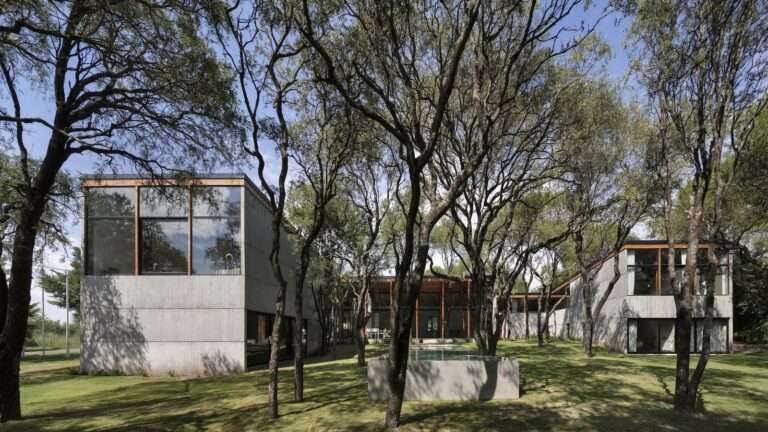
Nestled in the coastal suburb of Clovelly, a tropical garden house by Andrew Burges Architects is deeply rooted in its natural surroundings. Taking inspiration from the striking geography of the gully connecting the beach to the ridgeline, Gully House has been conceived as an extension of the landscape.
From the outset, the project was guided by a desire to create a tranquil, grounded space at ease with its context. “We wanted the house to feel like an extension of the gully,” says architect Andrew Burges. This has been realised through a series of thoughtful design moves that respond to the site’s steep terrain and orientation, prioritising simplicity and spatial coherence. These principles are central to the identity of this tropical garden house.
Visitors enter the tropical garden house by descending a series of floating concrete steps through a garden designed to resemble a piece of the gully. The house then unfolds across a series of levels that follow an untraditional layout. This sectional approach allows the kitchen to sit at courtyard level, and the living area steps up to capture sightlines down into the gully and towards the pool.
The internal spaces are crafted to feel open yet layered. Thickened edges around the open-plan living, dining and kitchen areas integrate both functional and aesthetic elements, such as shelving, fireplaces and an indoor garden. A timber bookshelf conceals a passage leading to a hidden powder room and storage area, creating a sense of discovery. It’s one of the defining features of the tropical garden house experience.
Bedrooms are located at either end of the plan, ensuring privacy while maintaining a strong connection to the landscape. The main bedroom opens towards the gully, while others face a quiet courtyard. At the heart of this tropical garden house lies a “secret garden” – a tranquil courtyard that ushers northern light into a central stairwell and the main bedroom. Overhead, a frameless skylight facilitates uninterrupted views of the sky, connecting the internal experience to the outdoors.
Materiality plays a crucial role in the home’s character. A palette of concrete, timber and stone reflects the tones of the surrounding environment, creating tactility and depth. A custom-designed brick screen offers both privacy and permeability, allowing light and air to flow through while softening the boundary between interior and exterior – hallmarks of this tropical garden house.
Gully House also plays with scale. Though the floor plan is compact, a four-metre-high ceiling in the kitchen brings a theatre and generosity that tempers the overall modesty of the space. It’s an intriguing interplay of scale and volume that enhances the dramatic effect of this minimalist tropical garden house.
More than just a dwelling, the home is a meditative retreat where built form and landscape coexist. As Burges says, it’s a place where “you’re connected to the sky and the landscape. That intangible quality that we try to create with a house is probably what we’re most proud of.”
00:00 – Introduction to the Tropical Garden House
01:02 – A Walkthrough of the House
03:08 – Design Highlights and Features
03:37 – Working with Raw and Refined Materials
05:04 – The Collaborative Process and Intangible Qualities
For more from The Local Project:
Instagram – https://www.instagram.com/thelocalproject/
Website – https://thelocalproject.com.au/
LinkedIn – https://www.linkedin.com/company/the-local-project-publication/
Print Publication – https://thelocalproject.com.au/publication/
Hardcover Book – https://thelocalproject.com.au/book/
The Local Project Marketplace – https://thelocalproject.com.au/marketplace/
For more from The Local Production:
Instagram – https://www.instagram.com/thelocalproduction_/
Website – https://thelocalproduction.com.au/
LinkedIn – https://www.linkedin.com/company/thelocalproduction/
To subscribe to The Local Project’s tri-annual print publication see here – https://thelocalproject.com.au/subscribe/
Photography by Peter Bennetts.
Architecture by Andrew Burges Architects.
Built by Robert Plumb Build.
Landscape by Dangar Barin Smith.
Engineering by Structure Consulting Engineers.
Filmed by The Local Production.
Edited by Cadre.
Location: Clovelly, New South Wales, Australia
The Local Project acknowledges the Aboriginal and Torres Strait Islander peoples as the Traditional Custodians of the land in Australia. We recognise the importance of Indigenous peoples in the identity of our country and continuing connections to Country and community. We pay our respect to Elders, past and present, and extend that respect to all Indigenous people of these lands.