how can materials generate movement, behavior, interaction?
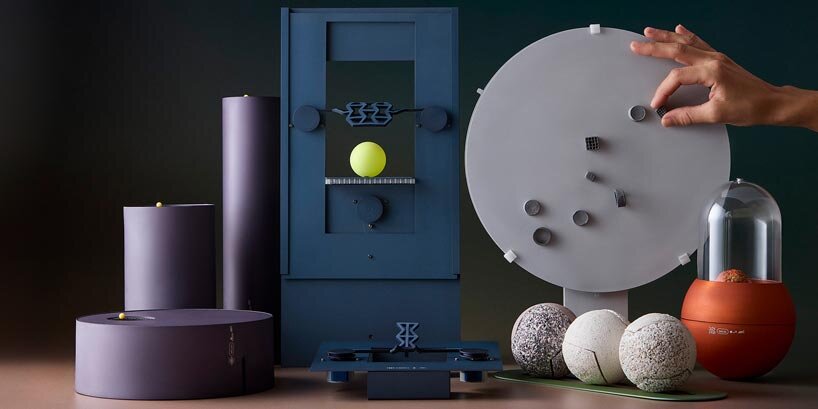
Material Interactions is a collaborative project by Nadya Suvorova and Heidi Jalkh, presenting a series of five kinetic sculptures that explore the role of materials as active components within design systems. Rather than treating matter as passive, the project investigates how materials can exhibit responsive behaviors, contributing to form, movement, and interaction.
The sculptures integrate experimental materials developed in Swiss and Argentine laboratories, combining approaches from materials science, biology, engineering, and design. Each object is conceived as a system in which material properties and embedded technologies generate specific reactions. Interaction is triggered through proximity, enabling the works to respond to the presence of visitors through movement and spatial shifts. This framework positions materials as agents within a dynamic environment, extending beyond conventional mechanical systems.
The project proposes an expanded understanding of design, where behavior emerges from the intrinsic qualities of materials and their configuration. By embedding responsiveness directly into material systems, the work reconsiders the relationship between users, objects, and environments.
all images courtesy of Material Interactions – Nadya Suvorova and Heidi Jalkh
the Five kinetic sculptures that compose Material Interactions
Material Interactions series by designers Nadya Suvorova and Heidi Jalkh presents five kinetic objects. Sculpture BM.01 / Bind (2026) is composed of a bioceramic material derived from ground seashells, including magellan mussels, oysters, and razor clams, combined with an algae-based binder. The material is shaped at room temperature into interlocking components that assemble into a spherical form. The resulting structure is capable of controlled movement, including rolling and self-stabilizing, demonstrating how recycled biological matter can be reconfigured into a functional kinetic system.
MG.02 / Grow (2026) piece incorporates a mycelium-based material formed from fungal species, including Pycnoporus sanguineus and Ganoderma lucidum. The living material develops within a contained structure supported by a kinetic framework of aluminum and synthetic components. Movement is gradual and continuous, supporting the growth process and emphasizing the integration of biological systems within designed objects.
In MC.03 / Magnetize (2026), a silicone compound embedded with neodymium iron boron particles forms a field of flexible, hair-like elements. Under the influence of magnetic forces, these elements align and move collectively, enabling the transfer of small objects across the surface. The system operates as a soft, distributed mechanism for transport, driven by coordinated magnetic interaction.
Work AS.04 / Strain (2026) utilizes auxetic structures fabricated from thin-sheet EVA foam. When subjected to tension, the material expands and transforms, allowing it to bend, curl, and enclose objects. The deformation is used as a functional mechanism for lifting and releasing elements without rigid gripping, demonstrating how geometry and elasticity can replace conventional mechanical systems.
Composed of steel powder elements activated by magnetic fields, MF.05 / Attract (2026) sculpture generates continuous motion across horizontal and vertical surfaces. The material responds to controlled magnetic forces, enabling adhesion, release, and directional movement. The system illustrates how magnetic interaction can be used to choreograph material behavior in space.
Across the kinetic sculptures series, Material Interactions presents a design approach in which material systems, responsive technologies, and environmental interaction are integrated into cohesive frameworks. The project highlights the potential of materials to contribute actively to performance, supporting new forms of interaction and expanding the scope of design beyond static objects.

AS.04 / Strain Material: Thin-sheet EVA foam auxetic structures Collaborators: Dr Lorenzo Guiducci, Matters of Activity (DE)

AS.04 / Strain Material: Thin-sheet EVA foam auxetic structures Collaborators: Dr Lorenzo Guiducci, Matters of Activity (DE)

BM.01 / Bind Materials: Ground seashells(magellan mussels, oysters, razors) and algae biopolymer Raw material source: Ultramarinos (AR)

MC.03 / Magnetize Material: Silicone rubber compound with neodymium iron boron particles Material source: Dr Ahmet Demirörs (CH), Complex Materials Group, ETH Zurich

MC.03 / Magnetize Material: Silicone rubber compound with neodymium iron boron particles Material source: Dr Ahmet Demirörs (CH), Complex Materials Group, ETH Zurich

MF.05 / Attract Material: Steel powder Material source: Apheros AG (CH), Complex Materials Group, ETH Zurich

MG.02 / Grow Material: Mycelium agglomerate of Pycnoporus sanguineus and Ganoderma lucidum Fungi inoculation: Dr. Leonardo M. Majul, Lab. de Micología Experimental y Liquenología (INMIBO-UBA)

MG.02 / Grow Material: Mycelium agglomerate of Pycnoporus sanguineus and Ganoderma lucidum Fungi inoculation: Dr. Leonardo M. Majul, Lab. de Micología Experimental y Liquenología (INMIBO-UBA)
project info:
name: Material Interactions
designers: Material Interactions – Nadya Suvorova and Heidi Jalkh | @material_interactions
design development: Lorenzo Rossi
programming: Mario von Rickenbach
electronics: Santiago Clancy
score and soundscapes: Ailin Grad
video editing: Andres Aguiló
photographers: Laura Macias and Vicky Rey
science communication: Dr. Exequiel Rodriguez
identity typography: Synt by Dinamo Typefaces
curatorial text: Caroline Hirt
inaugural exhibition: Material Interactions 一 A New Species of Design, on show at Artlab in Buenos Aires, Argentina
BM.01 / Bind (2026):
materials: Ground seashells (magellan mussels, oysters, razors), algae biopolymer
raw material source: Ultramarinos (AR)
MG.02 / Grow (2026):
materials: Mycelium agglomerate of Pycnoporus sanguineus, Ganoderma lucidum, anodised aluminium, PLA, plexiglas, motor, electronic components, proximity sensor
fungi inoculation: Dr. Leonardo M. Majul, Lab. de Micología Experimental y Liquenología (INMIBO-UBA)
MC.03 / Magnetize (2026):
materials: Silicone rubber compound with neodymium iron boron particles, anodised aluminium, magnets, PLA, motors, electronic components, proximity sensors
material source: Dr Ahmet Demirörs (CH), Material Science Department, Complex Materials Group, ETH Zurich
AS.04 / Strain (2026):
materials: Thin-sheet EVA foam auxetic structures, anodised aluminium, PLA, motors, electronic components, proximity sensor
collaborators: Dr Lorenzo Guiducci, Matters of Activity (DE)
MF.05 / Attract (2026):
materials: Steel powder, anodised aluminium, magnets, PLA, plexiglas, motor, electronic components, proximity sensor
material source: Apheros AG (CH), Material Science Department, Complex Materials Group, ETH Zurich
designboom has received this project from our DIY submissions feature, where we welcome our readers to submit their own work for publication. see more project submissions from our readers here.
edited by: christina vergopoulou | designboom


