the chairs we can’t stop thinking about after 3daysofdesign
Exploring Copenhagen during this year’s edition of 3daysofdesign, it was easy to lose track of how many chairs we’d seen by the time the rain came and went and another courtyard opened its gates. Seating appeared across the Danish city in garage installations, galleries, showrooms, museum displays, and the group exhibitions that have become some of the event’s most interesting stops.
For instance, at other circle and Ukurant, emerging designers brought together pieces that felt more hand-crafted, with visible joins, unexpected proportions, and materials that still carried some friction. Elsewhere, larger presentations placed the chair inside fuller environments, using it to shape places for rest and conversation.
A polished metal frame reflected Dalmatian spots, while a blocky pine chair seemed too heavy to lift. A wave of upholstery created a fluid landscape inside Designmuseum Danmark, and a sprawling conversation pit at Vipp turned a courtyard into a place where people gathered to play.
These are the chairs that stayed with us after the fair route blurred together, each one opening up a different way to think about seating.
Bend Chair, Oberdoerfer & Krebs
At Ukurant, an exhibition of emerging designers held on the outskirts of the city, locally-based studio Oberdoerfer & Krebs’ Bend Chair and Bend Stool began with a deceptively flat premise. The pieces are formed from 3D-printed sheets, heated and shaped by hand so that the material bends only where the geometry allows it to give.
What could read as a technical exercise becomes surprisingly direct, with the chair and stool holding onto the memory of the sheet while gaining the posture of furniture. Their appeal lies in that subtle tension between control and softness, and between digital fabrication and the visible pressure of the hand.
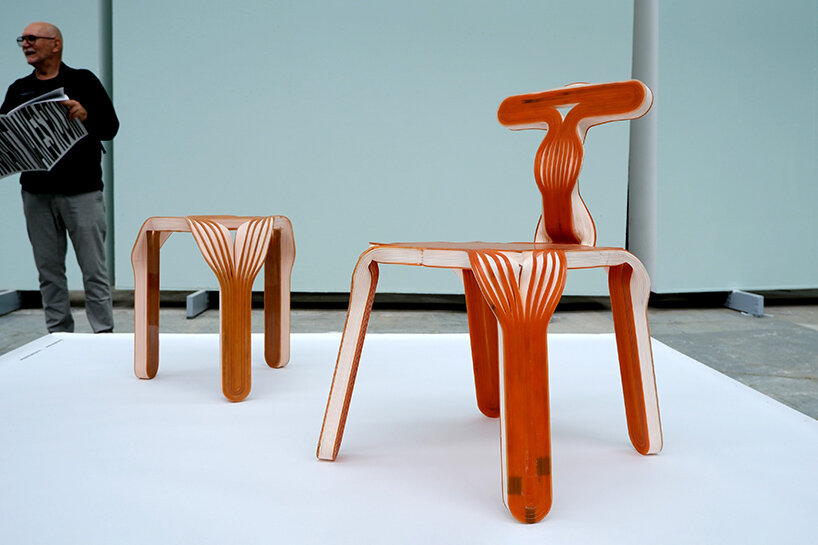
Bend Chair, Oberdoerfer & Krebs. image © designboom
Bouquet Theory, Niko June
With its series entitled Bouquet Theory, Copenhagen-based workshop Niko June brought together found industrial fragments, old mould parts, steel profiles, and leftover components, assembling them into objects that hover between furniture and improvised still life.
Seen at other circle, the work carries the confidence of something loosely gathered rather than drawn from scratch, with each element keeping a trace of its former use. Instead of prioritizing perfection or seamless construction, the team lets roughness and accidental character shape the work’s presence in the room.
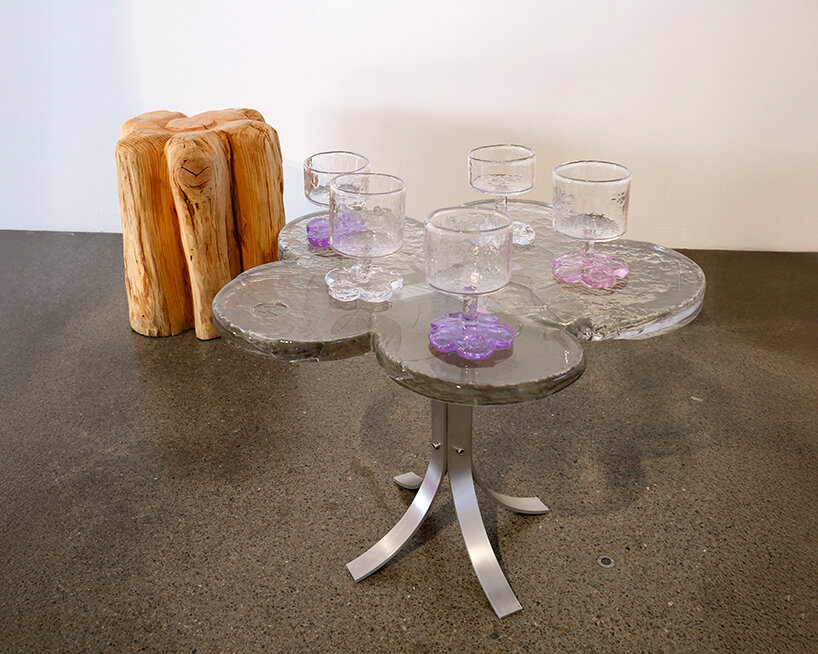
Bouquet Theory, Niko June. image © designboom
Gradas, UNS for Sancal
With Gradas, Dutch architecture studio UNS translates the stepped logic of public seating into an indoor furniture system for the Spanish furniture brand Sancal. The piece moves away from the singular chair and toward a small architecture of sitting. Here, people can perch, gather, turn, or occupy the same object in different ways.
The architects shape the stepped form to bring the language of plazas, auditoriums, and informal city edges to an individual scale, creating a social structure as much as a bench. During 3daysofdesign, it sat naturally within Sancal’s tactile living environment, where furniture acted as a spatial tool which invited play.
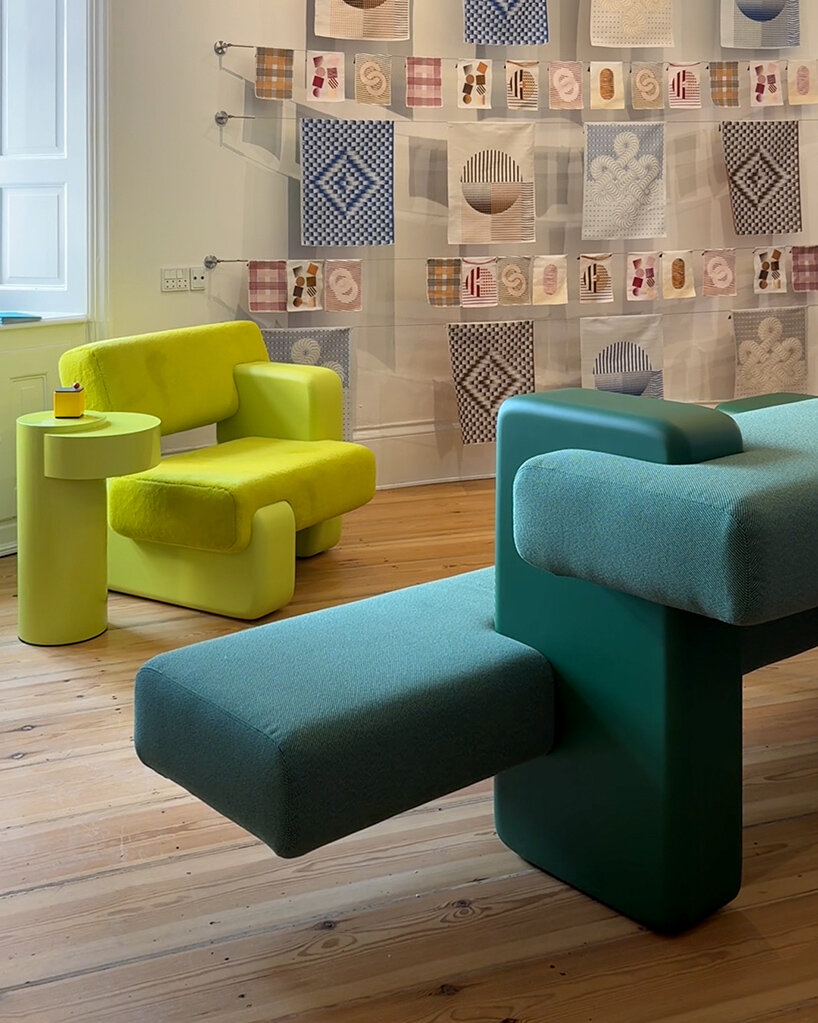
Gradas, UNS for Sancal. image © designboom
Poodle armChair, Mati Sipiora
Mati Sipiora’s Poodle Armchair turns a familiar type into something more animated, pairing a polished stainless steel frame with a soft upholstered seat. The tubular silhouette gives the chair its almost cartoon-like outline, while the reflective metal keeps it sharp and slightly aloof.
There is humor in the proportions, especially in the way the frame curls around the seat like a drawn line, but the object remains precise in its construction. Its softness arrives through contrast, with its patterned, Dalmatian-inspired textile set against the coolness of steel.
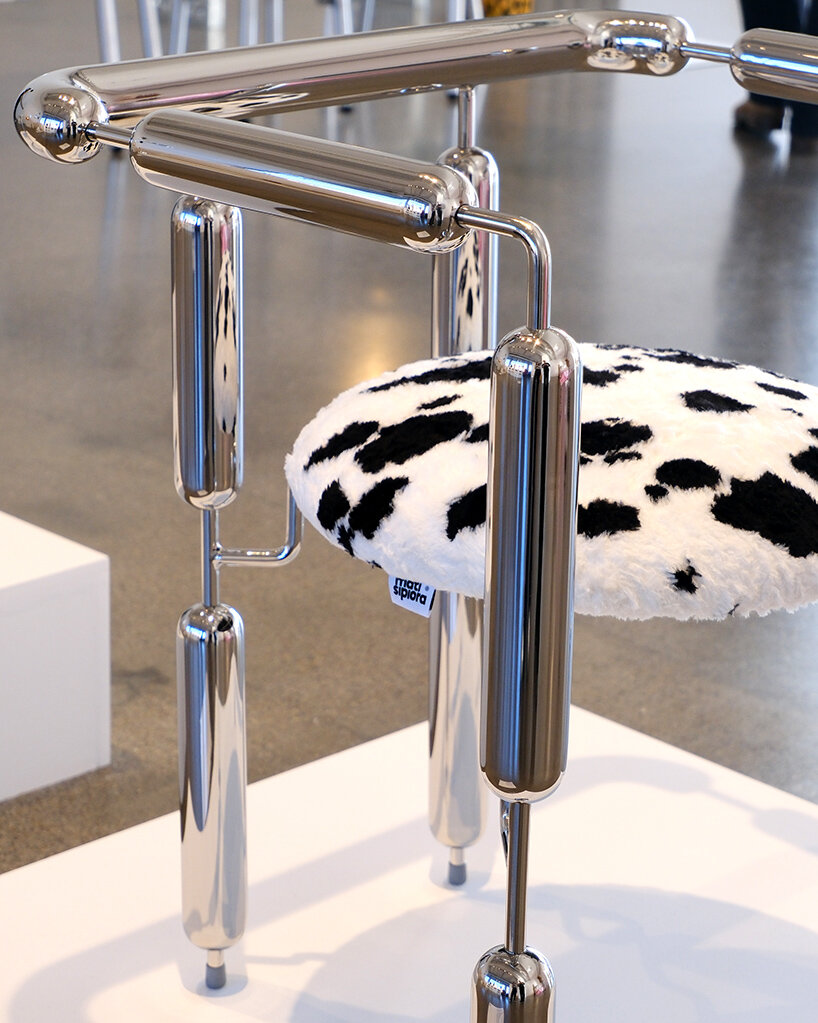
Poodle Armchair, Mati Sipiora. image © designboom
To Brick or not to Brick, Caspar Fischer
Caspar Fischer’s To Brick or Not to Brick approaches seating as an open-ended system rather than a fixed object. Built around a modular grid and a specially developed connection method, the project invites users to assemble and adapt their own furniture from repeatable parts.
At Ukurant, that logic gave the work a playful but architectural quality, somewhere between construction kit, domestic object, and spatial prototype. The chair becomes a prompt for participation, asking how much agency a user can have once a furniture system leaves the designer’s hands.
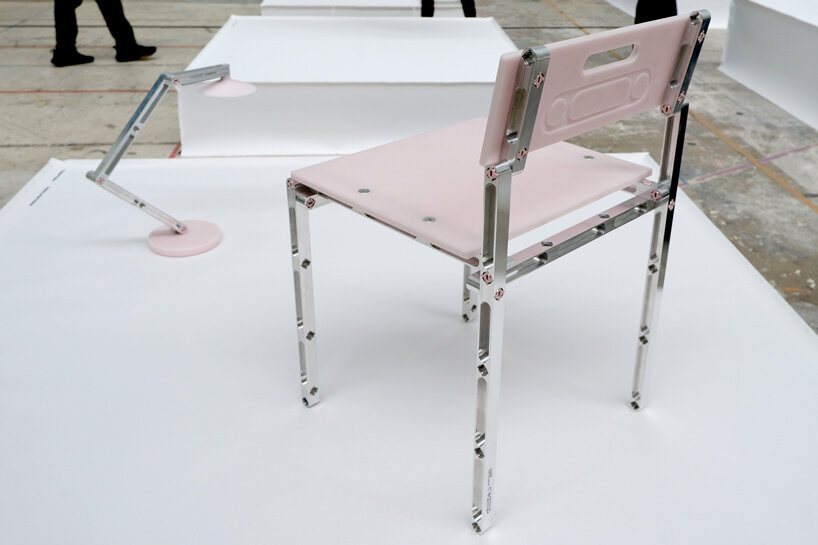
To Brick or not to Brick, Caspar Fischer. image © designboom
Conversation Pit, Vipp x Mesura
Inside Vipp’s Copenhagen campus, a colossal conversation pit by Danish design brand Vipp and Barcelona-based architecture studio Mesura expanded the chair into a shared landscape. During a visit to the space during 3daysofdesign, the team at Vipp tells designboom that this element of playful togetherness is a new exploration, as they’ve long curated retreats centered on relaxation in solitude.
Built from sections of Vipp’s modular Loft sofa, the installation — created with Mesura — used seating to redraw the courtyard and garage as a temporary playhouse, wrapped in plaid textiles and shaped around rest, conversation, and gathering. Its strength was spatial rather than sculptural, using the low, sunken typology of the conversation pit to slow the body down and pull people toward the center of the room.


