A Compact Prefab Cabin Draws in Spectacular Valley Views

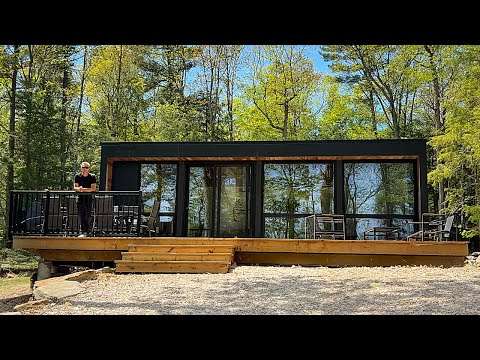
Economical and eco-friendly, a 725-square-foot prefab cabin is a cozy low-impact retreat in rural New Zealand.

Designed to sleep eight, the flexible cabin can be used as a quiet retreat for the couple or a gathering place for family and friends.

During a drive from Auckland to Wellington, Ainsley O’Connell and Barry Copeland spotted the perfect piece of land for a rural holiday cabin. Set high above the remote town of Taihape in the the middle of New Zealand’s North Island, the 1,000-square-foot plot was a former vegetable garden for the local market, sporting captivating views of the rural landscape and town lights below.

The AB Cabin is set in the middle of high country with Mount Ruapehu to the north and the Ruahine Ranges to the south. The building takes inspiration from the surrounding timber-framed houses and metal-clad farm buildings.

The AB Cabin is set in the middle of high country with Mount Ruapehu to the north and the Ruahine Ranges to the south. The building takes inspiration from the surrounding timber-framed houses and metal-clad farm buildings.

Paul McCredies

The couple, both architects, camped on the site to immerse themselves in the “constantly changing light and atmospheric conditions” before designing the cabin—a process that involved the creation of over 20 models before they settled on the design of a tiny prefabricated cabin inspired by the local rural vernacular.  

Set on a southeast-facing slope, the AB Cabin is fitted with double-glazed windows that frame views of the town of Taihape and rolling hills beyond.

Set on a southeast-facing slope, the AB Cabin is fitted with double-glazed windows that frame views of the town of Taihape and rolling hills beyond.

Paul McCredies

“One of the biggest challenges was the distance from Auckland,” notes Copeland of the five-hour journey. “We decided to design a prefabricated building to reduce the build time and thus make the process easier to control from a distance.”

With the help of local builder Daniel Crimp and his team, the couple also used the project as an opportunity to experiment with cross-laminated timber panels for the first time.

Concrete blocks lead up to an elevated timber deck with a sliding aluminum entrance door.

Concrete blocks lead up to an elevated timber deck with a sliding aluminum entrance door.

Paul McCredies

See the full story on Dwell.com: A Compact Prefab Cabin Draws In Spectacular Valley Views
Related stories:

  • 6 Northern California Prefab Homes With Verdant Forest Vibes
  • Now You Can Spend the Night in Hygge Supply’s New, Ultra-Modern Kit Home
  • Muji Just Unveiled a New Prefab Home—and it’s a Minimalist Dream Come True
Similar Posts

  • Add/Subtract House

    The Add/Subtract House is derived from the stereotomic operation of subtracting from and adding to a solid volume to enable specific programmatic relationships and daylight conditions. Sited on a typical 50’x150’ single-family residential lot in Austin, Texas, the design questions the standard house massing and arrangement by stretching along the length of the lot. Rather than single the dichotomy of front yard and backyard, the design establishes smaller courtyards, hardscapes and softscapes at various scales to relate to individual rooms. The external material palette (standing seam metal, tongue & groove wood paneling, and stucco) is applied to reinforce the distribution of individual program elements. Each material is composed into folding planes which capture space and define zones throughout the house. Every room in the house benefits from natural light from at least two sides as daylight is modulated throughout, offsetting the need for electric light during daylight hours and allowing occupants to more directly track seasonal and daily patterns.

  • Cascading House

    The site has the typical challenges of many urban lots in Ho Chi Minh city: abutted by tall neighboring houses, small developable area relative to the clients’ program, and compromised access to daylighting and natural ventilation. Due to the height restriction, the house was pushed 1 level below the ground to accommodate the large program. In an effort to solve as many issues as possible, we proposed a concrete column system hidden inside the north and south concrete wall that face the neighbors, acting as the primary structure for the house and freeing up the space in-between. These concrete walls provide privacy to the clients and their family, and open up the east and west facade for views and outdoor-indoor connection. Because the column system extends continuously from the basement to the roof, the concrete beams spanning in-between can be moved vertically without any structural concerns. This flexibility also meant total discretion to determine the elevations of the upper floors–which we intended to take advantage of. By convention, the program is stacked floor-by-floor to maximize the usable area of a small lot which could result in monotonous and isolated spaces. We wanted to do just the opposite: visually and spatially connecting the different parts of the house together by splitting the floor plates, and then cascading them to create a multi-story atrium. In this space, life unfolds naturally; once a family member steps out of the bedroom, he/she will be in an all-connected “room”, and in the company of another member, whether that person is on the other side of the atrium or 2 levels above. In addition to spatial articulation, this atrium brings daylighting down to the basement, and–working with the 2 sunken gardens which are naturally filled with cool air–aids the stack effect by letting the hot air rises to the top. The temperature of the lower floors, as a result, becomes more comfortable. From the outside, Cascading House looks solid as a rock that provides sturdy shelter. The interior, however, feels as porous as a sponge soaking up natural light and air, and brings family members closer together–the qualities that make this house a home.