|

bike without chain still rides using a series of 3D printed plastic gears

3D printed plastic gears make chainless bike ride

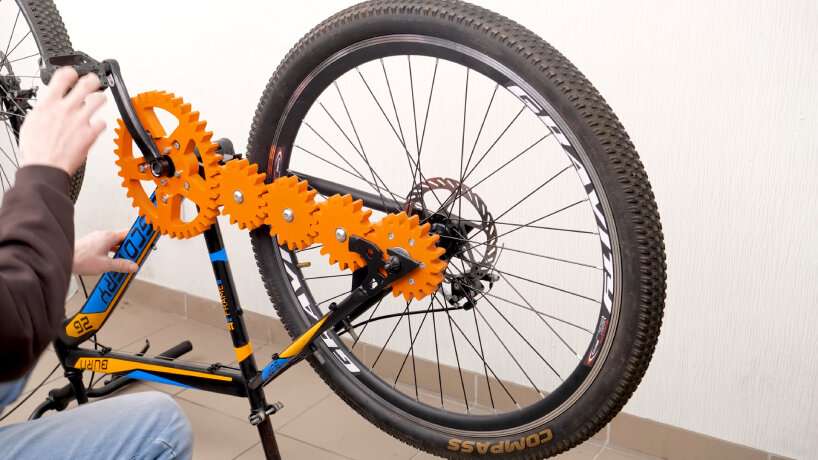
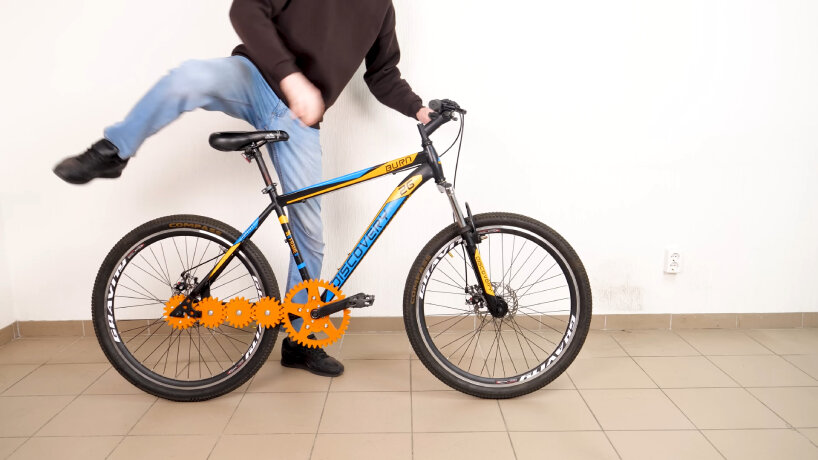
Sergii Gordieiev, the creator behind the channel The Q, revives a chainless bike by making it functional using a series of interconnected, 3D printed plastic gears. Interlocked in a row, the setup consists of a large gear and four mini ones. When the large one rotates, it transfers motion to the smaller gears, allowing for rotation and hence letting the chainless bike ride again even without its original chain.

The creator uses the printed Phrozen Arco, which uses high-flow engineering nozzles that push the melted plastic quickly. Before that, Sergii Gordieiev makes sure that the design of each gear is aligned correctly so the chainless bike can work. If one gear slips, the system fails, but thanks to the 3D printer, the sizes of the gears are accurate enough for them to work just fine. When printed, the plastic gears come out as white, the same color as the material, and the creator paints them orange so they stand out on the chainless bike when he rides it.
chainless bike 3D printed
all images courtesy of The Q

Replaceable and custom parts using 3D printer

In the video uploaded on Youtube, the creator is seen building the frame of the chainless bike to affix the 3D printed plastic gears. He measures them precisely, and rightly so, or else one of the gears could fall and hinder the bike’s run. He tests the gears on a wooden slab and screws them onto it before trying it out on the part where the chain is supposed to be around. He then places that last small gear onto the rear wheel’s hub, connecting the row of 3D printed plastic gears that makes the chainless bike run like a clockwork mechanism. 

The video shows how Sergii Gordieiev built the chainless bike with 3D printed plastic gears, serving as a preview or guide for crafty viewers who’d like to produce their own functional bicycle without a chain. Using a 3D printed can allow for cheaper parts replacement too, since the user can regenerate the components at home and without needing to go to a workshop with the filaments they already have. So far, only the plastic gears are extruded, but if the users want to customize their chainless bike with other 3D printed parts, now’s their time.
chainless bike 3D printed
interlocked in a row, the setup consist of a large gear and four mini ones
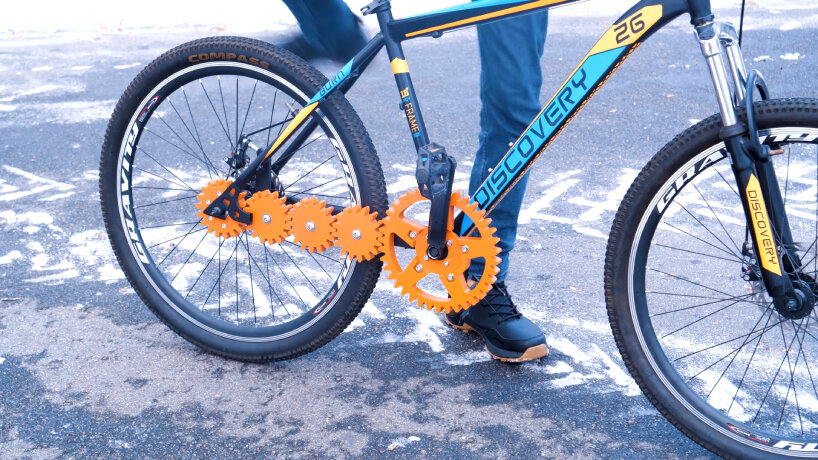
when the large one rotates, it transfers motion to the smaller gears


chainless bike 3D printed
the plastic gears make the chainless bike run like a clockwork mechanism
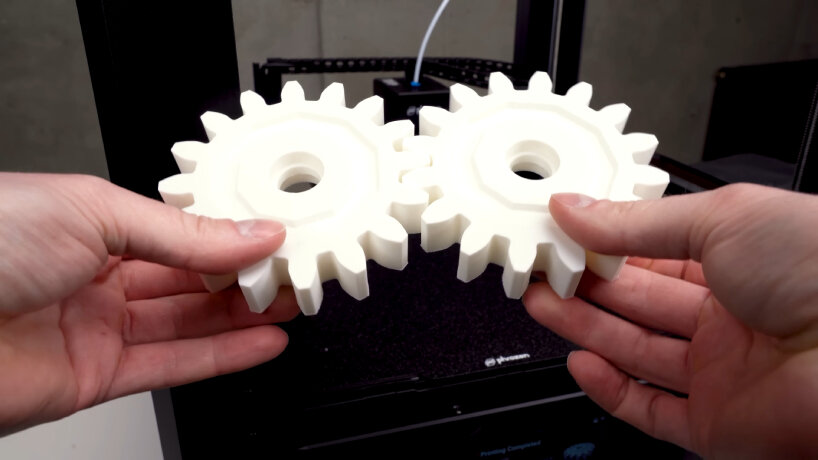
view of the gears after 3D printing

project info:

name: Chainless Bike – Gears Edition

channel: The Q | @theq_original

Similar Posts

  • Suncrest Residence

    This new residence is located on a pristine site comprised of a mature douglas fir and pacific madrone forest, with occasional rocky clearings and several small ponds. Our clients desired a work of architecture that minimized site impacts while creating a work of architecture that utilized their favorite materials (wood and concrete) and connected them intimately with the land and the view. The home is situated where the forest gives way to a large rocky clearing with views to the sea. The structure is ‘wrapped’ around a prominent outcropping of rock and carefully situated to require a minimum of tree removal. The long, narrow footprint of the home allows every room a view of the sea while also retaining a strong connection to the surrounding forest. Merit Award – AIA NW & Pacific Honor Awards, 2011 Merit Award – AIA Honor Awards for Washington Architecture, 2010

  • Maullin Lodge

    This lodge is a 120m2 house located in a rural scene in a southern region of Chile. The brief was to design a house with two bedrooms and two bathrooms with a main shared space, interpreting an old small traditional southern Chilean dwelling. The challenge of the proposal was to get that traditional southern look, which implies very opaque facades, but with a full translucent side where the landscape and light can get inside the building, creating its own private world. The house is placed between a forest of native trees, giving its back to the main street. So, the house is oriented to the north and west to get the most of sunlight, which this south down is much appreciated. The concept of the design is organized based on 3 contrast between old and new:
    1- Removing non-structural walls and floors: the main structural shape and volume are maintained the same as the old traditional house, but the interior is liberated from any non-structural dividing element, which helped to create a clean and continuous space.
    2- Concentrating the apertures: The main source of light is the north façade, keeping the other free opaque as a traditional southern house would have, so the proportion of void and mass was not lost.
    3- Material contrast: Big floor to ceiling windows in contrast to recycled traditional timber shingles, an evident contrast between old and new. The distribution of the house is developed in an almost square plan, divided into three volumes:
    The main one has the public areas of the house: kitchen, dining room, sitting room and mezzanine.
    The east one, the widest, has sleeping rooms and bathrooms with the main access of the house.
    And the west one is 1.5m wide acting as a corridor and informal dining room adjacent to the public areas of the main volume. The mezzanine is an opportunity to use the roof space, with a lot of light and natural heating, having control over the main space.