|

installation by head–genève envisions post-anthropocene landscapes at milan design week

2084: A Diorama of The Future at Milan Design Week 2024

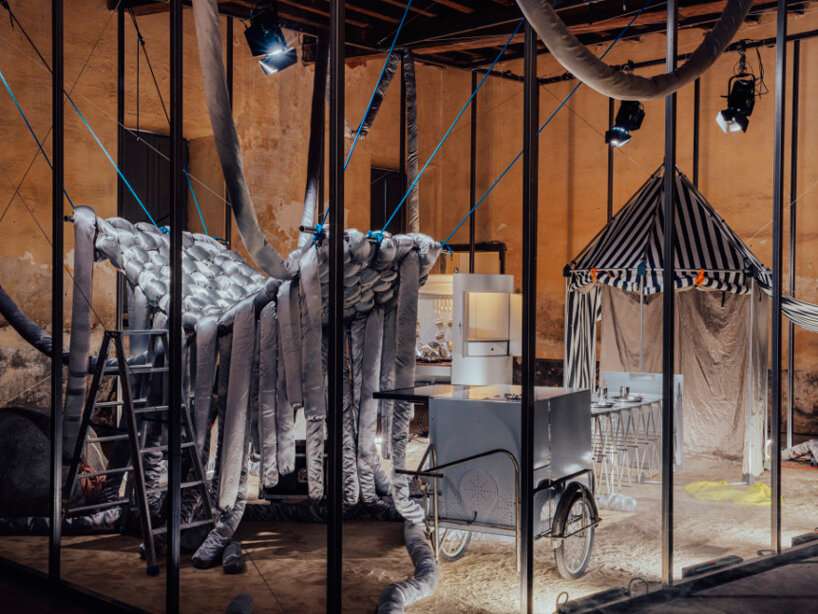
Designed by MAIA students of the Department of Interior Architecture, HEAD – Genève, 2084, Diorama of the Future is an architectural speculation on the challenges of the post-Anthropocene era. The scenario deals with the reconstruction of a near future in which some cities are submerged, while others endure extreme conditions, direct consequences of the climate emergency. Amidst this turbulence, a diverse group of human and non-human explorers parachutes into 2084, facing the challenge of survival and reconstruction.

Showcased at Milan Design Week 2024, the installation transforms parts of the historic annexes of Villa Bagatti Valsecchi into a dynamic and performative diorama inviting visitors to reflect on contemporary environmental and societal dilemmas. While 19th-century dioramas presented romanticized visions of exotic natures behind glass screens that detached visitors from their complexities, Diorama of the Future inserts visitors right in front of damaged environments, calling for new ecosystemic actions. Within this large device, students take on the role of inhabitants of this changing vivarium, whose evolution problematizes the relationship between representation, agency, and climate change.
2084 diorama of the future installation milan design week 2024
all images by Raphaelle Mueller

The camp, the Nap, and the Treat outline 2084’s scenery

Three projects developed by MAIA students of the Department of Interior Architecture, HEAD – Genève, inhabit the installation.

First, the Camp. The torrential rain, the increased exposure to various waves, and, above all, the scorching sun forced them to come up with a tent that was as protective as it was transportable. A ‘Swiss Army knife’ box unfolds into a space dedicated to celebration. A multi-purpose shape conceals the long table on which glasses, plates, and tools clash. The tent is made from shaped anodized aluminum tubes, with a two-layer fabric: aluminum to protect against waves, and black and white striped fabric to protect against water and rain. The trolley is based on a hijacked bicycle trolley, body in heat-welded aluminum, CNC cut, solar panel.

Second, the Nap. A large nomadic bed that could withstand the scorching rays of the sun during the day and sleep anywhere at night. The Nap is a succession of sheaths made from anti-radiation fabric filled with cotton insulation, spherical polycarbonate lamps, ropes, and steel tubes.

Last, the Treat. This ironic rocket was thought up as a kitchen drone by the food giants of the 2080s under the title ‘The Pleasure of Giving.’ The Treat comprises of a cupboard made from solid-stained MDF, covered with anodized aluminum sheets, chromed steel legs, marble, oak, and a hob.

2084 diorama of the future installation milan design week 2024
2084: A Diorama of the Future by MAIA students of HEAD – Genève was presented at Milan Design Week 2024

2084 diorama of the future installation milan design week 2024
the installation explores post-Anthropocene challenges such as climate-induced extreme conditions

installation by head–genève envisions post-anthropocene landscapes at milan design week
the Treat, an ironic kitchen drone, was designed as a futuristic cooking device by 2080s food giants

installation by head–genève envisions post-anthropocene landscapes at milan design week
the Treat features a combination of solid-stained MDF, anodized aluminum, chromed steel, marble, and oak
Similar Posts

  • Classy Sapphire Kitchen: Navy Blue and Brass Revitalizes Traditional Shaker Kitchen

    There are few colors that are trendy for a season or two before they quickly fall down the trends chart once again. Then there are colors that are perennial popular – those that seem to cut across styles, trends and even eras as they appeal to almost everyone. Blue definitely falls in the latter category […]

    You’re reading Classy Sapphire Kitchen: Navy Blue and Brass Revitalizes Traditional Shaker Kitchen, originally posted on Decoist. If you enjoyed this post, be sure to follow Decoist on Twitter, Facebook and Pinterest.

  • Good Haus

    The Good Haus celebrates the intersection between design and performance – and seeks to be an example of a “good house”. The house is the family home of principals Mela Breen and David Good (designer and builder) – and playfully gets it’s moniker from Dave’s last name. So what is our idea of a good house? In this case it is one that is pushing the possibilities of a site specific design while holding itself accountable to reaching the highest level of energy efficiency. Our good house is one that embodies our beliefs about resiliency, efficiency, health and comfort, beauty and playfulness. The DNA for the Good Haus is established by the site, a steep and rocky hillside that spills down onto a small neighboring foothill meadow. A limited buildable footprint, season drainage concerns, and an inviting flat outcrop of granite drove the initial design. Two intersecting geometric volumes were conceived, each reaching out to connect the building to the landscape, each intersecting the other and providing counter balance. The main first floor volume is a long south facing rectangle that stretches and anchors in the granite. A deep west facing porch protects the house from overheating, bridges a rocky drainage and links the open floor plan to the landscape with a large outdoor living space. The second floor volume runs perpendicular to the main living space and cantilevers to create a covered north entry, while a balcony on the south side cantilevers towards the oak canopy – creating a sense that the master bedroom is in a tree house. The exterior material pallet is in keeping with our love for the handmade modern. Cedar siding from trees grown on Mela’s childhood property and milled by her father is mixed with standing seam metal roofing that turns downing to clad the walls as a way to articulate the building form. Because the topography falls roughly 12’ over the relatively narrow width of the house, and the granite spine to the west hinted at what might lay below the soils (giant boulders and bedrock), we opted to build the first floor primarily on a steel pier and beam structure with a metal pan deck. This allows the building to float above the rocky drainage. The complexity of the design, with its cantilevers and steel deck foundation, require a heightened attention to the air sealing and insulation details. The super insulated, air-tight building envelope is wrapped in exterior Rockwool insulation, all the connections between interior and exterior structural members are meticulously detailed to avoid thermal bridges, and triple pane European windows and doors are used to maximize light, comfort, and performance. A CO2 heat pump water heater provides the most efficient domestic hot water delivery. Balanced heat recovery ventilation offers high indoor air quality and uniform temperature distribution. Indoor climate control is provided by super efficient ductless mini splits. A 6.5 kw roof mounted photovoltaic system is installed to offset the home’s energy usage (including the charging of an electric car) – creating a zero net energy building.

  • Beach Bungalow on Gulf Coast of Texas Brings Luxury to Coastal Style

    Luxury and beach style rolled into one – the Beach Bungalow in Galveston, Texas offers the best of both worlds without ever trying too hard. Designed by Mark Ashby Design, the spacious multi-level family home in Texas embraces a look that combines modernity, comfort and beach style seamlessly. You can see a certain ‘Texan’ charm […]

    You’re reading Beach Bungalow on Gulf Coast of Texas Brings Luxury to Coastal Style, originally posted on Decoist. If you enjoyed this post, be sure to follow Decoist on Twitter, Facebook and Pinterest.