|

Living Room Design Trends 2025

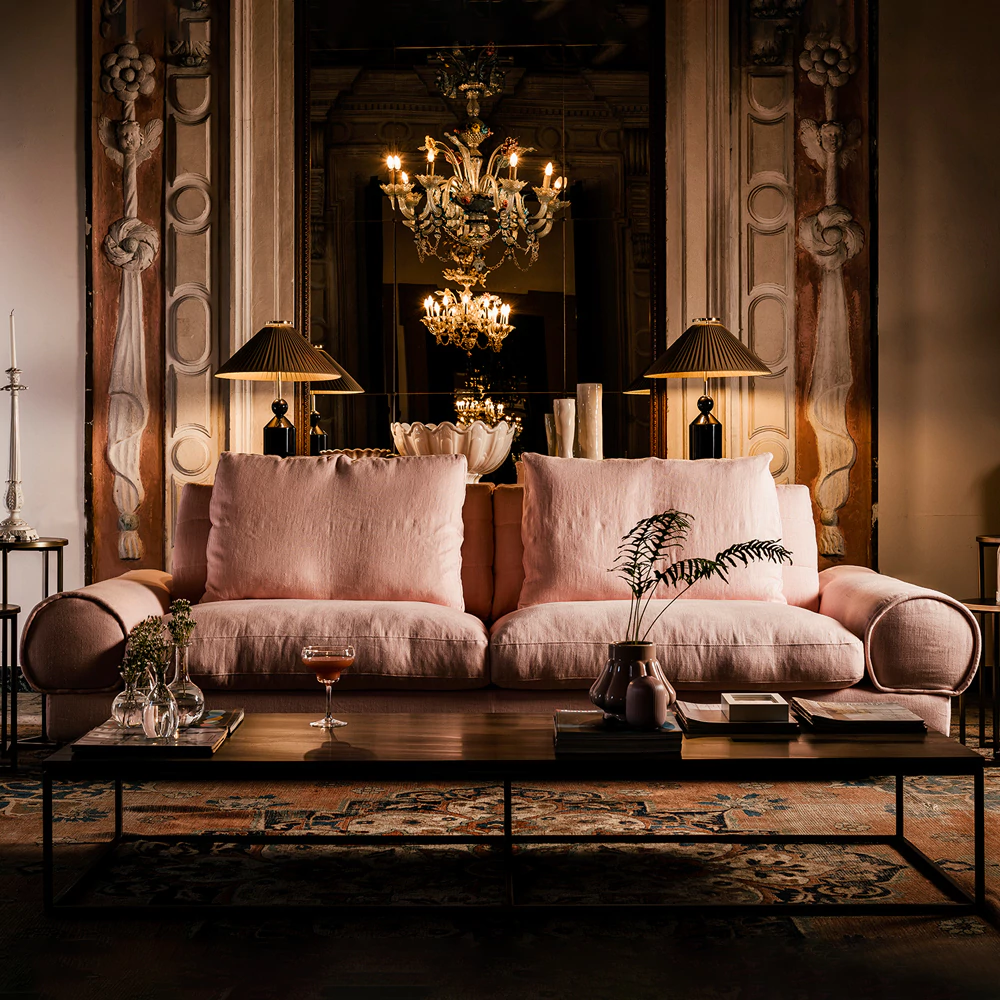
Contemporary Retro Designer Linen Sofa living room design trends 2025Contemporary Retro Designer Linen Sofa living room design trends 2025

The living room is arguably the heart of the home, it’s a multi-purpose space used by everyone, in a multitude of ways. To help you stay ahead of the curve, we’ve crafted our guide to luxury living room design trends 2025. These emerging trends are perfect for keeping your space stylish and on-trend from autumn/winter 2024 well into 2025. Today we’re looking at rising trends we’re seeing in interiors, that transcend the fleeting styles and innovations. Whether you’re an Interior Designer, Property Developer, Architect or interior design enthusiast with a penchant for superior style and quality, we’ve put together our top living room interior design trends that will captivate and inspire you. From creative concepts that fuse styles to luxury living experiences, all encapsulated in the design of your sitting room.

Beautilities Trend

The “Beautilities” trend for 2025 is all about creating beautiful and functional spaces. Living spaces that promote pleasure and wellness, with a leaning towards sensorial environments engaging more of our senses, than just pleasing the eye. In 2025, comfort is king (or queen) when it comes to designing your sitting room. With a huge focus on furniture that envelops you in comfort, the emphasis is on creating an inviting atmosphere where you can truly relax and feel at home. Imagine pieces that offer not just functionality but also a sense of warmth and security. From plush sofas that you can sink into, to armchairs that embrace you with their soft and supportive cushions.

Elegance in Curves: The New Shape of Comfort

Comfort doesn’t mean you have to sacrifice style. 2025 living room design trends are all about creating spaces that encourage socialising and connecting with friends, to creating personal spaces like a cosy nook perfect for reading a good book, and for everything else in between. Sofa design is paramount to creating an inviting, aesthetically pleasing environment that enhances your living space. Curved and soft designs are at the forefront of this trend, offering a harmonious blend of elegance and diaphanous comfort, enveloping you in a cloud-like embrace. By integrating soft curved lines, plump cosy and comforting elements, your living room becomes a sanctuary, a perfect retreat from the hustle and bustle of daily life.

Tactile Textures

Luxury finishes are arguably never out of fashion, but tactile textures are becoming ever more popular. Engaging our senses beyond just what the eyes see, creating a sensory environment. Tactile textures play a crucial role in sensory living. Elevating the experience of a space through materials like linen, leather, silk and velvet. Furthermore, these luxurious fabrics and finishes not only add visual appeal but also enhance the sense of touch, making every interaction with your furniture a delight. Whether it’s the cool smoothness of leather, the soft elegance of velvet, or the natural warmth of linen these textures create a multi-sensory living room environment that promotes relaxation and wellbeing.

Smell and home fragrance are integral to sensory room design, adding an often-overlooked dimension to creating a welcoming and comforting environment. When combined with tactile textures they transform a space into a truly immersive experience. The right scent can evoke feelings of relaxation, invigoration, or nostalgia, perfectly complementing the physical sensations of the materials in your home. Together, these elements create a harmonious multi-sensory living experience that activates mind, body and soul and enhances the overall ambiance of your living room.

Beauty in Utility: Functional Furniture for Everyday Living

So, functional doesn’t scream beauty but you don’t have to one or the other. Great design should enhance your living environment and enrich your day to day by being functional as well as beautiful. Smart storage is a great way to keep your living room looking amazing, free of unnecessary clutter ensuring a serene and organised environment where style and functionality coexist seamlessly. For example, in 2025, hidden storage in the form of storage coffee tables and even chaise longues with hidden storage, epitomise the pinnacle of functional beauty for living rooms, providing ample space to stow away everyday items while maintaining an elegant aesthetic. Whether featuring hidden compartments, sleek drawers, or multi-tiered surfaces, these multi-tasking marvels enhance the room’s decor and ensure a tidy, create a focal point and keep your living room organised.

Minimalist Maximalism

A trend that offers the best of both world. Minimal maximalism is the harmonious blend of the open, airy feel of minimalism with the vibrant, expressive character of maximalism. This design approach creates spaces that are both uncluttered and full of personality. Striking a perfect balance between simplicity and richness. Imagine a lounge design that embraces clean lines and ample negative space while incorporating bold, eclectic elements that add depth and intrigue. Maximal minimalism allows for a curated selection of standout pieces and striking decor, ensuring that each item contributes to the overall aesthetic without overwhelming the senses. This fusion of styles results in environments that are serene yet dynamic.

Pops of colour – 2025 isn’t moving away from neutrals, but it’s embracing vibrant accents of colour throughout. Adding bespoke focal pieces, bold hues that energise and create visually captivating. Key colours and tones for autumn winter 2024 and for 2025 are warm earthy hues, terracotta, clay and coral. Through to serene natural greens like rich emerald and verdant sea shades. However, you will need to ground these maximalist accents with 2025 minimalism. Beautifully balancing them with warm beige tones, light wood finishes, and an abundance of textiles. This approach harmonises bold, expressive elements with simple geometric shapes and clean lines, creating a sophisticated and inviting space. Encompassing a palette of earthy hues and incorporating natural materials like wood, marble and stone. This trend ensures that even the most dynamic features feel rooted and cohesive.

Vintage Vibes: Infusing Retro Glamour into Contemporary Spaces

This fusion of styles and aesthetics continues and is ever more prevalent in interior design for 2025. Modern eclecticism is a sophisticated fusion of contemporary accents and vintage furniture. Combining period pieces, minimalist design, and artisanal craftsmanship. Less, is more, when it comes to seamlessly infusing subtle retro notes into your interior. Only a few carefully chosen bespoke pieces, that showcase the skill of craftsmanship, are needed to create a harmonious balance. Bringing retro glamour into the heart of contemporary living spaces.

In 2025, living room design trends are all about fusion, to create living experiences that meet the needs of modern living and help prioritise wellness and comfort. Artfully blending maximal, minimal, modern and retro to create multi-functional, multi-sensory living rooms. Spaces that are inviting, enticing, stimulating and perfectly suited for modern living.

Experts in Bespoke Furniture Design and Manufacture

Luxury living room furniture is rarely “off the rack’; true elegance demands bespoke creations tailored to your unique style and specifications. With over two decades of expertise in bespoke furniture design and manufacture, Juliettes Interiors leads the industry. By using cutting-edge technology such as AI furniture design to turn your vision into reality, providing unparalleled luxury with custom-designed furniture. Our master artisans and designers meticulously craft pieces that are both exquisite and uniquely yours. Our award-winning interior designers, recognised both in the UK and internationally for their luxury high-end residential designs, are here to help. Get in touch or visit our showroom in London Chelsea and let us help bring your vision to life.
Similar Posts

  • Dark, Dashing and Full of Surprises: Ravishing Artist’s Apartment in Kyiv

    Modern apartment are spaces that are often filled with neutral hues and you have a curated blend of color and style in here. Most often it is white, light grays and beige that fashion the backdrop and there is no shortage of bright hues in here as well. But this Artist’s Apartment in Kyiv, Ukraine […]

    You’re reading Dark, Dashing and Full of Surprises: Ravishing Artist’s Apartment in Kyiv, originally posted on Decoist. If you enjoyed this post, be sure to follow Decoist on Twitter, Facebook and Pinterest.

  • Messner: A childhood dream comes true

    At the foot of the Sciliar, in the picturesque area of Alpe di Siusi (Bolzano), the spirit
    of a barn is reborn as a home. The project, realised by noa* (network of architecture), has
    at its core, the South Tyrolean tradition combined with surprising features internally,
    resulting from design of visionary and unexpected spaces. An almost magical ambience is
    created, inspired by childhood memories. Keep tradition in mind, but at the same time move away so as to create an original
    identity, a new way of living, a different structuring of the domestic space, and to search
    inspiration from a childhood passed in the mountains. This, in summary, was the challenge
    faced by noa* in the project to construct a new home at Siusi in Sciliar, a construction to
    take the place of a deserted house in the centre of the village, with the original
    structure dating back to 1850. The job, completed in 2017, needs to be understood in its complex and delicate context. We
    are talking about South Tyrol, and a project executed at a height of 1100 a.s.l. at the
    foot of Alpe di Siusi, a part of the Dolomites recognised as a Unesco World Heritage due to
    its outstanding natural beauty. It was therefore extremely important to respect the
    parameters of the original structure and the urban planning requirements and regulations of
    the village. For Stefan Rier, founder, together with Lukas Rungger of the noa* studio, and
    in this instance ‘his own client’, the project was an opportunity to give a personal
    footprint to his own property. In this sense there was a move away from the traditional
    principles of spatial distribution, this being achieved in part by recalling memories of a
    childhood spent in the mountains. “We wanted the project to respect the aesthetics and the urban aspects of the village, a
    village where wooden barns alternate with plaster-fronted houses destined for farmers and
    the keeping of cattle.”, explains architect Rier. “With this in mind, we finished the
    exterior structure with a ‘coating’ in keeping with tradition: a wooden grid on all 4
    sides, just as is used for alpine barns. However, as far as the interior is concerned, I
    decided to leave tradition behind me, and thereby free the design from any preconceived
    limitations. In this way I was able to look forward…but also a little back in time to the
    beautiful years of my childhood”. The outcome of the project is a dwelling, having two aspects which confront each other in
    their style. The exterior represents the traditional alpine location, splendidly immersed
    in the local topography, whilst the interior boasts the visionary impulse, the surprise of
    a space freed from the general scheme of things, almost permeable, osmotic, and certainly
    innovative. On the ground floor there is a common area which spreads out almost in a ‘piazza’ fashion
    for (habitational)and interactional use: there is a dining table to enjoy with friends, an
    ample sized kitchen to accommodate more than one cook! The rest of the house develops in a
    vertical way and instead of the classical room division there are what can be described as
    ‘hanging boxes’, which are positioned at different heights and interconnected by stairs and
    walkways – they giving the sensation of walking up a mountain path towards the peak. The
    hallways are carefully designed so that, apart from their connecting function, they
    accommodate other essential areas such as the library and open ‘bathroom’ areas with tubs
    and showers (only the WC are closed in). The entire structure is conceived in a way that
    the further one goes up the level of privacy and intimacy is heightened. The highest ‘box’
    which features a sauna opens out to the splendid view of the Santner mountain. The revolutionary distribution of the interior spaces can be noted also from the exterior,
    and a sort of counterpoint is created with the traditional presentation of the exterior
    itself. To the north the two boxes of the bedrooms, finished in bronze, can be seen behind
    the wooden trellis shell, and as a result the material contrast is evident, while to the
    south it is sauna box which protrudes the glass facade. It is an architectural concept, both extremely innovative and courageous in nature, but
    which also has the value of being able to evoke an atmosphere of time past. Viewing the
    structure from a distance, the larch framework which supports the hanging boxes with its
    roof supported by 12 metre high wooden columns, seems to be the outline of an old barn. “Thinking about it, I spent a lot of my childhood playing in barns”, underlines Stefan
    Rier, “and one of my lasting and favourite memories is of when I used to climb high up in
    the barns and then throw myself down into the hay. Maybe if I had not had that experience,
    I would never have come to design this house …”. THE STRUCTURE: A DIALOGUE BETWEEN TIME PAST AND TIME PRESENT
    The house mirrors the construction type of the location’s rural buildings. On the stone
    foundation (10x8m), is a wooden structure in larch on three levels, and which supports the
    gable roof, typical of the village’s dwellings. A wooden trellis covers the whole house in
    a shell-like manner, screening the light and heat of the sun in the hotter periods, and as
    a whole it is suggestive of the typical structures of alpine barns. Two boxes, one in
    bronze and one a glass structure ‘peak out’ from the trellis, to the north and south
    respectively, and so revealing to the exterior that there is something complex to the
    interior layout. To the south there is a glass facade and a terrace which opens out to the
    magnificent view over the landscape of the Dolomites, a view which is dominated by the
    splendid sight of the Sciliar massif. THE INTERIOR SPACES: A STATIC CHALLENGE
    Inside the house, the distribution of spaces and functions is really unusual. The ‘boxes’
    which house the three bedrooms are supported by the wooden beam structure, visible in its
    totality (12 metres high). The bedrooms are designed as micro-homes, each one having its
    own particular design, these boxes seem to almost ‘hang’ in the ample volume of the
    interior (1,100 cubic metres). One gains access via a staircase and a walkway system, which
    as well as having a connecting function, accommodate the ‘bathroom’ areas with tubs and
    showers (only the WC are closed in). On the last floor, a box plays host to the sauna with
    a panoramic view, extending out of the southern front. Preceding the sauna, there is a
    book-lounge with an antique majolica stove, which has been taken from the pre-existing
    building. The library together with a cloakroom area complete the private spaces on the
    higher levels.
    The ground floor is a large open space with three diverse ‘island’ functions: the
    relaxation area, the dining area, and the kitchen, resolved with a large working surface
    feature in natural brass, and decorated on the sides with artisan earthenware tiles. MATERIALS
    As well as incorporating materials having a local tradition – wood and stone – the project
    introduces others of a more contemporary nature, in some cases recalling a Mediterranean
    style. The floor resin, giving uniformity to the ground floor appearance, alternates
    between baked clay and sea-blue tiles, the same as used for the side covering of the
    kitchen’s work surface. The brass gives brilliant warm tones to the furniture details and
    to the work surface which also incorporates the cooking essentials and sink. The staircase,
    in finely worked steel recalls the grates of Arabian tradition, creating a chiaroscuro
    effect which is extremely unusual for the Alpine environment. Furniture and Cloth
    The furniture has all been produced to design specification, adhering to a zero-kilometre
    regime. Attention to detail has been scrupulous, as has the search for original solutions
    from both a formal and functional stance. Cloth chosen plays an intricate game with wood in creating an atmosphere almost theatrical
    in kind. Flowing blue drapes act almost as stage curtains in enclosing various spaces and
    giving different and new perspectives. There has also been a coming together of texture and
    décor for the box-like bedrooms, this evident even in the wallpaper in blue tones, and so
    creating a functional soundproofing barrier. Light
    The project strives to make the most of natural light: to the south the facade is a
    complete glass construction, the light being filtered by the external wooden grid
    positioned at 2.5 metres from the principal structure, whilst the jutting out roof shades
    protect the interior from the extreme heat of the summer months. On the roof, a skylight
    opens to the east providing another source of light. To the north there are windows.
    As for internal lighting, in the very high living area, there are suspension lights to
    guarantee sufficient light and in particular for the specific functional areas (dining and
    kitchen areas). Many of the lamps in the house have been design created.