Recyclable textiles over streetlights form an urban canopy
Located at Bangkok City Hall Square in the Phra Nakhon district, High Line Bangkok is a temporary public installation by HAS Design and Research that reconsiders the role of urban infrastructure within the public realm. Developed by architects Jenchieh Hung and Kulthida Songkittipakdee, the project uses existing streetlight poles as its primary structural framework, transforming them into a shaded civic space that supports gathering, circulation, and public occupation.
The intervention addresses a common condition within Thailand’s urban environment, where millions of streetlights serve functional purposes but rarely contribute to broader social or spatial activity. High Line Bangkok proposes an alternative approach by integrating recyclable Thai fabrics with existing infrastructure to create a lightweight architectural canopy that combines shading, ventilation, and spatial definition without introducing permanent construction or additional foundations.
Installed at Lan Khon Mueang Town Square, opposite the Bangkok Metropolitan Administration headquarters and adjacent to Wat Suthat Thepwararam, the project responds to the climatic conditions that shape public behavior in tropical cities. Site observations identified a shift in patterns of occupation throughout the day: during periods of intense heat, activity concentrates beneath tree canopies, while in the evening, cooler temperatures draw people toward illuminated areas surrounding streetlights.
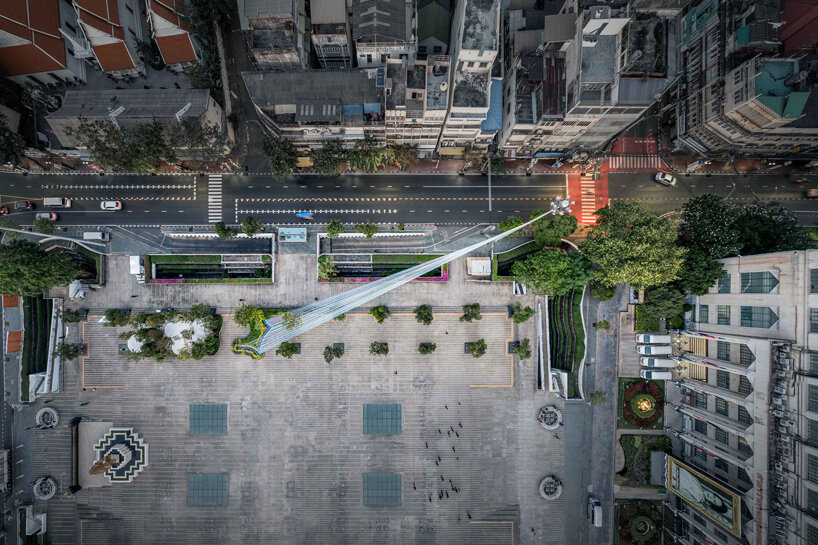
more than 100 meters of Thai fabric intentionally bent to form a pipe-like curve | all images by DOF SkyGround
Curved fabrics create a shifting canopy between day and night
The design connects these two environmental conditions by linking lighting poles and existing trees through a suspended textile structure. In doing so, HAS design and research studio establishes a continuous spatial system that brings together infrastructure, vegetation, shade, and light. Existing streetlights are repurposed as structural supports, reducing material consumption while demonstrating how everyday urban elements can be adapted for public use.
More than 100 meters of locally recyclable Thai fabric are arranged in curved, tubular forms that extend between poles and trees across the plaza. During daylight hours, the installation filters sunlight through colored surfaces, generating areas of shade and introducing changing patterns of light across the ground plane. The resulting canopy creates a semi-outdoor environment that encourages occupation throughout the day. After dark, the textile elements interact with the existing lighting infrastructure, diffusing and amplifying illumination across the square. The installation shifts from a shading device to a luminous architectural element, extending the role of the pavilion beyond daytime use and reinforcing the relationship between light, public activity, and urban space.
The geometry of the structure references architectural features of the adjacent Wat Suthat Thepwararam. Angular forms draw from the profile of the temple roof, while fish-scale patterns incorporated into the ground treatment reference traditional roof tiles. These elements introduce local cultural references within a contemporary architectural framework.
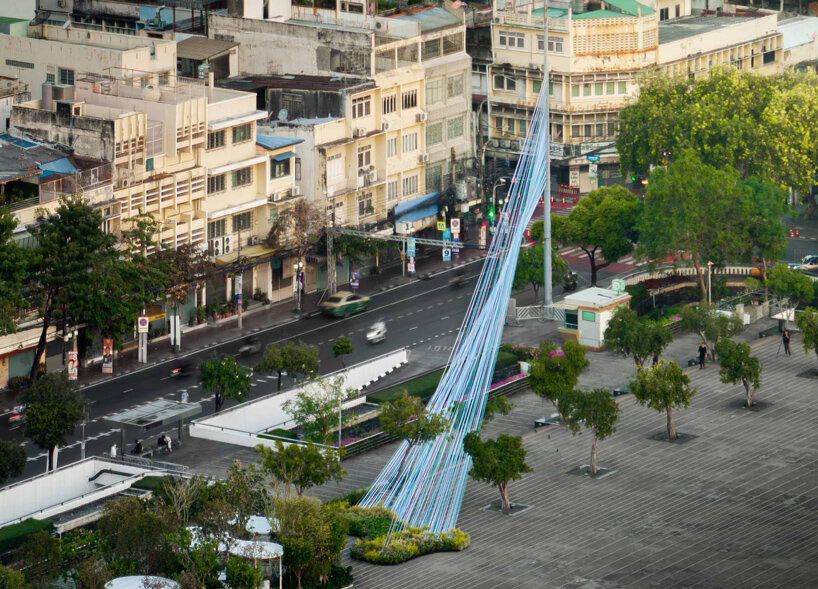
the flat concrete ground rises to connect with the urban infrastructure
High Line Bangkok functions as both a site-specific installation and a broader exploration of how existing infrastructure can support public life. By adapting streetlights into a spatial framework for shade, gathering, and environmental comfort, the project examines the relationship between tropical urban conditions, sustainability, and civic space. The intervention proposes a model through which existing infrastructural networks can be reconsidered as active components of the public realm rather than solely technical utilities.
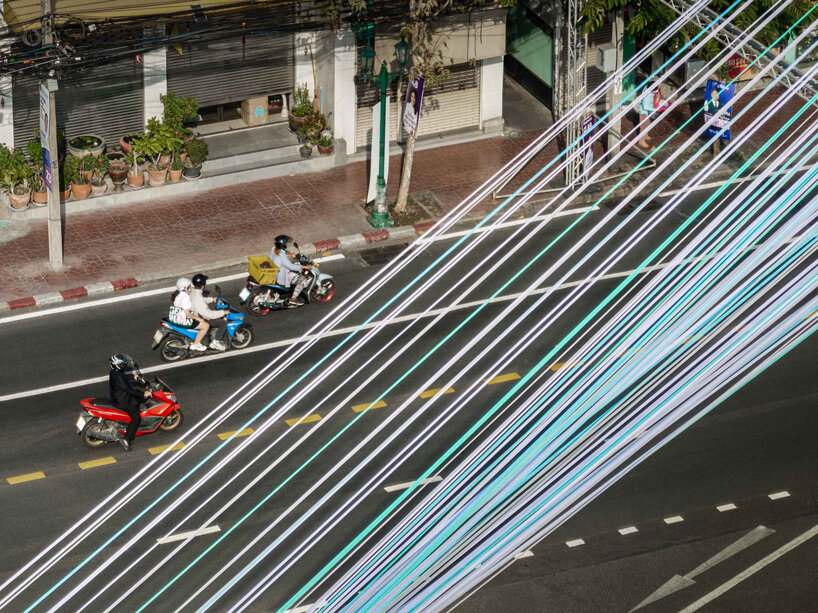
the temporary public installation blends with Bangkok city lifestyle
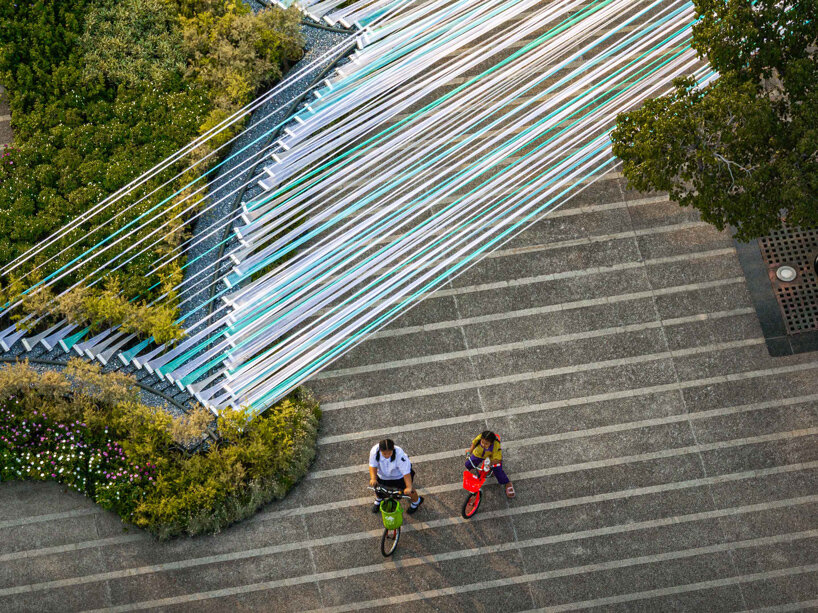
the architecture has been transformed into a playground for children
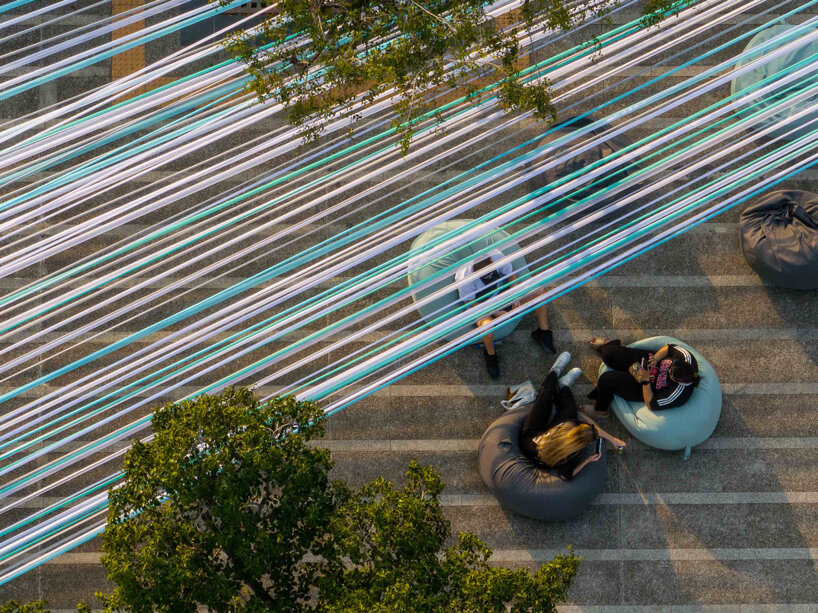
new shading and gathering space under the electric light post