|

red bivouac shelter in the alps becomes high-altitude base for bergamo’s modern art gallery

Aldo Frattini Bivouac: high-altitude base for GAMeC in Orobie Alps

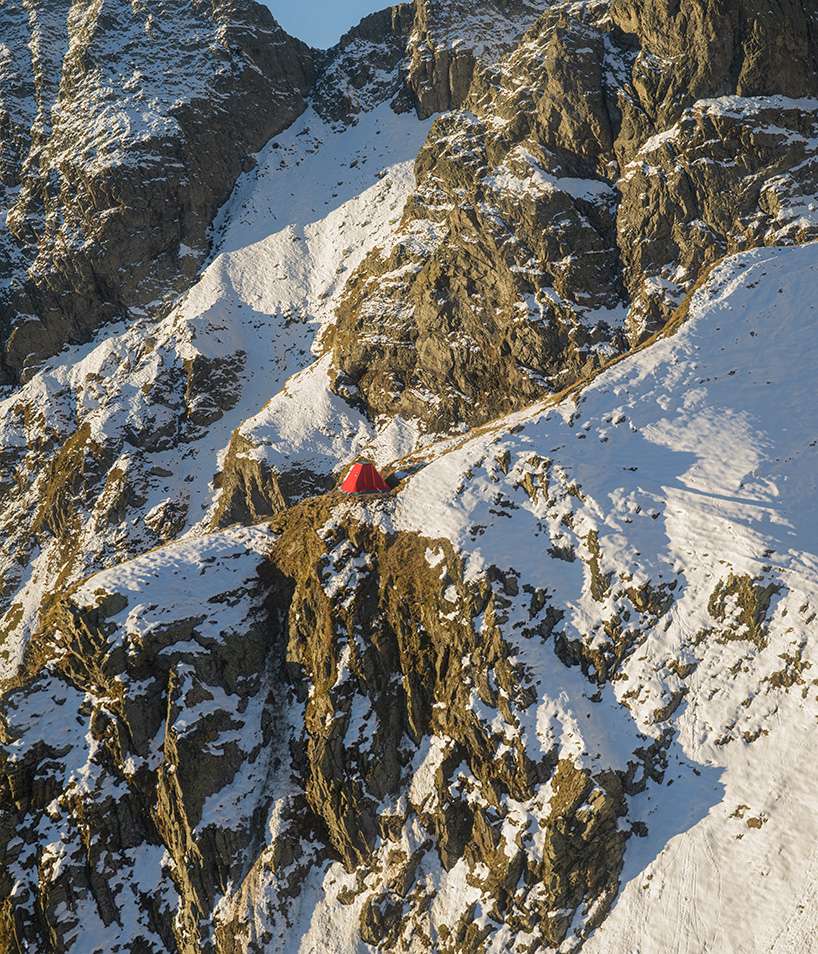
GAMeC – Galleria d’Arte Moderna e Contemporanea di Bergamo and the Bergamo Section of the Italian Alpine Club (CAI) unveil the new Aldo Frattini Bivouac, designed by EX. for The Orobie Biennial: Thinking Like a Mountain. Located at around 2,300 meters above sea level along the Alta Via delle Orobie Bergamasche in Val Seriana, Bergamo, Italy, the structure acts as both a mountain refuge and a cultural outpost. It is not conceived as a gallery or exhibition space but as a permanent shelter that offers a place of protection and rest, while establishing a dialogue between architecture, landscape, and contemporary culture.

The project is part of a wider exploration of the relationship between art, territory, and ecological systems. Developed with the support of Fondazione Cariplo and Fondazione della Comunità Bergamasca, the bivouac extends GAMeC’s cultural network into the alpine environment, proposing architecture as a medium of presence and observation rather than display.
red bivouac shelter in the alps becomes high-altitude base for bergamo's modern art gallery
all images by Tomaso Clavarino, courtesy of GAMeC – Galleria d’Arte Moderna e Contemporanea di Bergamo

a Lightweight, Reversible refuge Engineered for Alpine Conditions

Designed by EX., a design laboratory founded by Andrea Cassi and Michele Versaci working at the intersection of architecture, landscape, and technology, the bivouac adopts a lightweight and reversible construction system intended for minimal environmental impact. Its form recalls a classic alpine tent, referencing early mountaineering structures while integrating contemporary engineering and materials.

Developed in collaboration with Ferrino, a company known for outdoor equipment, the shelter features a technical textile skin engineered to withstand severe weather conditions. The structure is among the first permanent textile-based emergency shelters in an alpine setting, an experimental prototype combining sustainability, rapid assembly, and spatial efficiency. Weighing approximately 2,500 kilograms and occupying a footprint of around 2.5 sqm, the bivouac is compact (3.75 × 2.60 × 2.60 m) and optimized for ease of installation in remote contexts. The interior is lined with natural cork, offering thermal and acoustic insulation while maintaining a warm, tactile environment.

red bivouac shelter in the alps becomes high-altitude base for bergamo's modern art gallery
Aldo Frattini Bivouac sits at 2,300 meters in the Orobie Alps of northern Italy

Dual-Function Shelter: Refuge and Environmental Observatory

The layout accommodates up to nine people, with perimeter benches and foldable beds inspired by climbing portaledges that can also serve as emergency stretchers. This dual-purpose design underscores the bivouac’s functional flexibility as both a place of refuge and a survival station. A skylight and two porthole windows introduce natural light, while the cork surfaces and contained acoustics create a calm, introspective atmosphere. The design references Shelter (1973) by Lloyd Kahn and Bob Easton, a study of self-built and temporary dwellings, and applies the ‘shearing layers’ theory by Stewart Brand and Frank Duffy, viewing architecture as a dynamic system capable of adaptation.

Beyond its role as a refuge, the Aldo Frattini Bivouac also functions as a scientific monitoring station. Integrated sensors collect environmental data on local climatic and ecological conditions, transmitting real-time information to GAMeC’s headquarters in Bergamo. Through this dual function, as both a shelter and an environmental observatory, the project redefines the idea of permanence in high-altitude architecture. It proposes a form of construction that listens to the landscape rather than imposing upon it, aligning with Thinking Like a Mountain’s broader exploration of sustainability, cultural presence, and the fragile balance between human activity and the natural environment.

red bivouac shelter in the alps becomes high-altitude base for bergamo's modern art gallery
designed by EX. for The Orobie Biennial, the structure bridges art, architecture, and landscape

red bivouac shelter in the alps becomes high-altitude base for bergamo's modern art gallery
the bivouac acts as both mountain refuge and cultural outpost for GAMeC

red bivouac shelter in the alps becomes high-altitude base for bergamo's modern art gallery
the camp extends Bergamo’s contemporary art museum network into the alpine terrain
Similar Posts

  • Sofa Bed Solutions for Design Lovers

    A sofa bed has the power to add both seating and sleeping space to your interior. Now more than ever, a range of stylish options presents design lovers with solutions for every budget. Are you wondering what differentiates a sofa bed from a sleeper sofa? Today we’re rounding up a collection of diverse pieces, exploring […]

    You’re reading Sofa Bed Solutions for Design Lovers, originally posted on Decoist. If you enjoyed this post, be sure to follow Decoist on Twitter, Facebook and Pinterest.

  • Tesseract House

    A self-initiated, architect-led design-develop-build project, Tesseract house was not designed with a specific client in mind. Rather, it was conceived as a business case to prove that one can create great contemporary architecture that fulfills a demand in the marketplace, while demonstrating that unbridled creativity generates innovative and artful spaces, using conventional and readily available construction methods. All of this was accomplished without breaking the bank and with a typical budget for a house of this kind Located in Toronto’s western lakeside streetcar suburb, this single-family residence proves contextual while owing little to convention and serving as the antithesis to recent vernaculars. By simply and unconventionally engaging the immediate context this contemporary alternative has an impactful, yet unimposing outward presence. This geometry and the depth of experience from which the house derives its name is not provocatively innovative but nuanced, both simple and complex, revealing itself over time. All of this within the constraints of conventional local residential construction, the Tesseract House unapologetically desires to be more than just a place to live.

  • Creek House

    Set amidst a volcanic boulder field in a pine and fir forest, Creek House is a family retreat that inhabits an existing outcrop clearing at the edge of the spring fed Martis Creek. Near the base of Lookout Mountain at Northstar California Resort, the house is conceived in plan as three directional bars that slide between and alongside the boulders and trees. The largest contains the main living areas and sleeping quarters. A margin sized bar houses the entry and support spaces and connects the third bar that contains a tandem, drive-through garage to the house. A south facing, 140-foot long, insulated concrete wall demarks the spaces longitudinally and situates the house in the mountainous terrain.   A shift of the major bar to the west over the natural downslope of the site earns two requested rock gardens. The garden to the east is open to the sky and built into the void left by the displacement, with building height concrete walls retained to provide privacy for the master bedroom.  The gravel surface, set with site native basalt stones and framed with water, can be viewed only through a low, three-dimensional glass box that allows the garden to penetrate the room. A rectangular basin captures snow melt to create a protective and ephemeral pool of water around this most private area of the house. The second garden to the west lives under the cantilevered house that shields the lower level from the west sun and contains the largest boulders of the site. A glazed hallway floor above reveals a dramatic drop in the topography and car sized boulders. At the top of the slope, the one-story horizontal form presents a closed and secure face to the northwestern street exposure. Fire resistive steel rain screens and tempered glazing inhabit the territories earned by the concrete wall. The mass heavy house is designed as a long thin rectangle that faces the sun to maximize solar exposure during winter and minimize heat gain from the west and east in summer. The house is cooled by prevailing breezes that flow up and through the house from the west. Radiantly heated bluestone floors, solar assisted domestic hot water and LED electric light further reduce energy demands.