|

tattoo atelier and residence merge within angular casa T sculpted by SSAA in bangkok

Casa T: a dual-purpose home for a tattoo artist in Bangkok

Located on a trapezoidal site in a medium-density suburb west of Bangkok, Casa T is a dual-purpose residence designed by SSAA for a tattoo artist. The project integrates two distinct programs within a single structure: a working atelier and a private family home.

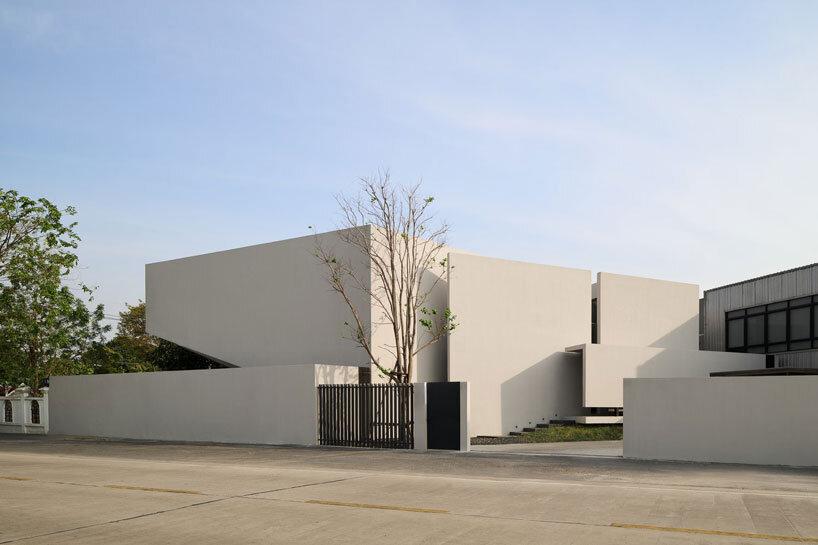
Set on a trapezoidal site, the design turns its angular facade toward the adjacent main road, providing a visual and acoustic buffer for the spaces within. The building’s exterior geometry, defined by sharp lines and angular surfaces, draws reference from the precision inherent in tattoo artistry. The massing strategy emphasizes a monolithic form with selective openings toward internal courtyards, introducing daylight and vegetation into the interior spaces.

tattoo atelier and residence merge within angular casa T sculpted by SSAA in bangkok
a street-facing solid facade reveals only a sharp cut | all images by Chakkraphob Sermphasit

SSAA’s design retains privacy while emphasizing visual openness

The atelier occupies the front portion of the house and is accessed via a concealed entrance. A double-height volume serves as the focal point of the workspace, introducing verticality and connecting to an internal courtyard. This spatial configuration allows natural light to penetrate deep into the interior while creating a controlled environment suitable for the nature of the craft. The material palette of the atelier is intentionally dark, drawing on inky tones that reference the artist’s medium, while internal finishes prioritize durability and ease of maintenance.

In contrast, the private residence is accessed separately and organized across two floors. It employs warmer materials and lighter tones, creating a distinct spatial character compared to the atelier. Private courtyards positioned along the plan provide filtered daylight and views of greenery, supporting a calm domestic environment. The layout prioritizes privacy while maintaining visual connections to the outdoors. Circulation between work and living zones is carefully managed to support both separation and proximity, allowing the resident to transition between professional and domestic activities as needed. By using spatial thresholds rather than rigid divisions, Casa T by SSAA architectural practice offers a nuanced balance between these two aspects of daily life.
tattoo atelier and residence merge within angular casa T sculpted by SSAA in bangkok
the project sits on a trapezoidal site in a medium-density suburb west of the city

tattoo atelier and residence merge within angular casa T sculpted by SSAA in bangkok
the entry is hidden behind the monolithic facade

tattoo atelier and residence merge within angular casa T sculpted by SSAA in bangkok
a double-height volume anchors the atelier, bringing natural light and greenery into the space

tattoo atelier and residence merge within angular casa T sculpted by SSAA in bangkok
dark finishes frame a sunken lounge, oriented toward the garden

tattoo atelier and residence merge within angular casa T sculpted by SSAA in bangkok
material contrasts reinforce the distinction between the atelier and the residence

tattoo atelier and residence merge within angular casa T sculpted by SSAA in bangkok
the concealed door sits flush within the dark wall, reinforcing the room’s geometric order

Similar Posts

  • Elephant’s Hill House

    The privileged view of nature was the core starting point for this project on the mountainous region of Nova Lima, State of Minas Gerais/Brazil. An adventurer couple chose us to create this special project in such an exclusive area. At first, the site’s high declivity seemed to be a big challenge, but it was also what inspired us to come up with the implantation’s solution. Exploring its natural landscape and the Elephant’s Hill view, it was possible to set the social floor at the height limit, above the trees. The street facade turned out to be the side elevation and the main facade now faces towards the side boundary. Due to the high declivity of the area, we were able to create a 3 level house. On the ground floor: garage, laundry, and storage. On the first floor, the office was fully integrated with the living room and a guests’ ensuite. Finally, on the second floor, there’s the hosts’ ensuite, with the most privileged view of the landscape. A slight angulation to the east gave us the opportunity to have both the ensuite and the barbecue area to take advantage of the morning sun and the region’s predominant ventilation. At the same time, it helped to protect the ground floor from the sunset light using a concrete wall that blocks the sunlight inside the house. With the major orientation E-W, the house opens to the northern landscape. Extensive eaves on the north view’s perimeter protect the openings of the summer sun, at the same time as the glasses receive the necessary natural heat to naturally warm the inside during the winter.
    We requested that two trees were precisely placed by the topographer in the middle of the elevated deck that connects the house to the suspended heated pool. These also work as a natural filter to the sun’s radiation, minimizing the sun’s entry in the living room and the kitchen. The 25m pool, a client wish, is a fundamental part of the volumetric composition of the house. Sustained by two concrete columns, they elevate the pool 6m above the natural floor level, providing to whom’s inside the pool a view of the treetops and the imponent Elephant’s Hill. With the capacity to generate about 1400kW of energy per month through photovoltaic panels, the house is self-sufficiency on energy, warming the pool water and neutralizing the energy consumption from equipment and artificial lightning.
    Columns and ribbed slab represent the constructive system. The use of apparent concrete in the house’s wall, swimming pool, and slabs bring the timelessness wanted to the project.