This Shape-Shifting Pad in Hong Kong Challenges What You Think of Smart Homes

Sim-Plex Design Studio transforms a tiny apartment into a flexible, four-bedroom home whose Zen-inspired interiors belie high-tech features.

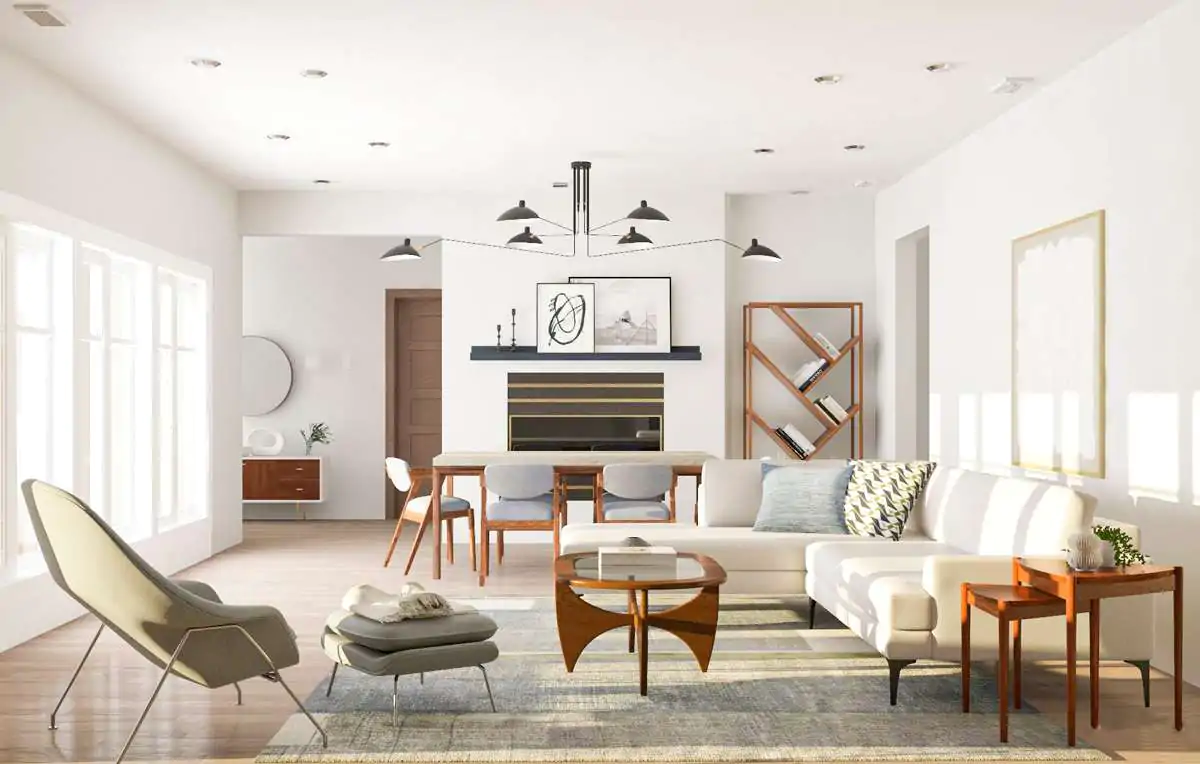
The original living room was converted into an open-plan kitchen and dining area with a living room that can be reconfigured into a bedroom. The use of natural materials and the large windows that flood the space with natural light and frame the views make the small space feel bright and airy.

Hong Kong–based architect Patrick Lam is no stranger to small spaces. He lived in a small tenement apartment in Kowloon for many years, and the experience of living in such a tiny home was the driving force behind his approach to architecture. Today, as the founder of Sim-Plex Design Studio, his focus is on investigating the possibilities to expand limited space. His latest project, an apartment renovation for a young family in Hong Kong, makes the most of its small footprint through a combination of high-tech functionality and Zen philosophy. 

The original living room was converted into an open-plan kitchen and dining area with a living room that can be reconfigured into a bedroom. The use of natural materials and the large windows that flood the space with natural light and frame the views make the small space feel bright and airy.

The original living room was converted into an open-plan kitchen and dining area with a living room that can be reconfigured into a bedroom. The use of natural materials and the large windows that flood the space with natural light and frame the views make the small space feel bright and airy.

Patrick Lam

“We are good at designing transformable space to create flexible, multifunctional and imaginative environments,” says Lam. “Our name—Sim-Plex—is derived from the idea of searching for complexity amongst simplicity. We believe every space can be expanded by finding complex spatial transformations in the simple details of living.”

The living room can be completely separated from the open-plan kitchen by closing the timber-and-glass partition. All high-tech features—including the air conditioning unit—are concealed behind timber panels to create a minimal, uncluttered fit-out.

The living room can be completely separated from the open-plan kitchen by closing the timber-and-glass partition. All high-tech features—including the air conditioning unit—are concealed behind timber panels to create a minimal, uncluttered fit-out.

Patrick Lam

The Smart Zendo apartment is located in Tung Chung, an area on the Northwestern coast of Lantau Island, and has stunning views of the surrounding hills. It takes its name from a zendo—a place for Zen meditation. Lam has used elements from both Zen and Feng Shui design philosophies alongside high-tech, adaptable features to create a harmonious living space that can meet the ever-changing needs of family life. 

The living room and kitchen can be separated with a sliding partition to either create a fourth bedroom or simply divide the spaces if they are both in use.

The living room and kitchen can be separated with a sliding partition to either create a fourth bedroom or simply divide the spaces if they are both in use.

Patrick Lam

See the full story on Dwell.com: This Shape-Shifting Pad in Hong Kong Challenges What You Think of Smart Homes
Related stories:

  • A Community of Eco-Friendly Cottages Pops Up in Massachusetts
  • The Frank Lloyd Wright–Inspired Home in “Mrs. Maisel” Is a Stunner—and it’s for Sale
  • Before & After: An Adirondacks Lake House Escapes its Amorphous Additions

Similar Posts

  • House LV1 (house nanchi 1 y 2)

    CASA LV1 (casa nanchi 1 y 2)
    BRIEF DESCRIPTION OF THE CONSTRUCTION
    The Casa LV1 (casa nanchi 1 and 2), is a multi-familiar conformed by two houses constructed in the same land, the main material used for its construction was white striated concrete.
    DESCRIPTIVE MEMORY
    The Casa LV1 (casa nanchi 1 and 2) is a complex of two houses designed for a family an elderly couple, their young daughter and their granddaughter. Each house has the necessary privacy for each development, with the interrelationship and coexistence of the family; they are located in an irregular diamond-shaped land of approximately 250m2, a gradient over 10% with a view to the southeast.
    The Casa nanchi 1, on its main floor has: living room, dinning room, kitchen, bathroom, main bedroom with closet and its own bathroom, this floor is directly connected with the service area; the lower floor has a hall, two bedrooms with closet and its own bathroom; the upper floor has a roofed recreation room and a garden terrace. All the floors are connected by a stair, and has a parking lot. The total constructed surface is of 160 m2.
    The Casa nanchi 2 has on its main floor: living room, dining room, kitchen, bathroom and service area; on the upper floor it has: main bedroom with closet and its own bathroom, an additional bedroom with closet, a little play room and a bathroom; on the lower floor, where the entrance is, has: two parking lots and an exterior stair which is connected to the other floors. The total constructed surface of the house is 145 m2 excluding parking lots.
    Both houses share main entrance, service yard, green spaces and services.
    The houses are named after the nanchi tree (byrosonimacrassifolia) that is located in that land; it was respected and the project was adapted around it, to make it a natural decoration for the dinning room of the Casa nanchi 1. This house was designed for an elderly couple and it has a terrace in the upper floor, which is a recreational and relaxing space with a view of the surroundings to enjoy with the company of family, friends and guests. It has a double-height space which allows the development of the tree.
    The design of the Casa nanchi 2, which was designed for the daughter and granddaughter of the family, is inspired in the Brno chair, designed by the architect Ludwig Mies van ser Rohe, which not only allows a large volume, but also an efficient and free structural principle because with this solution is obtained an overhang of 4.85 m with a support of 2.85 m, generating a space without any support under the construction.
    The concept of the houses is derogates no only from the connection (interior-familiar, exterior-landscape), but also from the visual freedom that people perceive before entering in the house and also in the interior of them. This is fulfilled by the volumetric integration that defined the spaces of each house, both prisms have specific substractions that allow a formal integration of the two elements; in the Casa nanchi 1 the terrace is subtracted and in the Casa nanchi 2 the parking area is subtracted, transforming both elements without losing its integrity.
    The connection of both houses is so important that is not only achieved materially with the union of the two architectonic objects from the common entrance, connotating the link of the family, but also with the landscape, through the transparency in the facade of the two houses, which creates a visual freedom for the inhabitants. This gives a greater illumination of the spaces, producing a feeling of spaciousness and allows the air circulation due to the large windows that are handled by the users.
    The material, white striated exposed concrete and stone dust of the region, recalls the honesty of the materials, this simplicity benefits the environment, because it doesn’t use coatings in walls, fooors or roofs, contributing the less possible to the pollution. The exposed finishes means less production, transportation and utilization of pollutant materials. As said before, the free circulation of air allows a constant cleaning of the interior air which allows a natural regulation of the temperature, achieving termic comfort for the users and reducing the use of electronic devices that cools artificially the place. Besides, the same large windows avoid the unnecessary use of artificial illumination during the day allowing the entrance of sunlight in the morning.