| |

Top 10 DMTV Milkshake Episodes of 2023

We spoke with Valgora about the legacy and importance of cities in civic life – and about the many projects he’s taken on to make cities stronger, better places. He also talks about how architects will continue to respond to updated, flexible ideas about what a workspace can be, even as he designs a new studio for his own practice: “Offices and residential environments are converging, and we really need to create new kinds of spaces to work in and collaborate,” he says.

kitchen with marble island

Catherine and VW Fowlkes of their eponymous studio are quite the powerhouse duo. They share about what it’s like working in one of the world’s power capitals and what makes DC architecturally unique from other big cities in America. The couple also explain why they can make bolder design decisions in the homes of historically preserved neighborhoods: “From an architectural standpoint, they tend to be a little bit more traditional in the front, and then clients give us license to be a little bit more daring in the back.”

interiors of a glassworks shop

Step into the dreamy, nostalgically sweet world of Helle Mardahl, who’s inspired by           and Charlie & the Chocolate Factory when designing her glass collections. The creative director reminisces about the exact moment that inspired her to create her work and how she now designs for all her senses. “Basically I think the more you can get of that, the more fun you can have, there’s so many layers to it. I’ve always thought like that: The more, the merrier,” she shares.

living room interior

Founding Principal of the LA architectural practice OWIU (Only Way Is Up) Amanda Gunawan is very inspired by the aesthetic culture of Japan: “It’s their passion and their dedication to craftsmanship that really impresses me.” This mindset is what Gunawan caries over to OWIU Goods, her line of ceramic works. She also shares a helpful strategy for trying to get everything done: “I don’t aim for 100 percent. I never do – I [usually] aim for 80%. My work, or my life, is a marathon. And because of that, I kind of have to pace everything out.”

living room with red bookshelf and black table

Lora Appleton is the founder of kinder MODERN, a contemporary and vintage design gallery and design studio that makes and showcases work for children. In this episode, she talks about how her son has taught her new ways of looking at design by seeing how he interacts with the built environment around him. “I thought that was really fascinating – the memory, the + of thinking, all of that really connects with kids in a way that before being a mom, I didn’t really understand,” she explains.

wall shelves filled with ceramics

We step into the ceramicist’s studio in Queens, New York where she creates her highly regarded work: mugs and cups, plates and bowls, and – our favorite – her colorful tiles. Levi talks about her breakthrough moment, a chance encounter with famed retailer Steven Alan. She reflects that “since I had been making pottery for a very long time as a hobby, it kind of lit a little light bulb in me that maybe this was a path that existed.” Levi also shares how she splits her artistic identity between potter and photographer (spoiler alert: she settled on “pot-ographer”).

modern atrium

Like many architects, Aron Himmelfarb has been inspired by Frank Lloyd Wright’s work which has instilled within him a love for a total experience of design, from the blueprints to the window trim. “What’s funny about Wright is that it’s almost unfashionable to appreciate his work – or maybe easy to overlook in contemporary architecture, due to his popularity,” Himmelfarb says. “But as I’ve grown in my practice, I really find myself looking to his work for inspiration a lot more, maybe with a more mature eye.” Also in this episode, the architect expresses a love for work – his own or others’ – that deepens over time.

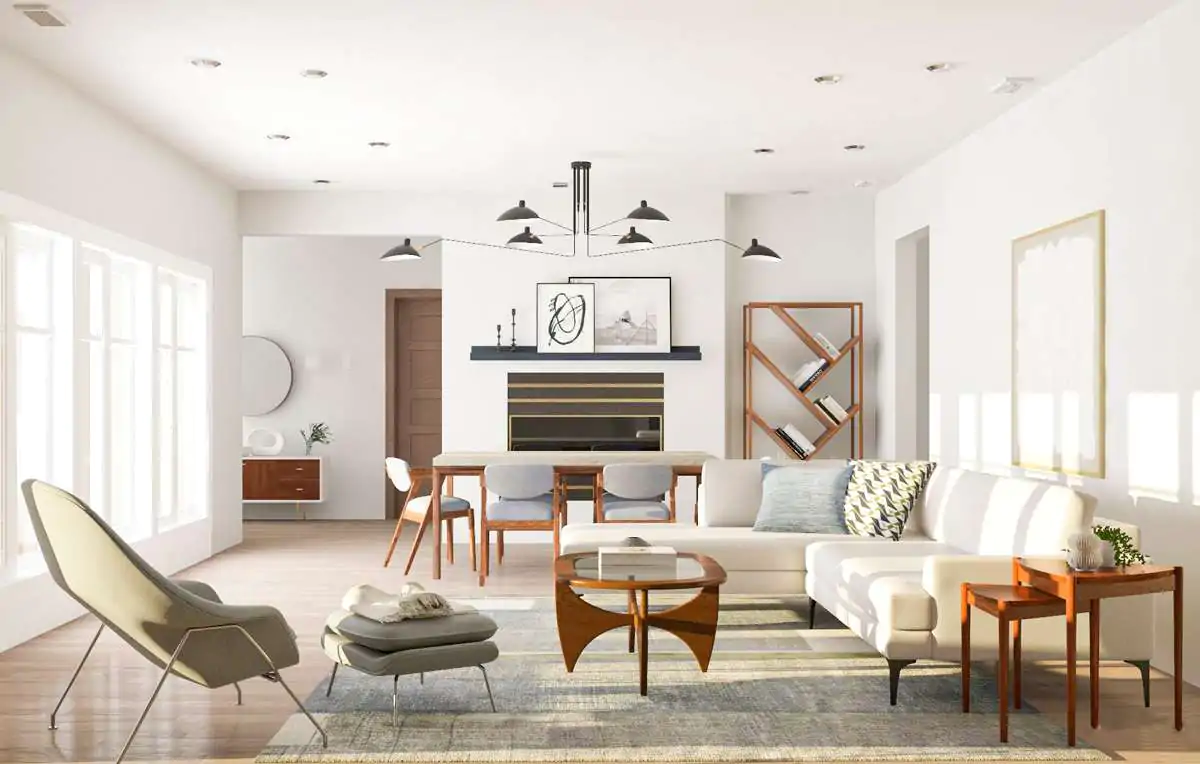
modern living room with dining space

Rimes imparts invaluable advice and insight behind her practice: how she ensures that her design world expands rather than shrinks with time – reusing familiar ideas, practices, and motifs – and how her time at Auburn University’s acclaimed Rural Studio has informed her priority of building relationships with the members of the communities who share their lives with her buildings. She also shares how traveling influences her work: “Having just returned from Japan, I’m already seeing how some of those experiences are influencing my design work, whether it be lighting design, or transparency in architecture or connection to nature.”

living room of midcentury modern home

Trends aren’t a priority for the Yale-trained architect. The designer, who appeared on Bravo’s Top Design in 2007, is instead focused on solving problems as part of a holistic experience. “My big thing about interior design is the whole picture,” he says. “So the mentality of à la carte is really difficult for me to kind of understand and fix. When you’re looking at interior design, I think you should step back and take a look at how things relate to each other in a larger picture.”

And the most popular DMTV Milkshake episode of 2023 is…

round lamp on wooden console

You all loved this chat with the CEO and founder of Gantri, the San Francisco-based lighting brand that partners with designers from around the world – like Oakland’s Prowl Studio, Felix Pöttinger in Munich, Heitor Lobo Campos in Brasilia, and former Milkshake star Bradley L. Bowers in New Orleans – to create their modern fixtures at a reasonable cost. “At Gantri, we’re rethinking how lighting is designed, made, and sold using 3D printing,” he says. “We’re supporting independent designers and studios – and making great lighting designs more accessible and more sustainable.”

Check out the rest of Design Milk’s end of the year coverage here!

As the Senior Contributing Editor, Vy Yang is obsessed with discovering ways to live well + with intention through design. She’s probably sharing what she finds over on Instagram stories. You can also find her at vytranyang.com.

Similar Posts

  • Messner: A childhood dream comes true

    At the foot of the Sciliar, in the picturesque area of Alpe di Siusi (Bolzano), the spirit
    of a barn is reborn as a home. The project, realised by noa* (network of architecture), has
    at its core, the South Tyrolean tradition combined with surprising features internally,
    resulting from design of visionary and unexpected spaces. An almost magical ambience is
    created, inspired by childhood memories. Keep tradition in mind, but at the same time move away so as to create an original
    identity, a new way of living, a different structuring of the domestic space, and to search
    inspiration from a childhood passed in the mountains. This, in summary, was the challenge
    faced by noa* in the project to construct a new home at Siusi in Sciliar, a construction to
    take the place of a deserted house in the centre of the village, with the original
    structure dating back to 1850. The job, completed in 2017, needs to be understood in its complex and delicate context. We
    are talking about South Tyrol, and a project executed at a height of 1100 a.s.l. at the
    foot of Alpe di Siusi, a part of the Dolomites recognised as a Unesco World Heritage due to
    its outstanding natural beauty. It was therefore extremely important to respect the
    parameters of the original structure and the urban planning requirements and regulations of
    the village. For Stefan Rier, founder, together with Lukas Rungger of the noa* studio, and
    in this instance ‘his own client’, the project was an opportunity to give a personal
    footprint to his own property. In this sense there was a move away from the traditional
    principles of spatial distribution, this being achieved in part by recalling memories of a
    childhood spent in the mountains. “We wanted the project to respect the aesthetics and the urban aspects of the village, a
    village where wooden barns alternate with plaster-fronted houses destined for farmers and
    the keeping of cattle.”, explains architect Rier. “With this in mind, we finished the
    exterior structure with a ‘coating’ in keeping with tradition: a wooden grid on all 4
    sides, just as is used for alpine barns. However, as far as the interior is concerned, I
    decided to leave tradition behind me, and thereby free the design from any preconceived
    limitations. In this way I was able to look forward…but also a little back in time to the
    beautiful years of my childhood”. The outcome of the project is a dwelling, having two aspects which confront each other in
    their style. The exterior represents the traditional alpine location, splendidly immersed
    in the local topography, whilst the interior boasts the visionary impulse, the surprise of
    a space freed from the general scheme of things, almost permeable, osmotic, and certainly
    innovative. On the ground floor there is a common area which spreads out almost in a ‘piazza’ fashion
    for (habitational)and interactional use: there is a dining table to enjoy with friends, an
    ample sized kitchen to accommodate more than one cook! The rest of the house develops in a
    vertical way and instead of the classical room division there are what can be described as
    ‘hanging boxes’, which are positioned at different heights and interconnected by stairs and
    walkways – they giving the sensation of walking up a mountain path towards the peak. The
    hallways are carefully designed so that, apart from their connecting function, they
    accommodate other essential areas such as the library and open ‘bathroom’ areas with tubs
    and showers (only the WC are closed in). The entire structure is conceived in a way that
    the further one goes up the level of privacy and intimacy is heightened. The highest ‘box’
    which features a sauna opens out to the splendid view of the Santner mountain. The revolutionary distribution of the interior spaces can be noted also from the exterior,
    and a sort of counterpoint is created with the traditional presentation of the exterior
    itself. To the north the two boxes of the bedrooms, finished in bronze, can be seen behind
    the wooden trellis shell, and as a result the material contrast is evident, while to the
    south it is sauna box which protrudes the glass facade. It is an architectural concept, both extremely innovative and courageous in nature, but
    which also has the value of being able to evoke an atmosphere of time past. Viewing the
    structure from a distance, the larch framework which supports the hanging boxes with its
    roof supported by 12 metre high wooden columns, seems to be the outline of an old barn. “Thinking about it, I spent a lot of my childhood playing in barns”, underlines Stefan
    Rier, “and one of my lasting and favourite memories is of when I used to climb high up in
    the barns and then throw myself down into the hay. Maybe if I had not had that experience,
    I would never have come to design this house …”. THE STRUCTURE: A DIALOGUE BETWEEN TIME PAST AND TIME PRESENT
    The house mirrors the construction type of the location’s rural buildings. On the stone
    foundation (10x8m), is a wooden structure in larch on three levels, and which supports the
    gable roof, typical of the village’s dwellings. A wooden trellis covers the whole house in
    a shell-like manner, screening the light and heat of the sun in the hotter periods, and as
    a whole it is suggestive of the typical structures of alpine barns. Two boxes, one in
    bronze and one a glass structure ‘peak out’ from the trellis, to the north and south
    respectively, and so revealing to the exterior that there is something complex to the
    interior layout. To the south there is a glass facade and a terrace which opens out to the
    magnificent view over the landscape of the Dolomites, a view which is dominated by the
    splendid sight of the Sciliar massif. THE INTERIOR SPACES: A STATIC CHALLENGE
    Inside the house, the distribution of spaces and functions is really unusual. The ‘boxes’
    which house the three bedrooms are supported by the wooden beam structure, visible in its
    totality (12 metres high). The bedrooms are designed as micro-homes, each one having its
    own particular design, these boxes seem to almost ‘hang’ in the ample volume of the
    interior (1,100 cubic metres). One gains access via a staircase and a walkway system, which
    as well as having a connecting function, accommodate the ‘bathroom’ areas with tubs and
    showers (only the WC are closed in). On the last floor, a box plays host to the sauna with
    a panoramic view, extending out of the southern front. Preceding the sauna, there is a
    book-lounge with an antique majolica stove, which has been taken from the pre-existing
    building. The library together with a cloakroom area complete the private spaces on the
    higher levels.
    The ground floor is a large open space with three diverse ‘island’ functions: the
    relaxation area, the dining area, and the kitchen, resolved with a large working surface
    feature in natural brass, and decorated on the sides with artisan earthenware tiles. MATERIALS
    As well as incorporating materials having a local tradition – wood and stone – the project
    introduces others of a more contemporary nature, in some cases recalling a Mediterranean
    style. The floor resin, giving uniformity to the ground floor appearance, alternates
    between baked clay and sea-blue tiles, the same as used for the side covering of the
    kitchen’s work surface. The brass gives brilliant warm tones to the furniture details and
    to the work surface which also incorporates the cooking essentials and sink. The staircase,
    in finely worked steel recalls the grates of Arabian tradition, creating a chiaroscuro
    effect which is extremely unusual for the Alpine environment. Furniture and Cloth
    The furniture has all been produced to design specification, adhering to a zero-kilometre
    regime. Attention to detail has been scrupulous, as has the search for original solutions
    from both a formal and functional stance. Cloth chosen plays an intricate game with wood in creating an atmosphere almost theatrical
    in kind. Flowing blue drapes act almost as stage curtains in enclosing various spaces and
    giving different and new perspectives. There has also been a coming together of texture and
    décor for the box-like bedrooms, this evident even in the wallpaper in blue tones, and so
    creating a functional soundproofing barrier. Light
    The project strives to make the most of natural light: to the south the facade is a
    complete glass construction, the light being filtered by the external wooden grid
    positioned at 2.5 metres from the principal structure, whilst the jutting out roof shades
    protect the interior from the extreme heat of the summer months. On the roof, a skylight
    opens to the east providing another source of light. To the north there are windows.
    As for internal lighting, in the very high living area, there are suspension lights to
    guarantee sufficient light and in particular for the specific functional areas (dining and
    kitchen areas). Many of the lamps in the house have been design created.

  • The Top Trends in Girls’ Room Decor

    If you love design and you’re searching for girls’ room decor inspiration, you’ll be happy to know that trends in this space are a reflection of today’s larger design trends. For all ages! As you can see from the photo below, geometric wall shelves, garlands and interesting lighting are a few of the game changers […]

    You’re reading The Top Trends in Girls’ Room Decor, originally posted on Decoist. If you enjoyed this post, be sure to follow Decoist on Twitter, Facebook and Pinterest.