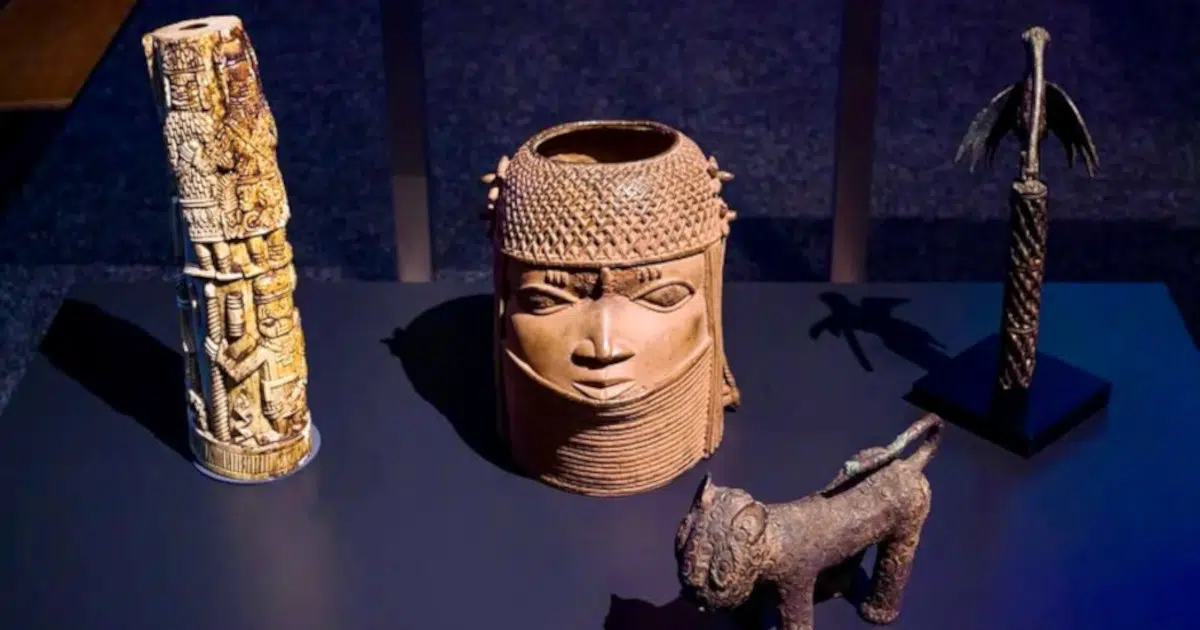
Over the last few years, museums around the world have vowed to return artwork and artifacts that were looted from their places of origin. The latest institution to fulfill their promise is the Wereldmuseum, in the Dutch city of Leiden. In tandem with the government of the Netherlands, they’ve returned 119 stolen artifacts, known as Benin Bronzes, to Nigeria.
These efforts are the result of the work of Nigeria’s National Commission for Museums and Monuments (NCMM), which has issued repatriation requests to museums across the world, such as the Wereldmuseum, which displayed these artifacts for decades. In February, the Dutch institution agreed to return the pieces, handing them over in a ceremony at the National Museum in Lagos. According to Olugbile Holloway, director of the NCMM, this is the largest single repatriation to date.
While these figurines are known as the Benin Bronzes, not all of them are made of bronze. The title refers to items of spiritual and historical significance to descendants of the ancient Benin kingdom. These objects were made between the 15th and 19th centuries and include jewelry, statues, tusks, and even an ornate ivory mask that belonged to a former ruler of the Kingdom of Benin.
As Holloway explains, the items are “embodiments of the spirit and identity of the people from which they were taken from.” The handover ceremony was led by Oba Ewuare II, current leader and guardian of Benin culture, who said the return of the Benin Bronzes is “a testament to the power of prayer and determination.”
Just like the Benin Bronzes are a source of pride, their absence was a painful reminder of the past. The objects were looted in 1897 by British soldiers during a raid that led to the Kingdom of Benin becoming part of colonial Nigeria. This event also caused the king of Benin at the time, Ovonramwen Nogbaisi, to go into exile.
“With this return, we are contributing to the redress of a historical injustice that is still felt today,” says Eppo Bruins, Dutch minister of culture, education, and science. As of now, the British Museum still has over 900 Benin Bronzes in their collection, while Germany has returned 20 and has agreed to return over a thousand more.
As for the returned items, some will be exhibited at the National Museum, while others have been returned to Oba Ewuare II. The Nigerian government also plans to open the Edo Museum of West African Art in Benin City, where the Kingdom of Benin once stood, in 2026. The building was designed by architect Sir David Adjaye, and will be home to the largest collection of Benin Bronzes in the world.
The Wereldmuseum in Leiden and the government of the Netherlands have returned 119 stolen artifacts, known as Benin Bronzes, to Nigeria.
Sources: Netherlands returns 119 looted artifacts known as Benin Bronzes to Nigeria; Netherlands to return stolen Benin Bronzes to Nigeria; The Netherlands returns 119 stolen sculptures to Nigeria
Related Articles:
Looted 2,500-Year-Old “Green Sarcophagus” Is Returned to Egypt
London Museum Is Returning Over 70 Pieces of Looted Art to Nigeria
Painting Looted by the Nazis Is Returned to 101-Year-Old Dutch Woman
The Metropolitan Museum of Art Returns Three Ancient Sculptures to Iraq