Pulp Galerie Revisits Gaetano Pesce’s ChiatDay New York Project
Pulp Galerie presents Gaetano Pesce, The CHIATDAY New York Project, its second exhibition at the gallery’s new space in Paris’ 6th arrondissement, bringing together rare elements from the experimental advertising offices designed by Gaetano Pesce in New York in the mid-1990s. On view from March 26th through May 30th, the exhibition revisits a moment when architecture, furniture, and workplace culture merged into a vivid spatial experiment.
The selection of desks, doors, chairs, and furniture pieces were originally created for the CHIATDAY advertising agency. The exhibition reconstructs fragments of a project that once occupied the thirty-eighth floor of a Financial District tower. Destroyed only a few years after its completion, memories of these offices have long circulated in through photographs and drawings. At Pulp Galerie, these objects return as physical evidence of Gaetano Pesce’s radical interiors.
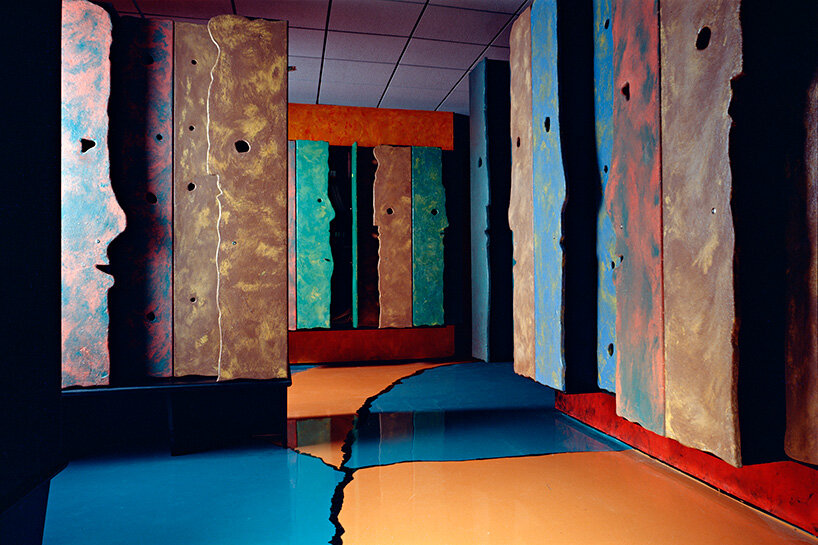
original CHIATDAY agency interiors, archival image © Donatella Brun
A workplace as an open landscape
When Jay Chiat commissioned Gaetano Pesce in 1994, he envisioned a workplace free from assigned desks and rigid partitions. The Italian designer responded with a space conceived as a flexible field of movement. The office functioned almost like a small city, where meeting areas and work zones formed an informal network of routes and gathering points.
This spatial strategy reflected a changing understanding of work during the early digital era. Rather than arranging employees around fixed stations, the design encouraged constant movement and adaptation. One could settle at different locations throughout the day, responding to shifting needs and collaborations.
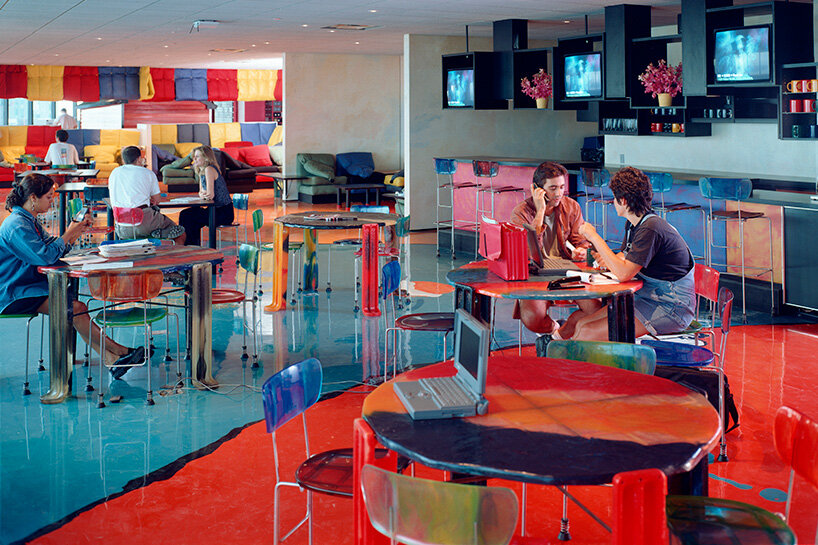
original CHIATDAY agency interiors, archival image © Donatella Brun
Resin, color, and the expressive workplace
Pulp Galerie shows that for Gaetano Pesce, material played a defining role in this environment. Many architectural elements and furnishings were cast in translucent resin, a medium closely associated with the designer’s work. Its surface captured pigment in swirling layers, producing objects that carried variation and subtle irregularity.
The exhibition at Pulp Galerie presents several pieces that demonstrate this approach. Locker doors with uneven perforations and shifting colors transform a functional component into an expressive surface. Nearby, the Waffle Table introduces a circular resin top supported by legs in contrasting colors, creating a composition that feels animated even in stillness. These objects reveal the designer’s interest in individuality and variation within repeated forms.
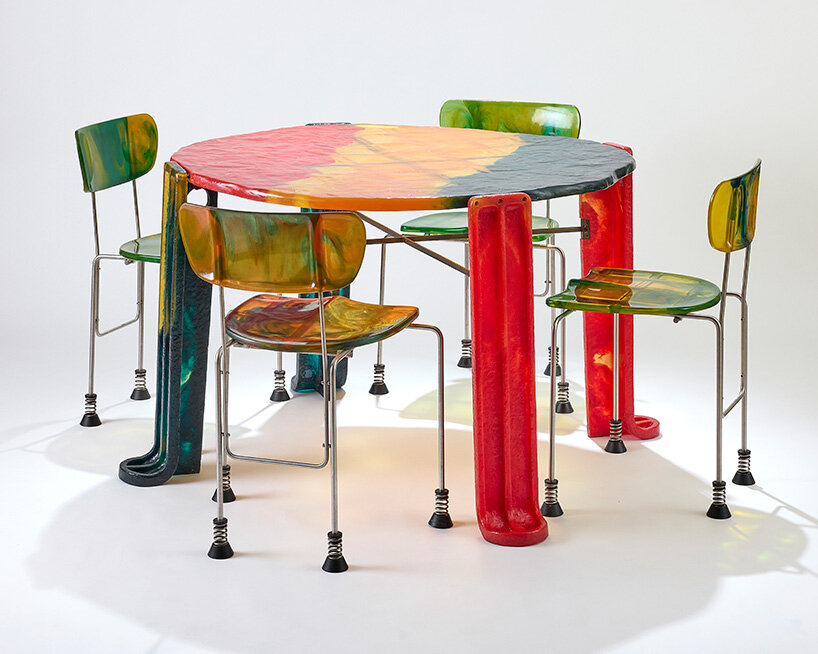
Gaetano Pesce, Waffle table with Broadway chairs, 1994, from TBWACHIATDAY headquarters, New York, image © Alexis Narodetzky
Furniture as fragments of architecture
The TBWAChiatDay desks on view show how Gaetano Pesce integrated furniture into a broader architectural language. Their resin surfaces reveal the imprint of a metal grid embedded beneath the translucent layer. The grid also appeared across the office structure as a link between the furniture and the interior’s overall framework.
Meawhile, the Highway door transforms a simple element into a narrative object. Behind a metal frame, the resin surface depicts a miniature roadway populated by toy cars. The imagery introduces a sense of movement that echoes the constant circulation within the workplace itself.
Seen together, these objects illustrate how the ChiatDay office blurred the architecture and furniture together. Desks, doors, and partitions formed a continuous system that shaped the experience of moving through the space.
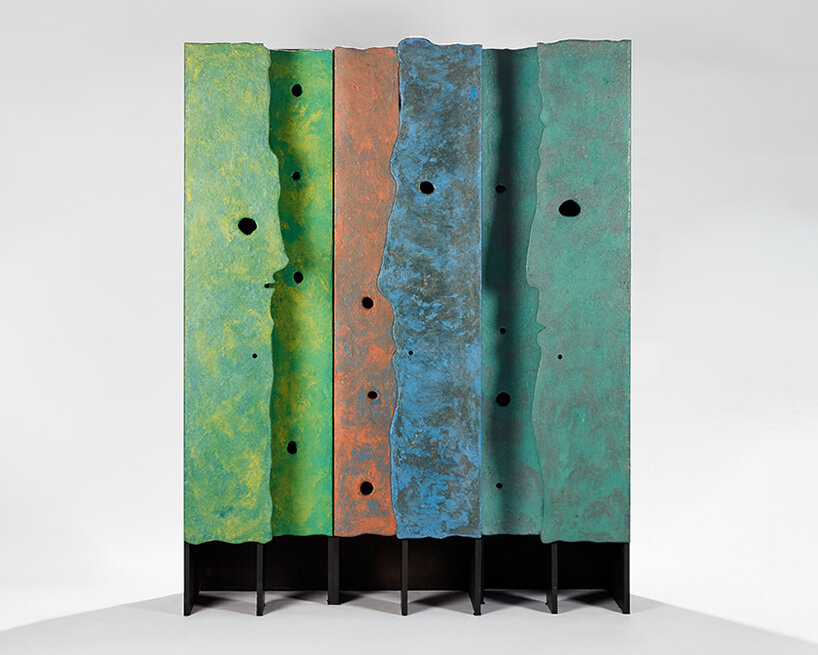
Gaetano Pesce, Locker Doors, 1994, from TBWACHIATDAY headquarters, New York, image © Alexis Narodetzky
Revisiting a lost interior
The original office existed for only a short time before being dismantled in the late 1990s. Its disappearance transformed the project into a legend, remembered through documentation and scattered objects.
Thus, Pulp Galerie’s exhibition brings a rare chance to view those pieces in-person. Many retain traces of their previous use, marks that speak to the energy of a workplace filled with creative teams and constant activity. The installation reconstructs a small portion of the atmosphere that once defined the New York interior.
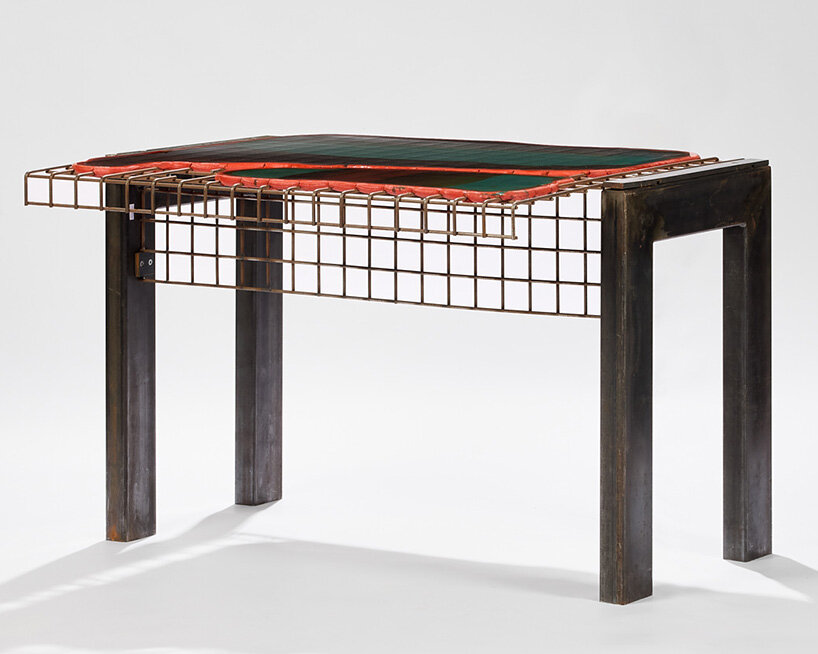
Gaetano Pesce, Desk, 1994, from TBWACHIATDAY headquarters, New York, image © Alexis Narodetzky


