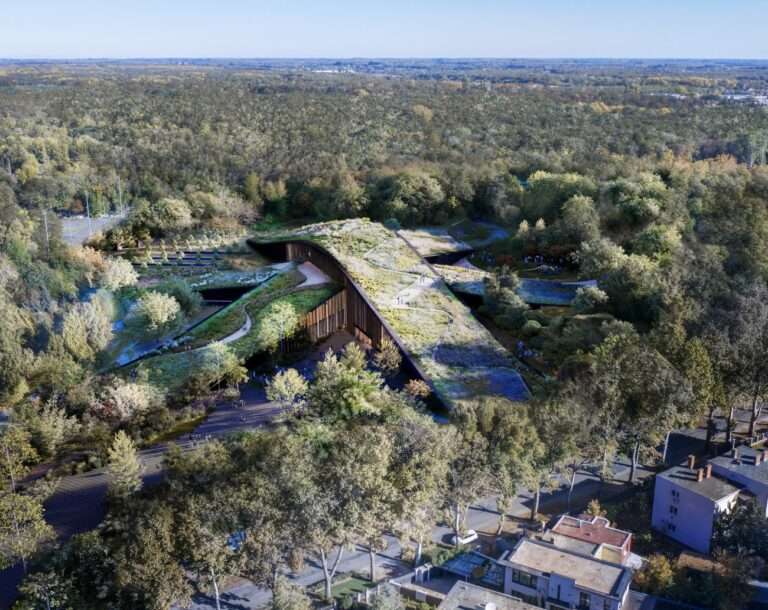
The Canopy House is a minimalist residence located in Kanegem, Belgium, designed by Glenn Buydaert. This dining and guest house connects to an existing structure and adjoining orangery, with the unique surroundings featuring a central sunken garden playing a significant role in the design and realization. The architectural concept began with the alignment and connection of these key elements, resulting in a slender, elongated volume in harmony with its environment, orientation, and panoramic views.
The use of delicate steel canopies provided necessary shading from the sun while also establishing a material dialogue with the existing steel orangery. The clean, geometric volume unfolds within the greenery, revealing or concealing itself depending on the season, demonstrating how architectural interventions can engage with landscape temporally where deciduous vegetation creates seasonal variations in building visibility and spatial character establishing dynamic relationship between architecture and nature’s annual cycles.
In contrast to the linear exterior, the interior was conceived as “fluid” where spaces transition seamlessly through sliding wall elements without rigid alignment. One flows naturally through the house where every room unveils a fragment of the garden and the vast surrounding landscape, demonstrating spatial planning strategy prioritizing experiential sequence and view framing over conventional room divisions creating processional quality appropriate for guest house program requiring varied spatial experiences within modest footprint.
On the exterior, only three materials were used: the steel canopies serving as horizontal alignments, the textured lime plasters acting as seemingly soft connection with natural surroundings, and the vertically charred wood marking both the endpoint and transition into the rough, wooded part of the garden. This restrained material palette demonstrates disciplined design approach where limited material vocabulary creates architectural clarity preventing visual fragmentation that might occur when numerous surface treatments compete for attention.
The interior was conceived with the same guiding principle. Since art plays an important role in the client’s life, it was essential to let the interior speak through a limited yet deliberate use of a few atypical materials applied only in carefully considered places. Simplicity and a certain sense of “chic” had to be united into one harmonious whole, demonstrating how residential design for art collectors requires neutral backdrop allowing artwork to dominate visual experience while architectural finishes provide subtle luxury through material quality rather than decorative elaboration.