a circle of mirroring steel branches composes a luminous forest in hanoi’s public realm

A LUMINOUS FOREST: Transforming Public Spaces into Shared Art

October 2025 marked a quiet but seismic shift in Hanoi’s public realm when Vietnamese artist Tia-Thuy Nguyen unveiled ‘A Luminous Forest’ in a central urban park. Far from another ornamental fixture, the installation turns collective memory into a living, breathing encounter. It sidesteps the frozen authority of traditional monuments and instead assembles an abstract constellation of light that pulses with the city’s own rhythm. Metal, glass, ceramics, illumination, and subtle sound weave together to enrich the urban landscape, inviting art, nature, and everyday life into a renewed conversation.

At the heart of the work stand eighteen mirror-polished stainless-steel columns, each rising twelve meters and hand-welded into a perfect twelve-meter circle. Visitors do not merely observe; they enter, move through, and complete the piece. The steel’s severity is tempered by delicate interventions rooted in Vietnam’s craft legacy: mouth-blown glass blossoms, hand-thrown ceramic forms, stainless-steel doves, and spinning pinwheels. Rigidity meets fluidity, industrial precision meets ancestral touch, and the result is a visual cadence that shifts with sunlight, weather, and human motion. In Tia’s hands, light is never decoration; it is the vital medium, refracting through glass, skating across metal, and conjuring a forest that feels both solid and spectral.

The making of the forest spanned thousands of hours and unfolded as a deliberate act of reverence for manual skill in an age of mechanized dominance. Tia worked shoulder-to-shoulder with master welders, ceramicists, glassblowers, and floral artisans, preserving Vietnam’s artisanal patrimony while folding it into the global language of contemporary practice. Engineered to withstand Hanoi’s relentless sun, monsoon downpours, and gusting winds, the installation stands as resilient testimony to human dexterity, every weld seam and vitreous petal a signature of singular and collective labor. Building on the momentum of her earlier 2025 commission, ‘Resurrection’, completed at the end of April and featured in designboom magazine, ‘A Luminous Forest’ represents Tia’s second major public art in Hanoi this year. The two projects together signal a broader evolution in the capital’s approach to renewal: moving beyond cosmetic greening toward deeper cultural and social resonance. Public art is no longer peripheral; it has become a vital layer of the city’s civic and spiritual fabric, cultivating local identity, fostering belonging, and injecting fresh energy into Hanoi’s creative life.
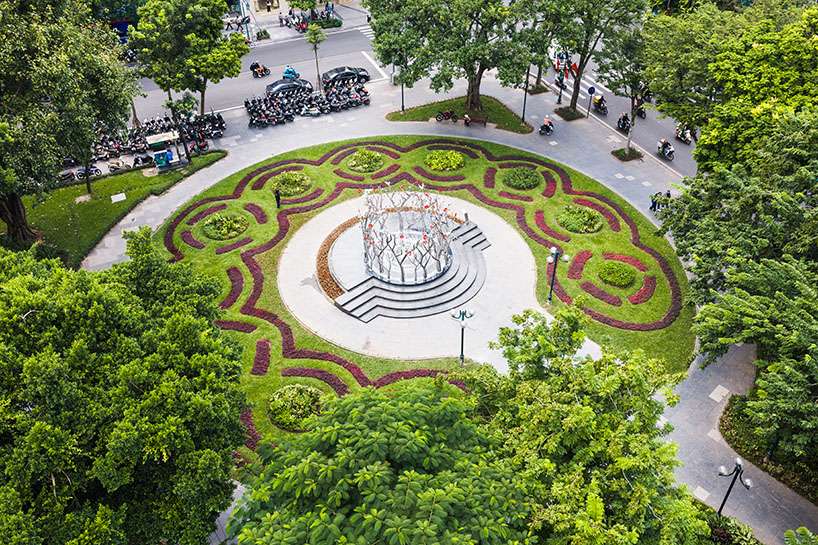
a circle of mirroring steel branches composes a luminous forest in hanoi's public realm
all images courtesy of Tia-Thuy Nguyen

The Forest as Conceptual Anchor: Art Symbolism and Innovation

The conceptual seed of art lies in Vietnam’s primordial forests, which are places of refuge, sustenance, and communal endurance across centuries of history. The steel columns do not mimic trees; they allegorize aggregated vitality and quietly evoke the revolutionary image of a hundred banners raised in unison. Inside the circle, industrial starkness collides with handcrafted softness, opacity with gleam, producing an ever-changing visual rhythm. More than a sculpture, ‘A Luminous Forest’ is a restorative overture. It radiates shared memory through light and human proximity, proposing a fresh archetype for Vietnamese public art: anchored in historiography yet fluent in global contemporaneity. Memory here is freed from the archive; it remains luminous, vital, and continuously remade by the daily gaze of passersby.

Vietnamese artist Tia-Thuy Nguyen’s Public Art trajectory is anchored in nature, energy, and urban artistic flow. In recent years, Tia’s public work has gravitated toward nature, energy, and the fluid currents of city life. Forests recur as emblems of resilience and collective narrative; light serves as a dynamic medium to animate shared space. By collaborating with traditional artisans, she safeguards Vietnam’s craft heritage against industrial erosion while positioning art as a regenerative force, nurturing identity, reconnecting people with the natural world, and syncing with metropolitan tempo.

a circle of mirroring steel branches composes a luminous forest in hanoi's public realm
A Luminous Forest’ introduces a new public installation in a central Hanoi park

a circle of mirroring steel branches composes a luminous forest in hanoi's public realm
the project transforms collective memory into an evolving spatial experience

a circle of mirroring steel branches composes a luminous forest in hanoi's public realm
the installation reinforces public art as a growing part of the city’s civic landscape

Similar Posts

  • 1110 apartment

    Measuring just 62m2, the apartment is located in a new building in Hanoi. Every unit of this building is small and is designed for young families. The original plan contains two bedrooms with compressed functions. The whole space is divided into small rooms. The renovated concept is to break the stifling sensation of closed rooms to create a new space where functions intertwine softly, flexibly and the natural light can enter the deepest corners. In the new design, a bedroom is removed to expand living space. A bathroom is converted into the washing room and storage. The balcony became a green space, connecting living space and bedroom. Finishing materials and furniture aim for simplicity, natural and rustication. Furniture are made to serve their very purposes, and not to put pressure on the space. Many old wooden parts have been reconfigured into two tables. Glass is used to show the structure of the tables and to avoid casting shadows on the wooden floor. The indigo plywood cabinet and the yellow cement wall cover the kitchen and are the highlight of the living space. With a small area, good quality of life can be achieved just by balancing the functions in a harmonious way; accepting to abandon some needs and to change our lifestyle.

  • Messner: A childhood dream comes true

    At the foot of the Sciliar, in the picturesque area of Alpe di Siusi (Bolzano), the spirit
    of a barn is reborn as a home. The project, realised by noa* (network of architecture), has
    at its core, the South Tyrolean tradition combined with surprising features internally,
    resulting from design of visionary and unexpected spaces. An almost magical ambience is
    created, inspired by childhood memories. Keep tradition in mind, but at the same time move away so as to create an original
    identity, a new way of living, a different structuring of the domestic space, and to search
    inspiration from a childhood passed in the mountains. This, in summary, was the challenge
    faced by noa* in the project to construct a new home at Siusi in Sciliar, a construction to
    take the place of a deserted house in the centre of the village, with the original
    structure dating back to 1850. The job, completed in 2017, needs to be understood in its complex and delicate context. We
    are talking about South Tyrol, and a project executed at a height of 1100 a.s.l. at the
    foot of Alpe di Siusi, a part of the Dolomites recognised as a Unesco World Heritage due to
    its outstanding natural beauty. It was therefore extremely important to respect the
    parameters of the original structure and the urban planning requirements and regulations of
    the village. For Stefan Rier, founder, together with Lukas Rungger of the noa* studio, and
    in this instance ‘his own client’, the project was an opportunity to give a personal
    footprint to his own property. In this sense there was a move away from the traditional
    principles of spatial distribution, this being achieved in part by recalling memories of a
    childhood spent in the mountains. “We wanted the project to respect the aesthetics and the urban aspects of the village, a
    village where wooden barns alternate with plaster-fronted houses destined for farmers and
    the keeping of cattle.”, explains architect Rier. “With this in mind, we finished the
    exterior structure with a ‘coating’ in keeping with tradition: a wooden grid on all 4
    sides, just as is used for alpine barns. However, as far as the interior is concerned, I
    decided to leave tradition behind me, and thereby free the design from any preconceived
    limitations. In this way I was able to look forward…but also a little back in time to the
    beautiful years of my childhood”. The outcome of the project is a dwelling, having two aspects which confront each other in
    their style. The exterior represents the traditional alpine location, splendidly immersed
    in the local topography, whilst the interior boasts the visionary impulse, the surprise of
    a space freed from the general scheme of things, almost permeable, osmotic, and certainly
    innovative. On the ground floor there is a common area which spreads out almost in a ‘piazza’ fashion
    for (habitational)and interactional use: there is a dining table to enjoy with friends, an
    ample sized kitchen to accommodate more than one cook! The rest of the house develops in a
    vertical way and instead of the classical room division there are what can be described as
    ‘hanging boxes’, which are positioned at different heights and interconnected by stairs and
    walkways – they giving the sensation of walking up a mountain path towards the peak. The
    hallways are carefully designed so that, apart from their connecting function, they
    accommodate other essential areas such as the library and open ‘bathroom’ areas with tubs
    and showers (only the WC are closed in). The entire structure is conceived in a way that
    the further one goes up the level of privacy and intimacy is heightened. The highest ‘box’
    which features a sauna opens out to the splendid view of the Santner mountain. The revolutionary distribution of the interior spaces can be noted also from the exterior,
    and a sort of counterpoint is created with the traditional presentation of the exterior
    itself. To the north the two boxes of the bedrooms, finished in bronze, can be seen behind
    the wooden trellis shell, and as a result the material contrast is evident, while to the
    south it is sauna box which protrudes the glass facade. It is an architectural concept, both extremely innovative and courageous in nature, but
    which also has the value of being able to evoke an atmosphere of time past. Viewing the
    structure from a distance, the larch framework which supports the hanging boxes with its
    roof supported by 12 metre high wooden columns, seems to be the outline of an old barn. “Thinking about it, I spent a lot of my childhood playing in barns”, underlines Stefan
    Rier, “and one of my lasting and favourite memories is of when I used to climb high up in
    the barns and then throw myself down into the hay. Maybe if I had not had that experience,
    I would never have come to design this house …”. THE STRUCTURE: A DIALOGUE BETWEEN TIME PAST AND TIME PRESENT
    The house mirrors the construction type of the location’s rural buildings. On the stone
    foundation (10x8m), is a wooden structure in larch on three levels, and which supports the
    gable roof, typical of the village’s dwellings. A wooden trellis covers the whole house in
    a shell-like manner, screening the light and heat of the sun in the hotter periods, and as
    a whole it is suggestive of the typical structures of alpine barns. Two boxes, one in
    bronze and one a glass structure ‘peak out’ from the trellis, to the north and south
    respectively, and so revealing to the exterior that there is something complex to the
    interior layout. To the south there is a glass facade and a terrace which opens out to the
    magnificent view over the landscape of the Dolomites, a view which is dominated by the
    splendid sight of the Sciliar massif. THE INTERIOR SPACES: A STATIC CHALLENGE
    Inside the house, the distribution of spaces and functions is really unusual. The ‘boxes’
    which house the three bedrooms are supported by the wooden beam structure, visible in its
    totality (12 metres high). The bedrooms are designed as micro-homes, each one having its
    own particular design, these boxes seem to almost ‘hang’ in the ample volume of the
    interior (1,100 cubic metres). One gains access via a staircase and a walkway system, which
    as well as having a connecting function, accommodate the ‘bathroom’ areas with tubs and
    showers (only the WC are closed in). On the last floor, a box plays host to the sauna with
    a panoramic view, extending out of the southern front. Preceding the sauna, there is a
    book-lounge with an antique majolica stove, which has been taken from the pre-existing
    building. The library together with a cloakroom area complete the private spaces on the
    higher levels.
    The ground floor is a large open space with three diverse ‘island’ functions: the
    relaxation area, the dining area, and the kitchen, resolved with a large working surface
    feature in natural brass, and decorated on the sides with artisan earthenware tiles. MATERIALS
    As well as incorporating materials having a local tradition – wood and stone – the project
    introduces others of a more contemporary nature, in some cases recalling a Mediterranean
    style. The floor resin, giving uniformity to the ground floor appearance, alternates
    between baked clay and sea-blue tiles, the same as used for the side covering of the
    kitchen’s work surface. The brass gives brilliant warm tones to the furniture details and
    to the work surface which also incorporates the cooking essentials and sink. The staircase,
    in finely worked steel recalls the grates of Arabian tradition, creating a chiaroscuro
    effect which is extremely unusual for the Alpine environment. Furniture and Cloth
    The furniture has all been produced to design specification, adhering to a zero-kilometre
    regime. Attention to detail has been scrupulous, as has the search for original solutions
    from both a formal and functional stance. Cloth chosen plays an intricate game with wood in creating an atmosphere almost theatrical
    in kind. Flowing blue drapes act almost as stage curtains in enclosing various spaces and
    giving different and new perspectives. There has also been a coming together of texture and
    décor for the box-like bedrooms, this evident even in the wallpaper in blue tones, and so
    creating a functional soundproofing barrier. Light
    The project strives to make the most of natural light: to the south the facade is a
    complete glass construction, the light being filtered by the external wooden grid
    positioned at 2.5 metres from the principal structure, whilst the jutting out roof shades
    protect the interior from the extreme heat of the summer months. On the roof, a skylight
    opens to the east providing another source of light. To the north there are windows.
    As for internal lighting, in the very high living area, there are suspension lights to
    guarantee sufficient light and in particular for the specific functional areas (dining and
    kitchen areas). Many of the lamps in the house have been design created.