|

Community Bands Together To Restore Crumbling 19th-Century Synagogue in NYC

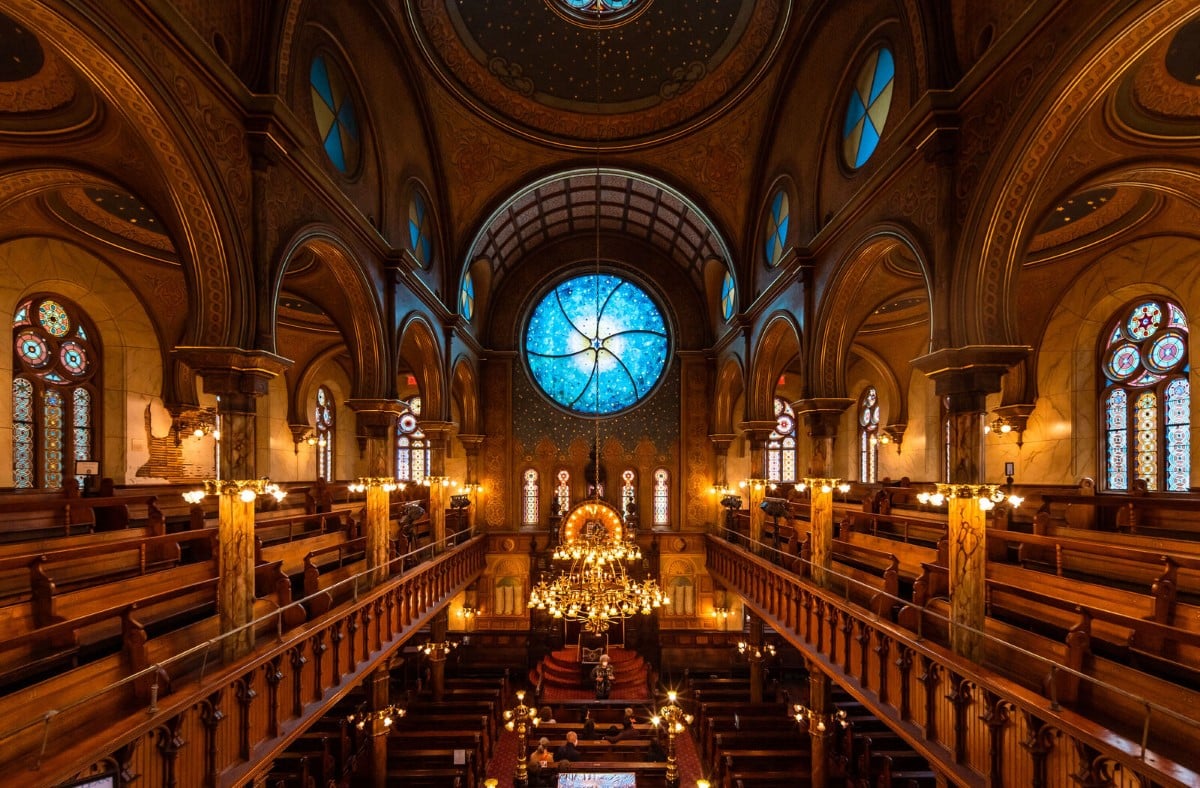
Interior of synagogue at Eldridge Street

Photo: Rhododendrites via Wikimedia Commons (CC BY-SA 4.0)

From the time it opened in 1887, Manhattan’s Eldridge Street Synagogue was a thriving place of worship for the local community. Located in Chinatown, it was one of the first synagogues erected by the Eastern European Jews in the United States. But after 50 years of bustling activity, it slowly fell into disrepair before being “rediscovered” in the 1980s and lovingly brought back to its former glory.

“The dust was so thick that you could write your initials on the benches,” recalls preservationist Roberta Brandes Gratz. Gratz first visited the synagogue in the early 1980s, when the roof was leaking and pigeons roosted in the balconies. By 1986, Gratz had founded the Eldridge Street Project with the goal of saving the historic place of worship. Now known as the Museum at Eldridge Street, the organization worked tirelessly to bring the massive renovation project to completion.

Over 18,000 people dedicated time and resources to the renovation. In the early years, people would turn up to dust and polish worn silver. As time passed, the grassroots effort gained momentum, and, in 1996, the building was named a National Historic Landmark.

Before and after of main stained glass window at the Eldridge Street SynagogueBefore and after of main stained glass window at the Eldridge Street Synagogue

Before and after the restoration.

Preservationists spent 20 years and $20 million to return the building to its Victorian-era glory. Whether it meant rewiring and polishing a 19th-century chandelier or hand-painting designs on the walls, every detail helps tell the story of the history of American Judaism in the early 20th century.

The restoration work was completed in 2007, but it wasn’t until three years later that one last touch would be added. As a nod to the space’s new revitalization, artists Kiki Smith and architect Deborah Gans designed a monumental glass-stained window to replace an earlier intervention from the 19th century.

Today, the space provides educational tours that explore the history of American Jews and Jewish culture in New York City.

“We’re one of the very, very few museums that are housed in a synagogue and are open to the general public,” said the museum’s deputy director, Sophie Lo. “Because of the history of [anti-semetic] hate, with most synagogues, you can’t just walk in. We want to say, come see us and experience this, and learn about these cultural practices.”

Over the course of 20 years, the public helped resurrect Manhattan’s Eldridge Street Synagogue.
Built in 1887, the synagogue was a popular place of worship over over 50 years before falling into disrepair.

Exterior of the Eldridge Street SynagogueExterior of the Eldridge Street Synagogue

Photo: Anne Ruthmann via Wikimedia Commons (CC BY-SA 4.0)

Doors at the Eldridge Street synagogue in New York CityDoors at the Eldridge Street synagogue in New York City

Photo: Anne Ruthmann via Wikimedia Commons (CC BY-SA 4.0)

It cost $20 million to bring the Victorian-era synagogue back to its former glory.

Interior dome at Eldridge Street SynagogueInterior dome at Eldridge Street Synagogue

Photo: Anne Ruthmann via Wikimedia Commons (CC BY-SA 4.0)

Interior of synagogue at Eldridge StreetInterior of synagogue at Eldridge Street

Interior of the Eldridge Street synagogue in ManhattanInterior of the Eldridge Street synagogue in Manhattan

Photo: Anne Ruthmann via Wikimedia Commons (CC BY-SA 4.0)

In 2010, a new stained glass window was commissioned to complete the interior.

Interior of synagogue at Eldridge StreetInterior of synagogue at Eldridge Street
Detail of Kiki Smith stained glass window at the Eldridge Street SynagogueDetail of Kiki Smith stained glass window at the Eldridge Street Synagogue

Stained glass window at the Eldridge Street SynagogueStained glass window at the Eldridge Street Synagogue

Photo: Peter Aaron

Now known as the Museum of Eldridge Street, the space provides educational tours about the history of Jewish culture in New York City.

Interior of synagogue at Eldridge StreetInterior of synagogue at Eldridge Street

Museum at Eldridge Street: Website | Facebook | Instagram

My Modern Met granted permission to feature photos by the Museum at Eldridge Street.

Related Articles:

Notre-Dame’s Famed Organ Will Undergo a Four-Year Restoration

France’s Beautiful National Library Reopens After a Decade of Renovations

New York Public Library Unveils Stunning ‘Rose Reading Room’ After Two-Year Renovation

Man Pays $6,000 for a Pair of Damaged Stained Glass Windows That are Actually Worth a Fortune

Similar Posts

  • Good Haus

    The Good Haus celebrates the intersection between design and performance – and seeks to be an example of a “good house”. The house is the family home of principals Mela Breen and David Good (designer and builder) – and playfully gets it’s moniker from Dave’s last name. So what is our idea of a good house? In this case it is one that is pushing the possibilities of a site specific design while holding itself accountable to reaching the highest level of energy efficiency. Our good house is one that embodies our beliefs about resiliency, efficiency, health and comfort, beauty and playfulness. The DNA for the Good Haus is established by the site, a steep and rocky hillside that spills down onto a small neighboring foothill meadow. A limited buildable footprint, season drainage concerns, and an inviting flat outcrop of granite drove the initial design. Two intersecting geometric volumes were conceived, each reaching out to connect the building to the landscape, each intersecting the other and providing counter balance. The main first floor volume is a long south facing rectangle that stretches and anchors in the granite. A deep west facing porch protects the house from overheating, bridges a rocky drainage and links the open floor plan to the landscape with a large outdoor living space. The second floor volume runs perpendicular to the main living space and cantilevers to create a covered north entry, while a balcony on the south side cantilevers towards the oak canopy – creating a sense that the master bedroom is in a tree house. The exterior material pallet is in keeping with our love for the handmade modern. Cedar siding from trees grown on Mela’s childhood property and milled by her father is mixed with standing seam metal roofing that turns downing to clad the walls as a way to articulate the building form. Because the topography falls roughly 12’ over the relatively narrow width of the house, and the granite spine to the west hinted at what might lay below the soils (giant boulders and bedrock), we opted to build the first floor primarily on a steel pier and beam structure with a metal pan deck. This allows the building to float above the rocky drainage. The complexity of the design, with its cantilevers and steel deck foundation, require a heightened attention to the air sealing and insulation details. The super insulated, air-tight building envelope is wrapped in exterior Rockwool insulation, all the connections between interior and exterior structural members are meticulously detailed to avoid thermal bridges, and triple pane European windows and doors are used to maximize light, comfort, and performance. A CO2 heat pump water heater provides the most efficient domestic hot water delivery. Balanced heat recovery ventilation offers high indoor air quality and uniform temperature distribution. Indoor climate control is provided by super efficient ductless mini splits. A 6.5 kw roof mounted photovoltaic system is installed to offset the home’s energy usage (including the charging of an electric car) – creating a zero net energy building.