Here’s Everything You Need to Know About IKEA’s Big Bet on Smart Home Technology

As big tech dominates the smart home realm, IKEA is flanking the industry with an approach all its own.

SYMFONISK WiFi speakers by IKEA and Sonos

Each year, IKEA conducts hundreds of home visits in multiple countries to gain a better understanding of its customers—in 2019, the company spent about 300 hours in homes, and it bolstered its insights with 33,500 interviews for its annual Life at Home report. This research is part of what makes IKEA so influential—and now it’s leveraging that influence to improve the home through smart technology.

While IKEA isn’t an expert in tech, it doesn’t really need to be. The company’s global business area manager Björn Block brought on Frog Design to help develop the hardware and software for IKEA’s Trådfri smart lights, which launched in 2017. Frog Design also ensured that the products would be compatible with Alexa, Google Assistant, and Siri.

Earlier this year, IKEA launched a Trådfri shelf and lamp that were co-developed and co-branded with Sonos—a partnership that flexed the strengths of each company by offering Sonos’ sound expertise with IKEA’s svelte packaging and affordable pricing.

A Home Smart dimmer kit comes with an array of functionality—you can change the lighting in your home from cool to warm, dim the bulbs, or turn them on or off.

A Home Smart control outlet allows you to turn any appliance or light into a smart device by programming it with the Trådfri app.

Courtesy of IKEA

The SYMFONISK WiFi speaker by IKEA and Sonos is part of the Trådfri line—what is now known as Home Smart. The device doubles as a table lamp, and it can be automated or controlled with an app to accommodate moods or certain times of day. With IKEA's scale, customers can own a smart device with a Sonos speaker at an affordable price point.

The SYMFONISK WiFi speaker by IKEA and Sonos is part of the Trådfri line—what is now known as Home Smart. The device doubles as a table lamp, and it can be automated or controlled with an app to accommodate moods or certain times of day. With IKEA’s scale, customers can own a smart device with a Sonos speaker at an affordable price point.

Courtesy of IKEA

IKEA is now taking those successes—along with some failures—to launch a new smart home ecosystem called “Home Smart.” Currently on offer are lights, blinds, chargers, motion sensors, sockets, and a variety of controllers like dimmers and switches. The company is making continual improvements to the ecosystem’s software, and it’s planning to launch a much wider range of tech-integrated products in the near future.

The reconfigured “Home Smart” title might feel awkward, but it’s IKEA’s distinct take on the future of smart home tech: “It means the life at home is more important than technology,” Block told The Verge. “The technology is a tool to make things work, but we’re not launching things just because it’s cool technology.”

These lightbulbs and switches are prototypes from IKEA’s Home Smart line that allow for customizable and programmable lighting.

These lightbulbs and switches are prototypes from IKEA’s Home Smart line that allow for customizable and programmable lighting.

Courtesy of IKEA

See the full story on Dwell.com: Here’s Everything You Need to Know About IKEA’s Big Bet on Smart Home Technology

Similar Posts

  • Westwood House

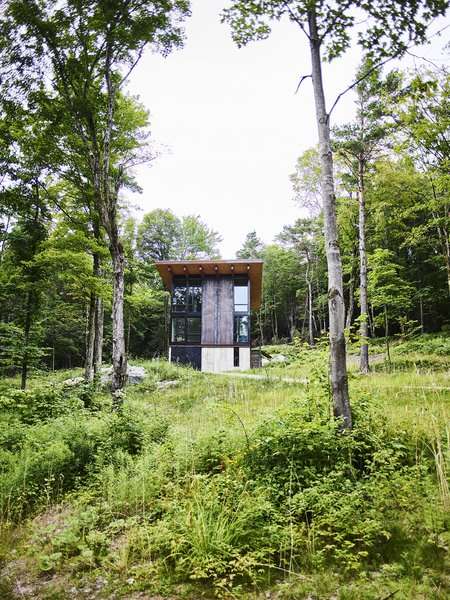
    Located in the Blue Ridge Mountains of Asheville NC with distant north views of Mt Spivey and a narrow sloping lot, this wedge-shaped home is a response to site. We took into careful consideration a variety of site-specific inputs including views, sun orientation, prevailing winds, privacy, and natural cooling/heating techniques among others. The result is a functional, energy efficient home with a distinctive exterior shape and warm light filled interior spaces. The home’s dominant shed roof maximizes solar orientation for photovoltaic panels while also allowing for a double-height central atrium to flood the core of the house with natural light and exhaust hot air on hot summer days. The introduction of natural light into the core of the house reduces the need for artificial lighting on cloudy days, while the chimney effect created by opening large operable skylights at the top of the atrium reduces HVAC loads by bringing cool air up from the basement. This central atrium is an example of how a design feature can multitask –it brings natural light deep into the core of the house, it cools the house using the chimney effect, and it provides a place to grow plants which filter interior air. It also allowed us to minimize the street facing windows for privacy while still maintaining a light filled interior. Anchoring the bottom of the atrium are four large arched openings and a Spanish terracotta tile floor. The tile floor is a durable surface good for watering plants and for heavy foot traffic. A keyhole opening marks the boundary between private and public sides of the house while two of the arched openings frame an intimate eating nook and entry foyer with walls covered in locally milled southern yellow pine. The last arch has steps spilling out into a sunken living room and kitchen area with access to a back deck. Locally milled cypress, a naturally rot resistant wood, covers the exterior and anchors the strong geometry of the house to the site. In the end, our desire for functionality created something more than just an energy efficient home. The interior took on an unexpected bohemian feel; one that originated from a desire for light and functionality, but resulted in warm soft interior spaces that were comfortable and welcoming.