Home Cleaning Tips during Coronavirus Pandemic

If you are starting each day with more gloom and news about the further spread of coronavirus and how the pandemic is engulfing the entire planet, then we completely understand your trepidation. A silver lining amidst the giant dark cloud hanging above us is how China seems to be back on its way to normalcy (if we can all it that), Corona numbers in Italy and Iran are slowly coming down and the everyone is taking lockdowns a lot more seriously. At his point the best thing one can do is to keep themselves, safe, secured at home and to ensure that they do not contribute to the spread of this deadly virus. An important part of this is to keep your house clean and Coronavirus-free.
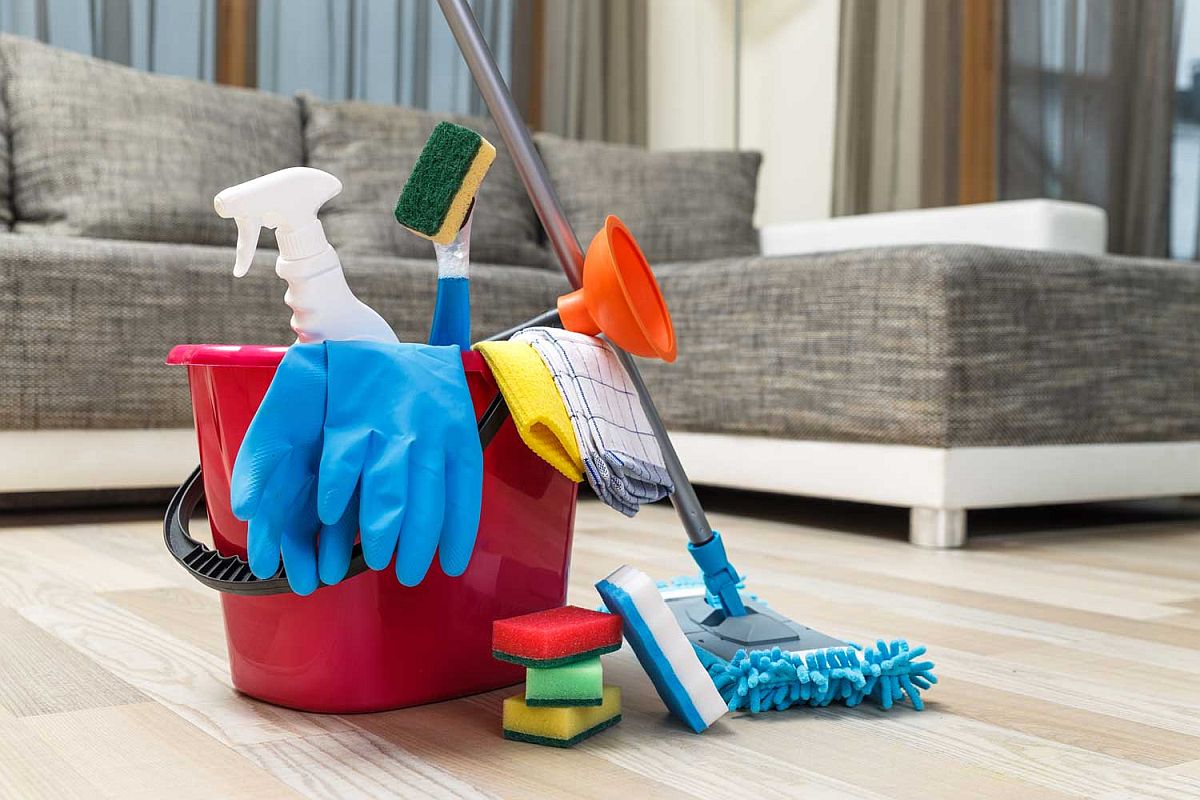
Getting ready to clean your home in the time of a global pandemic

Home cleaning tips for a Corona-free living environment are simple, easy to follow and might actually demand nothing beyond repeating your cleaning regimen just a bit more often. Without wasting too much of your time further, here are 7 simple tips that get the job done and keep the virus out –

1. Start with Basic Personal Hygiene

You might have already heard this a million times in the last few weeks, but do not undervalue the need for proper personal hygiene. Do wash your hands regularly with soap (new research suggest soap might be more effective than just handsanitizers in combating Corona), cover your face while coughing and sneezing and do not touch any other surfaces in your home when you do before washing your hands. These are simple and basic etiquette and habits and are your first defense against Coronavirus.

2. Mail and Food are Mostly Safe!

Before getting to the nitty-gritty of cleaning surfaces I your home, we want to dispel some myths first. Yes, Coronavirus can survive on cardboard for nearly 24 hours, but experts suggest that chances of contracting it through your mail or home delivery packages is almost close to zero. So are the chances of getting infected through food and food products. It is from one person to another that the infection spreads most rapidly. Yes, by all means clean your hands after handling new package, but there is no need to avoid them completely; especially when home quarantine is the better option.

Chart showcasing how long coronavirus can survive on surfaces

3. Leave Footwear Outside

Coming to your home and how the virus might find its way on to one of the surfaces inside, you can start off with the entry room. For the next few weeks leaving your shoes and footwear just outside the main living area is a good choice. This keeps dirt and everything else that you drag in firmly out.

4. Target Surfaces You Touch Often

‘High-touch surfaces’ is the key mantra in this time of crisis and cleaning them is a great way to keep out the Coronavirus. If you already are in quarantine, then the chances of being infected now are almost close to zero. Clean surfaces like door knobs, handles, work desk tops, kitchen counters, islands and other areas that see plenty of traffic all day long. Wipe them with a cleaning agent first and then with a disinfectant to get the job done.
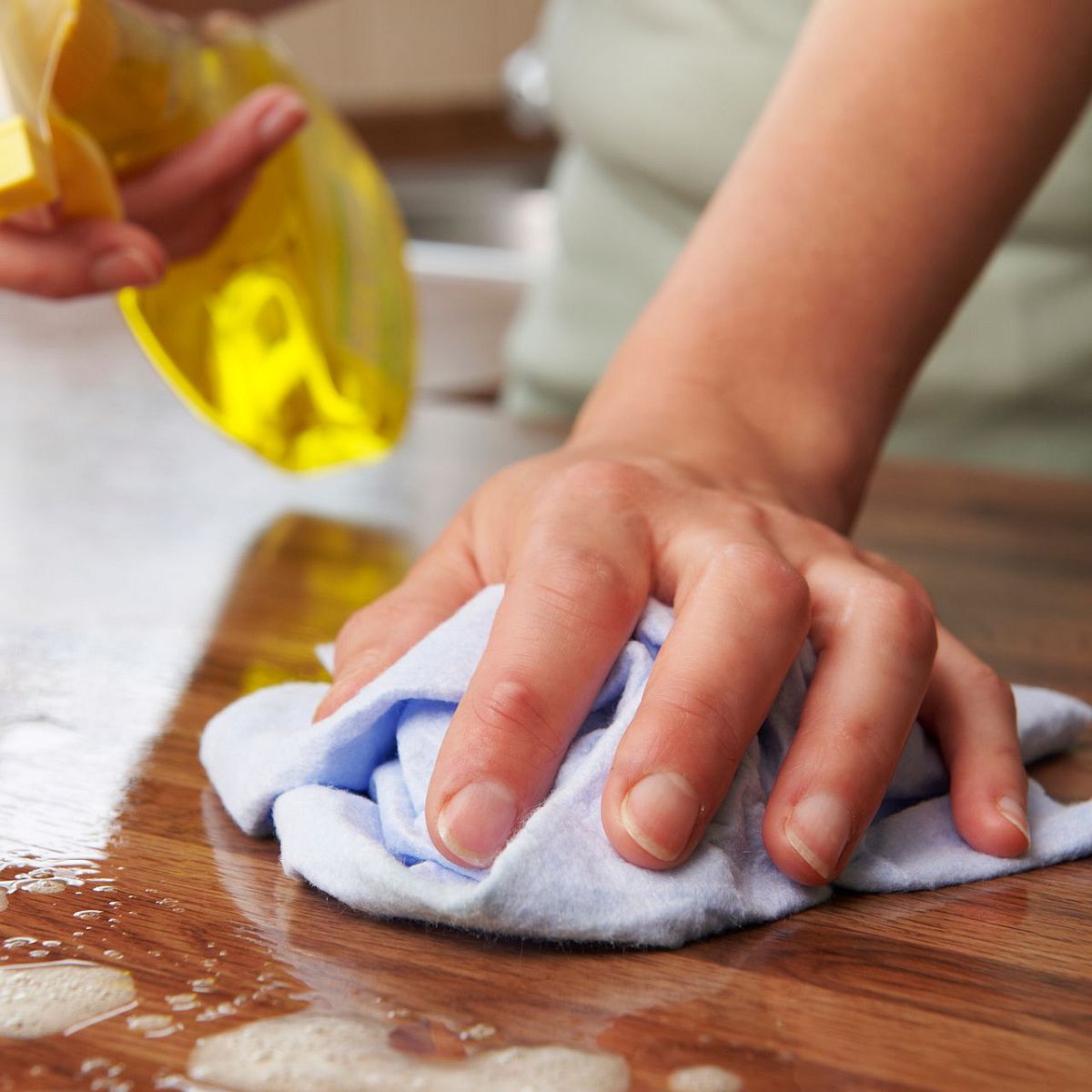
Cleaning to keep your home Coronavirus-free

5. Clean things Thoroughly

Experts are starting to suggest that instead of just randomly spraying disinfectants all around, a better way of dealing with the virus is by first cleaning out any dirt before you use a disinfectant that is appropriate. This might feel a bit tiresome, but it is the least you can do for your own safety. Start by removing dirt and other contaminants before using those wipes and sprays!

6. Use your Basic Cleaning Products

The EPA has already given a detailed list of everything you can use to clean your home effectively and keep out the virus. The list is pretty basic with components like Hydrogen peroxide, Isopropyl alcohol, which can be found in most store-bought disinfectants and cleaners. In fact, everything you need should be present in you array of cleaning products already at home. Just repeat your cleaning routine more often in these trying times.

7. Clean Your Electronic Devices and Accessories

This is one step that you just not miss; especially in this digital age where even kids come in contact with a wide range of gadgets. Everything from your phone to the TV remote, gaming console controls and laptop keyboard can harbor the virus if not cleaned properly. There is no need to go overboard here, but do keep them as clean as possible. Do not forget your headsets and other devices that you constantly come in contact with.

Cleaning your phone and electronic devices during Corona pandemic

You’re reading Home Cleaning Tips during Coronavirus Pandemic, originally posted on Decoist. If you enjoyed this post, be sure to follow Decoist on Twitter, Facebook and Pinterest.

Similar Posts

  • Hillside Sanctuary

    The owner of this property came to Hoedemaker Pfeiffer looking for a personal retreat inspired by a home lost to fire decades earlier in the hills of Appalachia. The firm’s task was not to recreate that home but rather to give its spirit new form in the Pacific Northwest. Taking inspiration from its remote site in the San Juan Islands, our team envisioned a series of simple stone volumes. From that concept emerged the main house and a guest house, each responding to its own unique location on the site. Together they provide friends and family with comfortable accommodation while offering a sanctuary for the owner at the main home. Taking full advantage of sweeping views of Puget Sound, the main home is sited on a small plateau high on top of a steeply-sloping hillside. With a view on one side and a road on the other, the site suggested a stone plinth and stone wall to form the base and rear of the house. A pair of stone fireplace volumes support the concept, rising together to form the boundaries of a central stone staircase that separates the main level into public and private realms. Atop the low stone base then perches a light-filled wood structure. Its simple shed roof tips low in front to protect from the summer sun while offering space for a photovoltaic array above. Winter light in turn penetrates deep into the main living spaces through a wall of glass running continuously across building’s south elevation. The relative height difference between this wood pavilion and that of the adjacent stone volume also allows consistent north light to flood into the primary living spaces via a series of clerestory windows, which release warm air high on the leeward side of the structure. The site for the guest house came with more significant technical challenges. The concept begins with a stone tower set near the center of the small circular parcel. Rising high above steeply-sloping grade, it acts as a three-dimensional datum through which feature program elements are allowed to puncture. The main entry offers ease of access to the project’s public spaces through a simple, full-height opening cut into the stone volume’s north elevation. The stair, comprised of a concrete base below large casement windows, allows natural light to fill the main stairway as it leads guests toward the bedrooms located at the home’s lower level. Opposite the entry, the view deck extends from the great room, cantilevering far above grade. The dining room, finally, was conceived as a three-sided glass object floating in a forest of trees. Two steel beams carry its entire weight and extend deep into the floor system. To enhance the concept, our team preserved trees only a few feet from the dining room by developing custom retaining walls capable of avoiding critical root zones. Project Team: Hoedemaker Pfeiffer (Architecture) ​Schuchart Dow​ (Contractor ​Randy Allworth, Allworth Design​ (Landscape Architect) ​Malsam Tsang​ (Structural Engineer) ​LPD Engineering​ (Civil Engineer) Nelson Geotechnical Associates, Inc. (Geotechnical Engineer) Island Tree Doctor (Arborist) ​Kevin Scott​ (Photographer)

  • Modern Industrial Makeover of Loft-Style Condominium in Seattle Maximizes Space

    Capitol Hill in Seattle is as much known for its amazing array of industrial buildings as it is for its awesome nightlife. Sitting in the renowned 1310 East Union Building designed by the Miller Hull Partnership, this gorgeous loft-style condo was recently revamped and given a whole new lease of life by SHED Architecture & […]

    You’re reading Modern Industrial Makeover of Loft-Style Condominium in Seattle Maximizes Space, originally posted on Decoist. If you enjoyed this post, be sure to follow Decoist on Twitter, Facebook and Pinterest.

  • Exploring the Terrazzo Trend

    The last time we at Decoist explored the terrazzo trend, it was definitely gaining popularity. Yet terrazzo decor was mostly offered by artists and design houses. Now that more time has passed, the look has gone mainstream, which has its pros and cons. One definite pro: affordable terrazzo finds at retailers such as Target and […]

    You’re reading Exploring the Terrazzo Trend, originally posted on Decoist. If you enjoyed this post, be sure to follow Decoist on Twitter, Facebook and Pinterest.

  • The Fieldhouse

    Built for family and friends as a space for sport and gathering, the Fieldhouse is a simple, functional structure. Like the immersion of nature and recreation in the development of state and national parks of the early 20th century, this family wanted a structure where friends, family, and neighbors could gather, play sport, celebrate and relax in the country. The Fieldhouse feels distant and secluded, located on a mostly undeveloped seven-acre site, surrounded by a meadow of natural grasses, a fruit orchard, wetland ponds and a maintained field for sporting. As long time natives of the Pacific Northwest, the family was keen to convey a specific sense of place and longevity. The architecture responds to those ideas in its simplicity and versatility, and in its construction from durable, local materials. Inspiration was taken from vernacular stone and timber structures built across the country in the 1930s by the Civilian Conservation Corps. The architects and clients channeled their own recollections of summers spent in Seattle’s waterfront parks and their simple elegant structures, often by early 20th century Seattle architect Ellsworth Storey. The 1,664-square-foot structure consists of a covered outdoor patio flanked by two, offset and enclosed spaces housing a sun room and inglenook to the west, and a kitchen, grill and two bathrooms to the east. Designed to accommodate almost any situation, the Fieldhouse can shelter four as comfortably as it can 60, hosting sleepovers, family sports tournaments, reunions and outdoor dining with ease. The structure employs a gradient of enclosure and structural qualities from the immersive intimate inglenook to the ever thinning shed roof structure, gently lifting off above the central patio. The building can be shutdown to weather storms, or opened wide to allow light, air and activity to pass through freely. The structure provides a straight-forward and visibly-constructed language of materials. It progressively lightens from a solid stone base, to thick timber columns, to pairs of rafters and thinner yet pairs of purlins, supporting the single-plane shed roof. The timber is all Douglas fir and cedar harvested and salvaged from the Pacific Northwest. The stone is taken from a quarry on nearby Vancouver Island and the early, factory-style steel casement doors and windows are West Coast built. This timeless assembly of materials and method of construction suggest that this is a building about its surroundings and a stalwart of the region it resides in, functioning as well today as it will in 100 years. Hoedemaker Pfeiffer design team
    Steve Hoedemaker, co-founder and partner
    Justin Oldenhuis Project team
    Hoedemaker Pfeiffer (Architecture)
    Hoedemaker Pfeiffer (Interior Design)
    Joseph McKinstry Construction Company (Contractor)
    Swenson Say Faget (Structural Engineer)
    Kenneth Philp Landscape Architects (Landscape Architect) Photography
    Andrew Giammarco