|

one-aftr frames urban stillness with suspended mesh ‘open hut’ in south korea

a quiet pause in hwaseong’s urban fabric

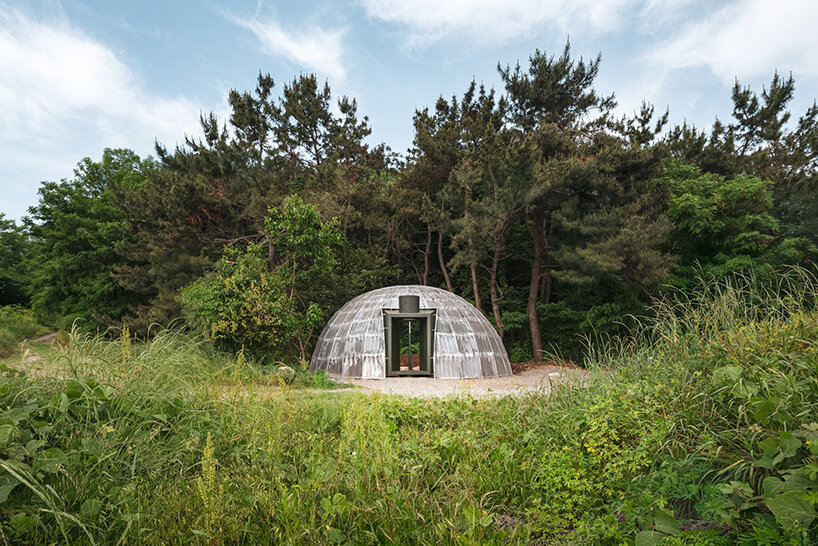
Open Hut (Teummak) by Seoul-based architecture studio one-aftr is a temporary pavilion installed in a forested plot within Hwaseong, South Korea. Located in a park surrounded by residential apartment towers, the structure introduces a porous and reflective space that foregrounds its surroundings rather than replacing them.

The project draws from the Korean words mak (막), meaning hut, and teum (틈), meaning gap. This hybrid term ‘Teummak’ frames the structure as both an architectural gesture and a conceptual opening. Where standard buildings often seal themselves off from their natural surroundings, this pavilion offers a deliberate exposure. It emphasizes the natural conditions already present, such as the quality of soil and the canopy of trees.

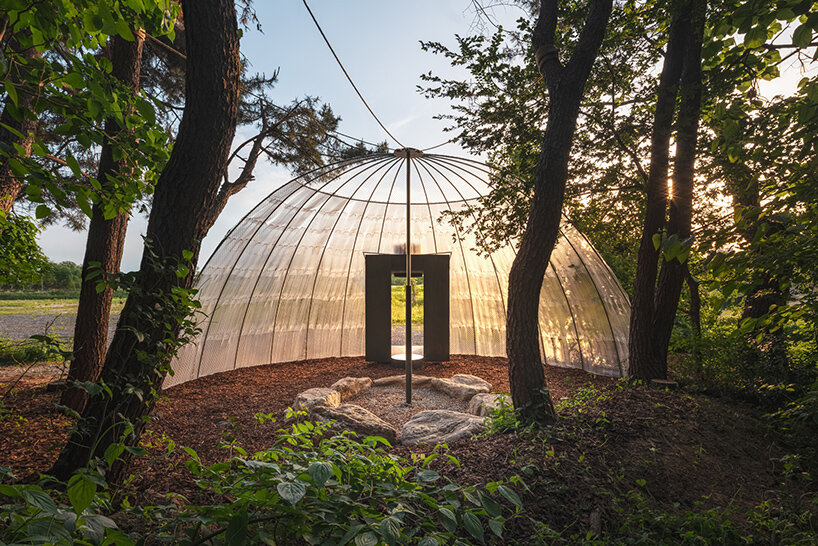
By centering the design around the site’s existing trees, the pavilion resists formal imposition. The structure delicately links these trees with a low, hovering roof to create a moment of spatial coherence without enclosure. It allows the verticality of trunks and foliage to continue uninterrupted.
one-aftr open hut
Open Hut is a pavilion designed by one-aftr in Hwaseong, Korea | image © Jang Mi

a lightweight, open framework by one-aftr

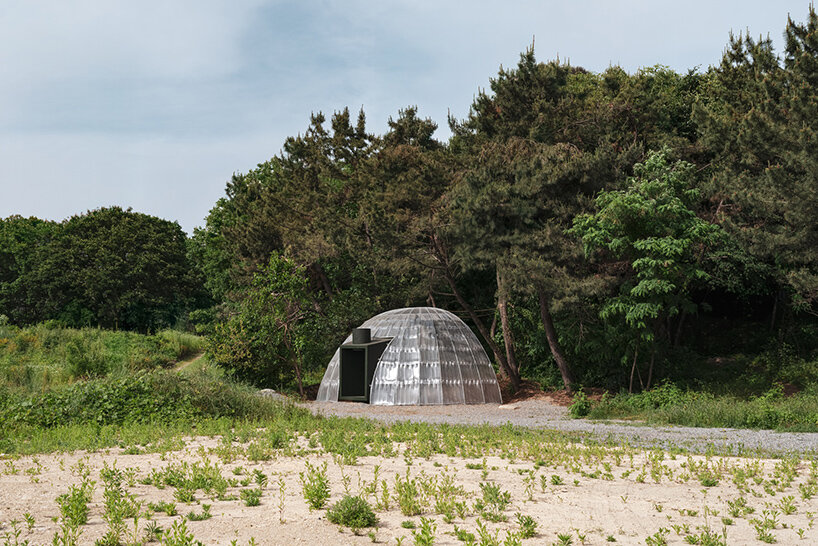
The architects at one-aftr build the open hut from a light framework of wood and metal, with mesh and acrylic panels integrated into the composition. These materials are arranged to diffuse views of the city beyond, filtering urban noise into softened light and color. The roof remains suspended above the ground plane, and its segmented, circular form suggests both shelter and void.

The geometry is loosely domed, shaped through a negotiation between the structural grid and the growth patterns of the trees. Rather than dominating the landscape, it mirrors it to create a calm interplay of shade and movement as sunlight passes through the canopy and materials throughout the day.
one-aftr open hut
the structure combines ideas of the Korean hut and the concept of a spatial gap | image © Jang Mi

a moment of interruption

The Open Hut by one-aftr can be understood less as a moment of interruption, rather than a destination. Visitors arrive to find a space that does not demand interpretation or participation but allows for quiet observation. The pavilion foregrounds the fleeting qualities of urban nature that are already there — the rustling leaves overhead, the shifting shadows filtered through the canopy, and the soft earth below.

Its success lies in how lightly it touches the land. The Open Hut avoids unnecessary ornament, offering instead a framework that listens, establishing an elemental relationship between shelter and site.
one-aftr open hut
it is located in an empty lot bordered by apartment blocks | image © Jang Mi
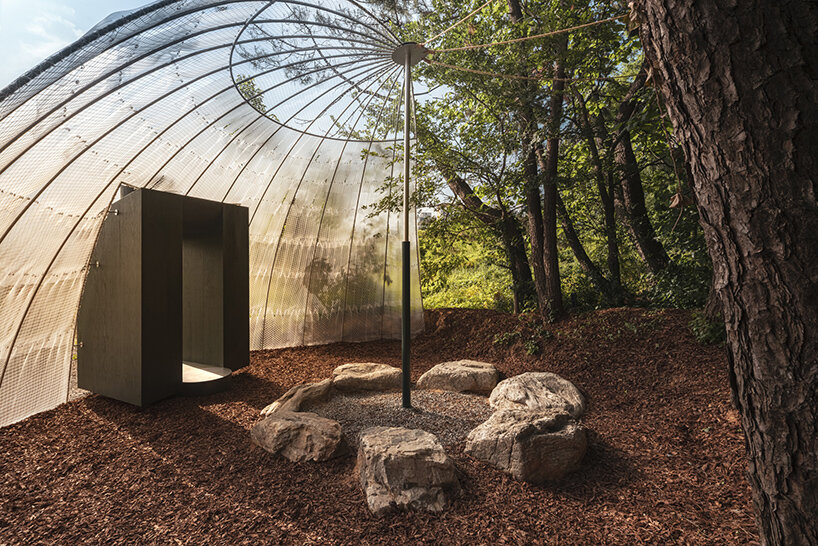
one-aftr open hut
the project connects the site’s existing trees with a suspended circular roof | image © Jang Mi
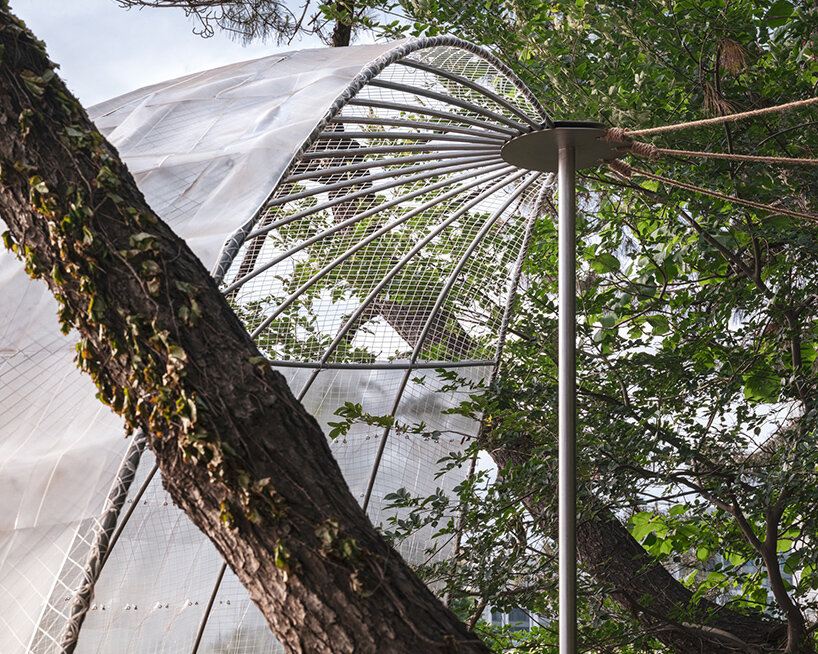
one-aftr open hut
wood, metal, mesh, and acrylic panels are used to frame and filter the surroundings | image © Jang Mi

Similar Posts

  • House LV1 (house nanchi 1 y 2)

    CASA LV1 (casa nanchi 1 y 2)
    BRIEF DESCRIPTION OF THE CONSTRUCTION
    The Casa LV1 (casa nanchi 1 and 2), is a multi-familiar conformed by two houses constructed in the same land, the main material used for its construction was white striated concrete.
    DESCRIPTIVE MEMORY
    The Casa LV1 (casa nanchi 1 and 2) is a complex of two houses designed for a family an elderly couple, their young daughter and their granddaughter. Each house has the necessary privacy for each development, with the interrelationship and coexistence of the family; they are located in an irregular diamond-shaped land of approximately 250m2, a gradient over 10% with a view to the southeast.
    The Casa nanchi 1, on its main floor has: living room, dinning room, kitchen, bathroom, main bedroom with closet and its own bathroom, this floor is directly connected with the service area; the lower floor has a hall, two bedrooms with closet and its own bathroom; the upper floor has a roofed recreation room and a garden terrace. All the floors are connected by a stair, and has a parking lot. The total constructed surface is of 160 m2.
    The Casa nanchi 2 has on its main floor: living room, dining room, kitchen, bathroom and service area; on the upper floor it has: main bedroom with closet and its own bathroom, an additional bedroom with closet, a little play room and a bathroom; on the lower floor, where the entrance is, has: two parking lots and an exterior stair which is connected to the other floors. The total constructed surface of the house is 145 m2 excluding parking lots.
    Both houses share main entrance, service yard, green spaces and services.
    The houses are named after the nanchi tree (byrosonimacrassifolia) that is located in that land; it was respected and the project was adapted around it, to make it a natural decoration for the dinning room of the Casa nanchi 1. This house was designed for an elderly couple and it has a terrace in the upper floor, which is a recreational and relaxing space with a view of the surroundings to enjoy with the company of family, friends and guests. It has a double-height space which allows the development of the tree.
    The design of the Casa nanchi 2, which was designed for the daughter and granddaughter of the family, is inspired in the Brno chair, designed by the architect Ludwig Mies van ser Rohe, which not only allows a large volume, but also an efficient and free structural principle because with this solution is obtained an overhang of 4.85 m with a support of 2.85 m, generating a space without any support under the construction.
    The concept of the houses is derogates no only from the connection (interior-familiar, exterior-landscape), but also from the visual freedom that people perceive before entering in the house and also in the interior of them. This is fulfilled by the volumetric integration that defined the spaces of each house, both prisms have specific substractions that allow a formal integration of the two elements; in the Casa nanchi 1 the terrace is subtracted and in the Casa nanchi 2 the parking area is subtracted, transforming both elements without losing its integrity.
    The connection of both houses is so important that is not only achieved materially with the union of the two architectonic objects from the common entrance, connotating the link of the family, but also with the landscape, through the transparency in the facade of the two houses, which creates a visual freedom for the inhabitants. This gives a greater illumination of the spaces, producing a feeling of spaciousness and allows the air circulation due to the large windows that are handled by the users.
    The material, white striated exposed concrete and stone dust of the region, recalls the honesty of the materials, this simplicity benefits the environment, because it doesn’t use coatings in walls, fooors or roofs, contributing the less possible to the pollution. The exposed finishes means less production, transportation and utilization of pollutant materials. As said before, the free circulation of air allows a constant cleaning of the interior air which allows a natural regulation of the temperature, achieving termic comfort for the users and reducing the use of electronic devices that cools artificially the place. Besides, the same large windows avoid the unnecessary use of artificial illumination during the day allowing the entrance of sunlight in the morning.