ford nucleon is atomic-powered car with nuclear reactor
Meet the Ford Nucleon, an atomic-powered concept vehicle with a nuclear reactor that Ford Motor Company never produced. Presented to the public in 1958, the project proposed a car that would run on nuclear power instead of gasoline. It came from the car manufacturer’s Advanced Styling Studio, whose premise was to work on projects that looked 10 to 20 years into the future. The American industrial and automotive designer George W. Walker led the styling division of the atomic-powered car Ford Nucleon.
He believed that concept cars should create publicity and reportedly told the designers to develop ideas that would pique the public’s interest, even when the technology didn’t exist yet. Joining him were James R. Powers, who drew the Nucleon design, and Alex Tremulis, who headed the Advanced Styling Studio. The Nucleon project started as an exercise in packaging, with the leads asking the styling team to design a vehicle with a heavy power source mounted in the rear instead of a front-mounted gas engine. James Powers realized that placing a heavy reactor in the back meant the passenger cabin needed to move forward to balance the weight. This created the cab-forward design that defines the atomic car Ford Nucleon’s overall look.
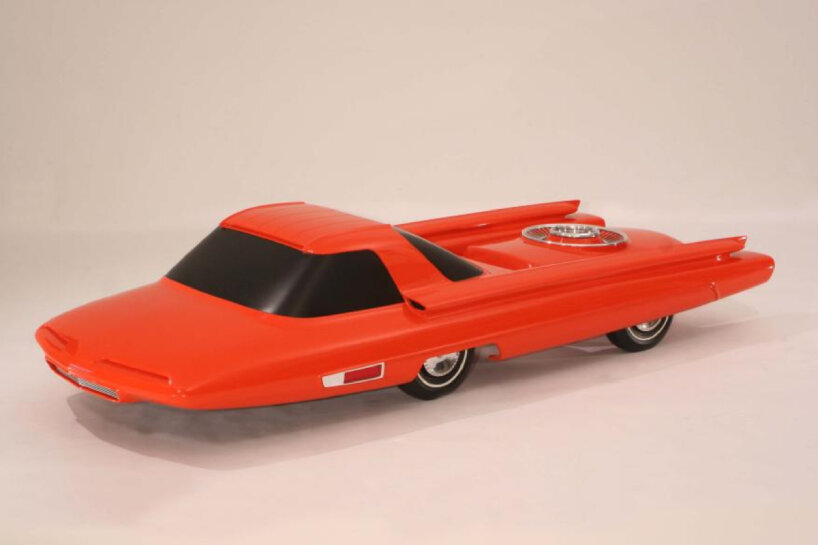
Ford Nucleon Scale Model, 1958 | image courtesy of The Henry Ford Museum from its collections
bubble’ houses cabin, referencing fighter jet cockpits
The resulting vehicle was part of an exploration of future transportation that included flight, nuclear power, and aerodynamics. It measured 200 inches in total length with a wheelbase of 69 inches (the wheelbase is less than 6 feet on a 17-foot car). This means the vehicle had large overhangs at both ends and that the front wheels sat under the passenger cabin. The rear wheels are positioned far back to support the reactor weight. The short wheelbase would allow the car to turn in cities, but it created handling problems with the heavy rear load. Then, the passenger cabin extended beyond the front axle. This cab-forward design served two functions. First, it balanced the weight of the nuclear reactor behind the rear axle. Second, it maximized distance between occupants and the radiation source. The cabin features a cantilever roof, which allows a windshield with no pillars and a curved rear window.
A ‘bubble’ houses the cabin, an element referencing fighter jet cockpits and appearing on other 1950s concept cars like the Lincoln Futura. Since the nuclear reactor would generate waste heat that must leave the system, James Powers placed air intakes at the front edge of the roof to channel cooling air toward the reactor at the rear. The team also added more intakes into the roof support pillars. The rear section of the atomic car Ford Nucleon holds the Power Capsule with twin tailfins that could stabilize it for high-speed travel. The fins created a V-angle that drew attention to the reactor location, and the bumpers retracted to reduce air resistance during highway driving. Ford planned to make the body panels from aluminum to reduce weight to offset the lead shielding that the reactor required. Then, the propulsion system would work as a closed-loop steam cycle.
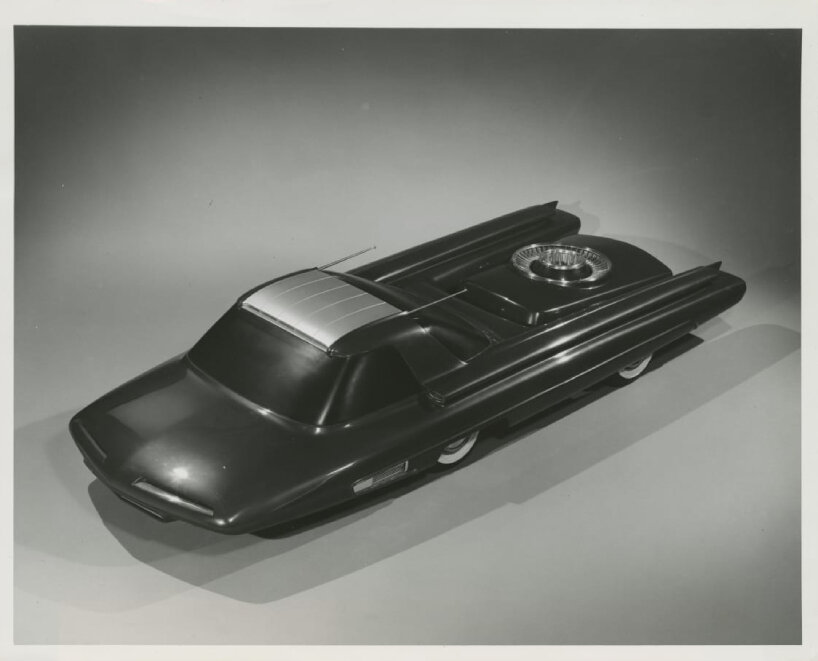
scale model of the Nucleon, a 1958 Ford Motor Company styling conception for an atomic-powered car | image courtesy of The Henry Ford from its collections
drivers would not need to refuel the car with nuclear reactor
A small nuclear reactor using Uranium-235 fission would generate heat, and then this heat would transfer through a primary coolant loop to a steam generator. The steam generator would turn water into high-pressure steam, and the steam would drive turbines. One turbine would power the propulsion system. Another turbine would run cooling pumps and electrical generators. After passing through the turbines, the steam would cool in a condenser and return to liquid water. The system would pump this water back to the boiler to repeat the cycle.
Ford recognized that car owners could not handle uranium fuel rods, so the company proposed a service model based on the replaceable Power Capsule. Owners would never refuel the car, and when the core depleted after 5,000 miles, the driver would visit a specialized Ford station. Technicians would remove the entire Power Capsule and install a fresh one. The atomic car Ford Nucleon started to face problems that made production impossible. The main issue was radiation shielding weight. A fission reactor releases neutrons and gamma rays, and gamma rays need dense materials like lead or tungsten to block them.
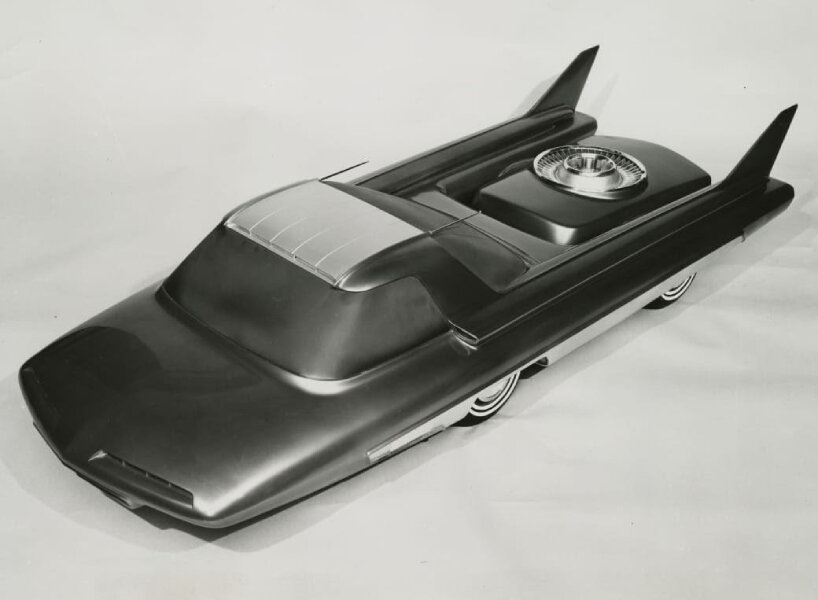
the project would run on nuclear power instead of gasoline | image courtesy of The Henry Ford from its collections
Neutrons require hydrogen-rich materials like water or concrete to slow them down. A reactor producing 100 to 200 horsepower would need shielding that weighs approximately 50 tons. George Walker stated the design assumed reactor bulk and shielding weight would decrease in the future, but this assumption was reportedly wrong. The physics of how radiation interacts with matter cannot change through engineering, making the 50-ton shielding around the concept vehicle immovable. The second problem of the atomic car Ford Nucleon was heat rejection.
The concept vehicle only had air, and the roof intakes James Powers designed could not remove the waste heat the reactor would produce. The third problem was accident safety since a traffic collision that breached the containment vessel would release radioactive steam and core material. Even if the vehicle was never produced in the end, a ⅜ scale and non-functional model of it exists today at the Henry Ford Museum in Dearborn, Michigan, inside the Driving America exhibit. The museum has loaned it to other institutions, including the Atomic Museum in Las Vegas. Studio photographs from 1957 to 1958 show Ford built at least two models during development. One was plaster for studying forms. One was fiberglass for the final show model. The surviving artifact is the fiberglass version.
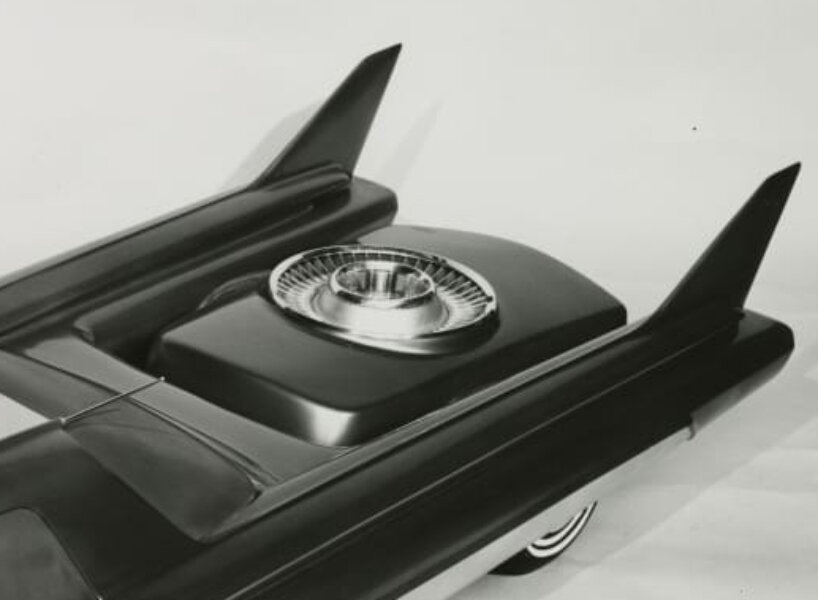
nuclear reactor mounted in the rear | image courtesy of The Henry Ford from its collections
project info:
name: 1959 Ford Nucleon
company: Ford Motor Company | @ford
museum: Henry Ford Museum | @thehenryford
location: 20900 Oakwood Blvd, Dearborn, Michigan