Casa T: a dual-purpose home for a tattoo artist in Bangkok
Located on a trapezoidal site in a medium-density suburb west of Bangkok, Casa T is a dual-purpose residence designed by SSAA for a tattoo artist. The project integrates two distinct programs within a single structure: a working atelier and a private family home.
Set on a trapezoidal site, the design turns its angular facade toward the adjacent main road, providing a visual and acoustic buffer for the spaces within. The building’s exterior geometry, defined by sharp lines and angular surfaces, draws reference from the precision inherent in tattoo artistry. The massing strategy emphasizes a monolithic form with selective openings toward internal courtyards, introducing daylight and vegetation into the interior spaces.

a street-facing solid facade reveals only a sharp cut | all images by Chakkraphob Sermphasit
SSAA’s design retains privacy while emphasizing visual openness
The atelier occupies the front portion of the house and is accessed via a concealed entrance. A double-height volume serves as the focal point of the workspace, introducing verticality and connecting to an internal courtyard. This spatial configuration allows natural light to penetrate deep into the interior while creating a controlled environment suitable for the nature of the craft. The material palette of the atelier is intentionally dark, drawing on inky tones that reference the artist’s medium, while internal finishes prioritize durability and ease of maintenance.
In contrast, the private residence is accessed separately and organized across two floors. It employs warmer materials and lighter tones, creating a distinct spatial character compared to the atelier. Private courtyards positioned along the plan provide filtered daylight and views of greenery, supporting a calm domestic environment. The layout prioritizes privacy while maintaining visual connections to the outdoors. Circulation between work and living zones is carefully managed to support both separation and proximity, allowing the resident to transition between professional and domestic activities as needed. By using spatial thresholds rather than rigid divisions, Casa T by SSAA architectural practice offers a nuanced balance between these two aspects of daily life.
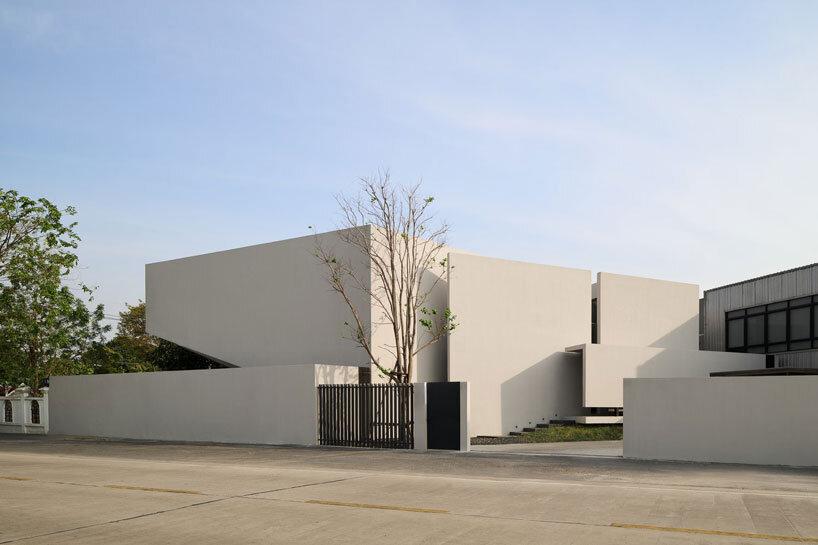
the project sits on a trapezoidal site in a medium-density suburb west of the city

the entry is hidden behind the monolithic facade

a double-height volume anchors the atelier, bringing natural light and greenery into the space

dark finishes frame a sunken lounge, oriented toward the garden

material contrasts reinforce the distinction between the atelier and the residence

the concealed door sits flush within the dark wall, reinforcing the room’s geometric order