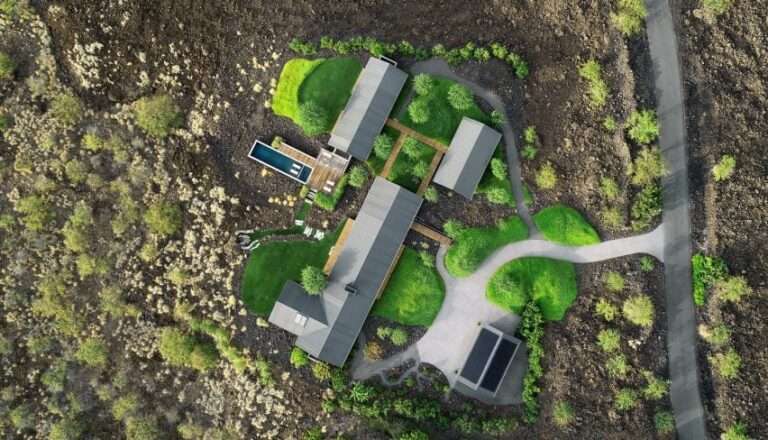
Ayoughi House is a minimalist residential villa located in the Taunus region, Germany, designed by Philipp Architekten. The most demanding brief in residential architecture is not the technical one – it is the human one. When the client is herself an architect, the conversation between designer and inhabitant shifts entirely. Expectations sharpen, vocabulary aligns, and the resulting project carries an unusual degree of conceptual precision. Ayoughi House emerges from exactly this dynamic: a collaboration between Philipp Architekten and a client whose professional fluency allowed the design to reach toward something genuinely considered rather than merely accomplished.
The organizing gesture of the project is the central planted atrium – an interior courtyard that functions simultaneously as light well, spatial anchor, and living ecosystem. This typology has deep roots, from the Roman impluvium to the courtyard houses of Persian and Andalusian tradition, and its revival in contemporary residential work signals a broader turn away from the optimized suburban plan toward architecture that mediates between enclosure and atmosphere. Here the atrium does not merely borrow light from above; it pulls air and vegetation into the domestic interior, dissolving the boundary between architecture and landscape at the building’s very core.
The entry sequence establishes this ambition immediately. The foyer opens vertically into a double-height atrium volume, and within that space a sculptural staircase rises alongside a geometric wooden cube – an object that operates simultaneously as furniture and as built form. This kind of deliberately ambiguous element recalls the spatial thinking of designers like Carlo Scarpa, where the boundary between architecture and object collapses into something richer than either category alone. The cube anchors the vertical composition while introducing a tactile, craft-forward counterpoint to the surrounding stone and plaster surfaces.