Before & After: A Remodel Brings a Famous Cartoonist’s Former Home Back to Life

This Seattle house high above Lake Washington once belonged to illustrator Irwin Caplan. Now it blends refreshed midcentury character with a seamless addition.

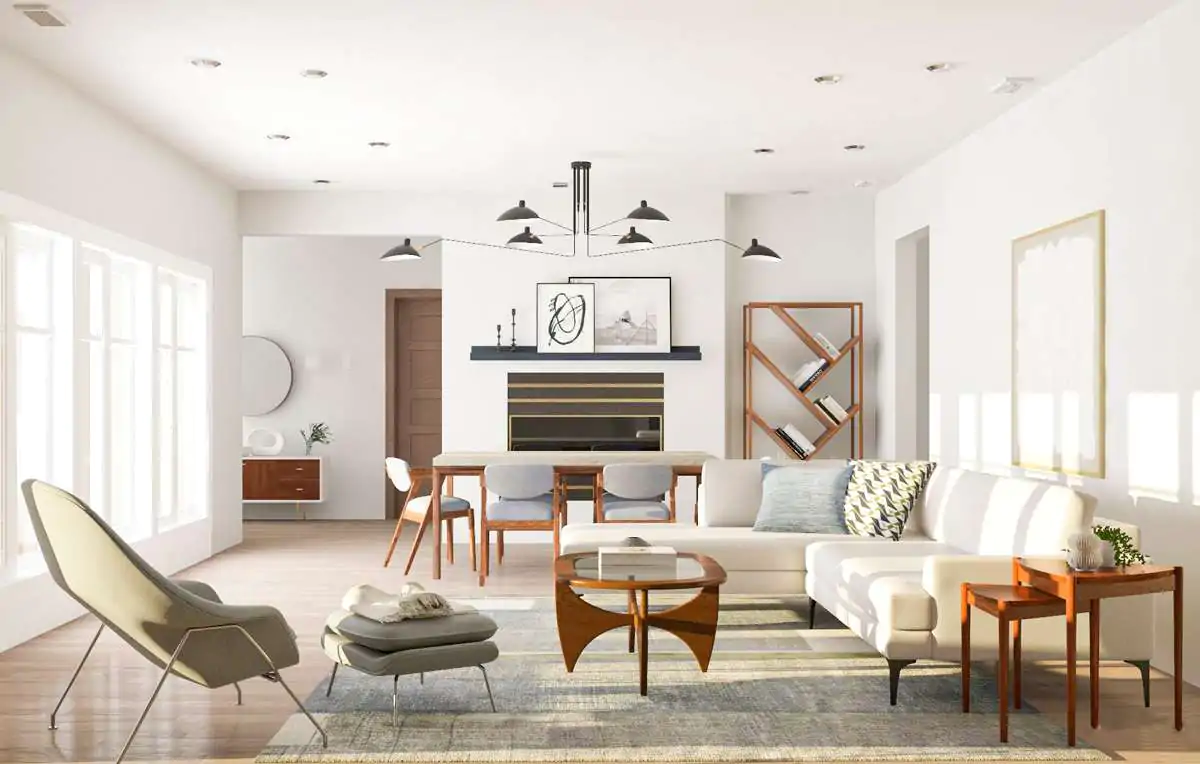
Now, the furniture grouping comfortably occupies the room. A sectional from Gus Modern sits with a custom steel coffee table and Paulistano Armchair.

The cliché goes that you shouldn’t judge a book by its cover—and the same could be said for the front facade of this 1951 home in the Laurelhurst neighborhood of Seattle. The low-slung street front is mostly defined by a carport—but the interior tells a different story, with a wall of glass overlooking Lake Washington.

The stunning views were a welcome surprise to Prentis Hale and Kyle Griesmeyer of SHED Architecture + Design. It looks like “a very humble, modest home from the street because of the slope—and the door was opaque, with the garage just sort of in your way,” says Hale. “Once you walked in, the house really opened up to the landscape.” 

Before: Exterior

Before: A carport dominated the front façade of this 1951 house.

Before: A carport dominated the front facade of this 1951 house.

Courtesy of SHED Architecture and Design

The house was originally built for illustrator Irwin Caplan, known for the “Famous Last Words” comic strip in the Saturday Evening Post. The residence was recently bought from Caplan’s estate by new owners, who found that it ultimately needed both cosmetic and functional upgrades. A renovation led by SHED lightly reorganized the interior so that the home’s midcentury character can shine.

After: Exterior

A fresh coat of paint gives the home a striking update.

A fresh coat of paint gave the home a striking update.

Photo: Rafael Soldi

A combed cedar plank soffit sits above a refreshed front door. The opaque glass was replaced with clear glass so the owners can see out, and the wall-mounted mailbox is from V Sons Designs.

A combed cedar plank soffit sits above the refreshed front door. The opaque glass was replaced with clear glass so the owners can see out, and the wall-mounted mailbox is from V Sons Designs.

Photo: Rafael Soldi

See the full story on Dwell.com: Before & After: A Remodel Brings a Famous Cartoonist’s Former Home Back to Life

Similar Posts

  • San Antonio House

    The trapezoidal tracing of the property is what defined the construction of this house into three clearly settled volumes. Vegetation also plays a protagonist role in the design of this house, both outdoors and indoors. The exterior trees enclose the house generating distinct tons of shades and colours during the different seasons of the year. Within the interior, the unruly green vegetation, contrasts with the stone floors and solid walls, reaching a perfect sense of balance. The entrance, a double height lobby that creates contrasting sensations and distinct visual ending points originated by water mirrors, light shafts, a tree and a staircase. The walls that shape this area, divide the spaces into private and public areas. The ground floor, is organized into two blocks each with a different purpose: The left side, is a white solid cube that integrates the study and the master bedroom and is separated from the other block by a water mirror and a yard that generates the desired privacy, peace and tranquility. The right side, the social area, is a rectangle closed to the west by a rigid wall and opened towards the interior of the house through large floor to ceiling glass walls, giving sober transparency to the yard with views to the garden and the central courtyard. The different angles within the construction achieve visual ending points with great character, as well as, enhancing the sensations provoked by the pure whites that evolve into mixed tones as the day and the seasons go by.

  • Raw Concrete Beauty Coupled with Earthen Green Charm Inside Elegant Aussie Restaurant

    We love the going out once in a while to that fancy restaurant for which you need to dress up a touch. It is an experience that we tend to reserve for special occasions. On a more regular basis, we like our hangouts to be much less formal, far more inviting and even a little […]

    You’re reading Raw Concrete Beauty Coupled with Earthen Green Charm Inside Elegant Aussie Restaurant, originally posted on Decoist. If you enjoyed this post, be sure to follow Decoist on Twitter, Facebook and Pinterest.

  • Ravoli Drive Residence

    Sited on a site slightly under an acre in the heart of the Pacific Palisades area of Los Angeles, the site for this estate residence descends over thirty feet from top to bottom. Narrow at the street and widening toward the rear, the building was designed to appear as a very private single story structure from the street and expand as the house moves into the site. At just under 14,000 sq. ft. the house was conceived of as a California Modernist Estate the building utilizes the site slope and widening to create a wing typology each reaching into the site to capture garden spaces, set up views and account for service amenities. Designed for peak privacy to the street, there are a series of site walls and fencing that define the property edge. After passing through the gate, the entry to the house is through a descending Entry Garden with water feature with a view through the house to the slopes of Will Rodgers State Park beyond. Shaped as a modified T, the wings of the house extend into the landscape creating separate wings dedicated to the elaborate programming of the building. Containing formal spaces for Entry, Living and Dining the house also offers a large entertainment style kitchen, Large Family Room, Library, 16 person Theater, Wine Cellar, Gym with Spa Bath including Sauna and Steam Room, secondary winter closets, dedicated two bedroom Guest House as well as six bedrooms including a Master Suite over 1,500 square feet with his and hers baths and closets as well as a garage for seven plus additional carport parking for three. All of this is balanced with a series of large exterior decks, patios and pool all wrapping around the stately eighty-foot tall Eucalyptus tree, which served as the aesthetic basis for the materiality of the building. Balancing the solidity of the extensive board form concrete walls is an expansive use of glass and the warmth of stained wood siding throughout the building. The remainder of the building is wrapped in integral colored steel troweled stucco. This palette is based on the colors and tones of the tree that is the center of the garden. Passing materials from the interior to the exterior, doors disappearing into internal pockets and flooring extending onto the decks and patios all help to create a seamless relationship for the interior to the exterior, house to land. This relationship realizes a full use of the site for its entire acre site.