|

new york’s space-age bubble house lists for sale for the first time in over 50 years

the new york townhouse fit for a martian

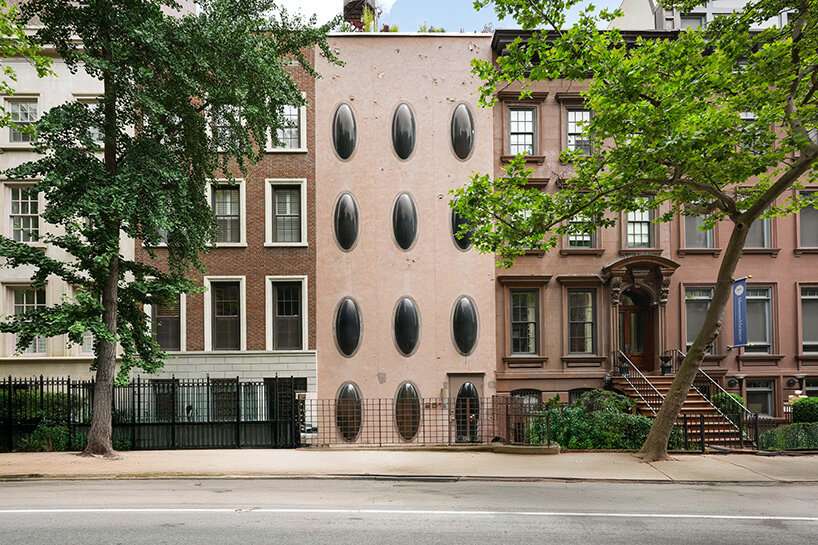
A rare example of space-age residential architecture in New York, the Bubble House at 251 East 71st Street has been listed for sale by Leslie Garfield for the first time since 1973. Originally a 19th-century brownstone, the property was dramatically transformed in 1969 by architect Maurice Medcalfe of Hills & Medcalfe into a beloved modernist townhouse recognized by its Martian-esque facade.

The house’s exterior is defined by a smooth, pale stucco surface punctuated by convex oval windows, Medcalfe’s reinterpretation of the classic bay window. These deeply curved apertures flood the interior with light while forming the feature that gives the residence its popular nickname, the Bubble House. Set among the brick and limestone facades of Lenox Hill’s Upper East Side, the house asserts its difference through form, material, and rhythm, projecting an architectural language more aligned with futurism of the Space Age than historic revival.

Medcalfe’s renovation in the late 1960s came at a moment when modern architecture was beginning to infiltrate even the most tradition-bound New York neighborhoods. His approach to the townhouse typology was both playful and disciplined, rejecting symmetry in favor of curvature and lightness. The building’s facade appears as a shell, closed in its material consistency but animated by the swelling windows that seem to hover over the street.
bubble house new york
images courtesy Leslie Garfield

a mid-century home in need of renovation

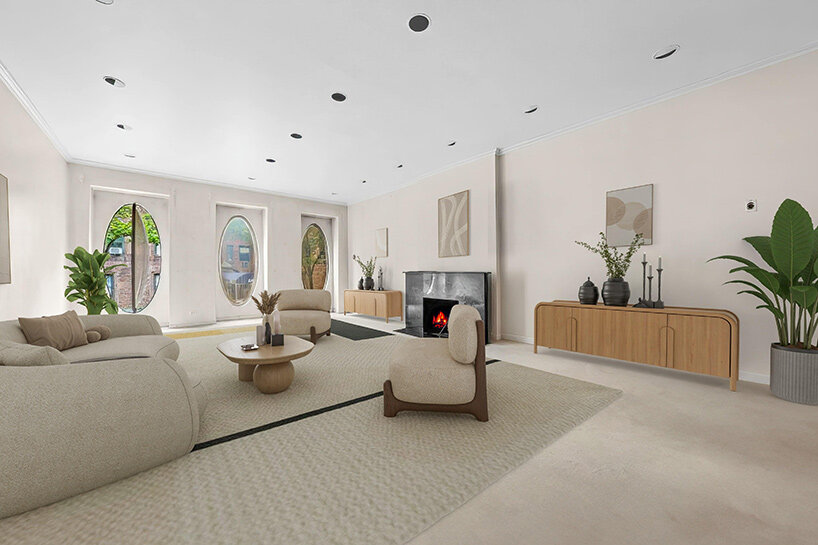
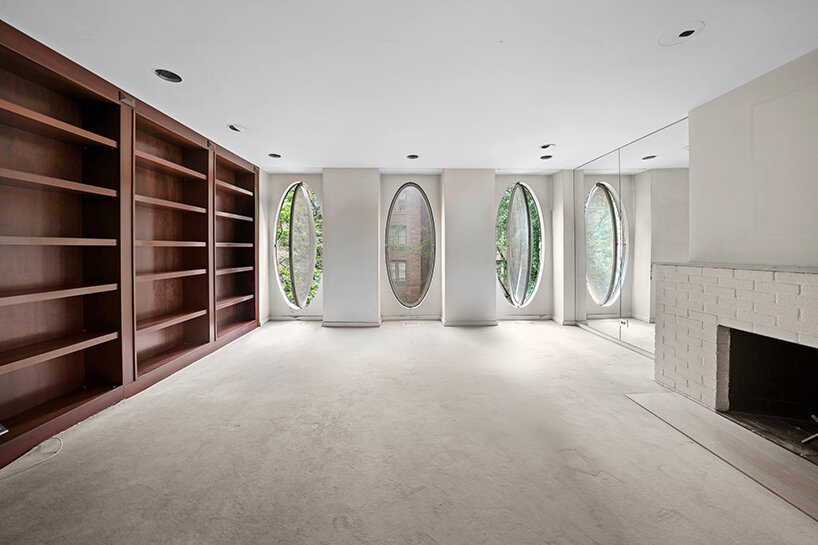
Inside the iconic Bubble House, the generous proportions and mid-century layout of a New York townhouse are retained. These interiors span approximately 4,736 square feet across four stories plus a basement. The current configuration includes four bedrooms, five bathrooms, and a street-level office that allows for flexible live/work arrangements. While the finishes have aged, the structure offers a clear framework for adaptation.

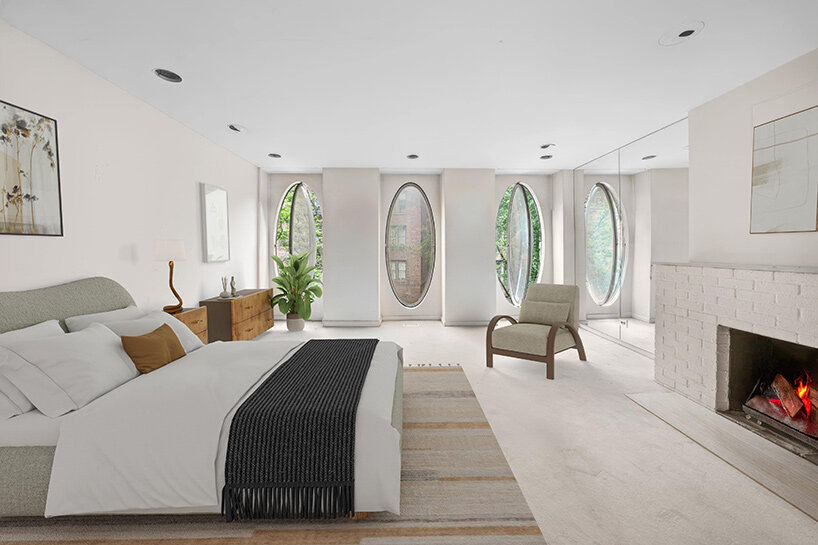
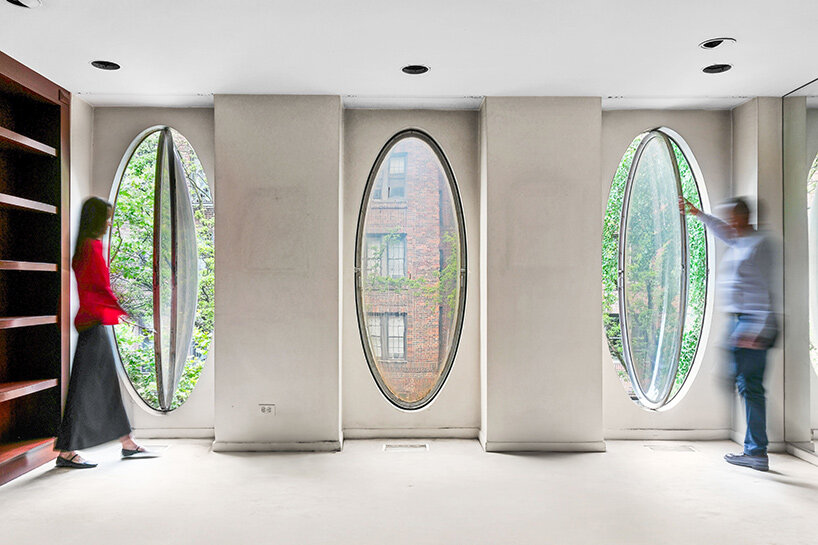
The plan provides large, open rooms with natural light channeled in through the oval fenestration. The resulting brightness and privacy create a foundation that could maintain the building’s architectural identity even through a much-needed contemporary restoration.
bubble house new york
the Bubble House in New York is listed for sale for the first time in over fifty years

the bubble house: an upper east side outlier 

Located on a quiet, tree-lined block just off Second Avenue, the Bubble House is within walking distance of Central Park and numerous cultural institutions. Its presence in Lenox Hill — a neighborhood characterized by turn-of-the-century architecture and prewar apartment buildings — offers a study in contrast. Unlike many historic conversions that blend into the streetscape, this residence stands apart, a deliberate interruption that has endured for more than five decades.

That durability is due in part to the consistency of its ownership. After designing and living in the home for several years, architect Maurice Medcalfe sold the property to Rabbi Arthur Schneier, who has maintained it ever since. The listing marks the end of an era and opens a new chapter for a house that continues to provoke curiosity and admiration. 
bubble house new york
architect Maurice Medcalfe transformed the 19th-century brownstone into a modernist home in 1969

Although the Bubble House is not officially landmarked, its design has earned cult recognition among architecture enthusiasts. Its distinctiveness lies in its resistance to classification. It is neither a standard modern townhouse nor a nostalgic replica. Instead, it occupies a narrow but compelling territory between residential function and architectural experiment.

With its $5.75 million asking price through Leslie Garfield (see here), the property enters the market as both a collectible and a canvas. Its next owner will inherit a home with architectural pedigree, spatial character, and an enduring sense of otherness in the heart of Manhattan. Whether preserved, restored, or reimagined, the Bubble House remains one of New York’s most singular architectural statements.
bubble house new york
the facade features smooth stucco and convex oval windows that earned the home its nickname
bubble house new york
natural light enters through the operable windows, creating bright spacious interiors

Similar Posts

  • L7 Home

    Architects: Augusto Fernández Mas (K+A Diseño),
    Mauricio Miranda (MM Desarrollos),
    Mariel Esquivel and Cesar Cardoso. Construction: K+A Diseño Main Purveyors: MicMac, Solesdi y Venster. Interior decoration: TAI Arquitectura de Interiores Photography: Onnis Luque The linear black cabin was designed by the collaboration between Augusto Fernández Mas and Mauricio Miranda as a country house for a client with three specific demands: simple layout, low maintenance, and living quarters and public areas in one floor. RA.L7 is located within Rancho Avandaro Country Club in the outskirts of Valle de Bravo, an hour and a halve drive from Mexico City. It is a project that portrays a strong character form the outside but at the same time invites passersby to enter. In the inside, it offers a warm cabin like feeling that through its simplicity and windows facing the golf course, guides the view to the outside. The lower concrete volume ads a sense of solidity and stability to the house, and its layout divided by a garage open on both sides provides an invitation to enter. [
    The project uses the topography of the terrain to its advantage, thus generating two volumes: the upper one which encloses the living and general public areas and the bottom one encompassing the garage, technical and service areas. The outside materials are Japanese style burnt wood (Shou-sugi-ban), Canadian darkened wood, concrete, and ceramic tiles (roof) that in turn evidence the simple lines of the design. The choice of materials demands close to null maintenance.
    The west façade, which faces the street, has dark wood symmetric divisions over the main interior hallway, creating privacy at an angle and almost unrestricted view when perpendicular to them. The purpose is to allow light into the house and permit the views to the equestrian club on the other side of the street while maintaining limited exposure to passersby’s. The east façade faces the golf course, thus there is an honest openness through all glass façade with sliding window doors and complemented with a glass-roofed terrace. In attention to the requested simplicity in the layout, the linear internal distribution has four rooms laid in a sequential manner culminating with living—room, dining-room and kitchen. One dramatic hallways communicates all areas in a straight line, adding to the simplicity of the design layout. With over 650 square meters of inside space, only one internal staircase was employed to communicate with the service areas and garage. There are two accesses to the house without stairs for the owner to comfortably access. In total, the terrain is 2,200 square meters of which ___ square meters were used for the house.
    There is a comforting feeling of warmth inside, but the same time opens up to go and enjoy the outside. It is to be lived inside wanting to be outside and, once outside, feeling invited to be protected inside. The linear and simple geometry of the house is soothed by the layout of the wood beams on the ceiling and the elegant and at the same time rough aspect of the wood floor and wood paneling on the walls. RA.L7 house is one of two recent projects done by the collaboration of Augusto Fernandez and Mauricio Miranda in Rancho Avandaro. Augusto Fernandez, through its K+A Diseño firm, is an active architect and constructor in Valle de Bravo with several country homes competed in the last years. Photography is by Onnis Luque.

  • Timeless Opulence: 20 Victorian Kitchens with Modern Functionality

    An era that was defined by opulence, a brazen show of wealth and power and born out of deep English traditions that have been altered as they spread to different corners of the globe – Victorian period is one that instantly conjures up images of opulence. Its influence on home design can be seen in […]

    You’re reading Timeless Opulence: 20 Victorian Kitchens with Modern Functionality, originally posted on Decoist. If you enjoyed this post, be sure to follow Decoist on Twitter, Facebook and Pinterest.

  • Office for Visual Effects Studio Combines Industrial Style with Creative Spaces

    A high-end VFX design studio demands a very special style of architecture and StudioAC delivers in this regard with the ARTJAIL Offices in Toronto. The office feels modern and elegant with the existing industrial elements of the building being carefully intertwined with modern overtones. A number of new spaces were added to the existing floor […]

    You’re reading Office for Visual Effects Studio Combines Industrial Style with Creative Spaces, originally posted on Decoist. If you enjoyed this post, be sure to follow Decoist on Twitter, Facebook and Pinterest.