Robots and AI at the venice architecture biennale 2025
At the Arsenale of the Venice Architecture Biennale 2025, robots and AI exist for and with humans, a glimpse at everyday life in future cities. These humanoids and robotics at the international exhibition, which runs until November 23rd, display their growing role in reshaping how structures and wearables are designed, built, and used, both on Earth and in space. They support human exploration and survival out of Earth, form part of construction tasks, and bear systems that allow them to adapt to the environment and collaborate with humans to perform different tasks. Take the BioSuit by Dava Newman and Guillermo Trotti. It’s a 3D textile framework built with computational design and fiber integration, tailored to everyone’s body dimensions. It has wearable sensors and actuators, thermal protection, radiation shielding, and active materials for compression.
The suit is designed to support astronaut activity on the Moon and Mars. It even comes with real-time mission planning and metabolic monitoring to combine astronaut data with environmental inputs and guide the astronauts with their exploration. Positioned next to this suit at the Arsenale, visitors see the Lunar Ark by IVAAIU City. Another application of robotics in space development, it depicts a data center on the Moon using robotic systems. The goal is to mitigate risks related to climate change on Earth by storing critical data off-planet. The robots come in by assembling the archive infrastructure and carry out the system updates using optical laser communication. For the exhibition, the design team places a robot arm on top of Boston Dynamics’ robot dog, Spot.
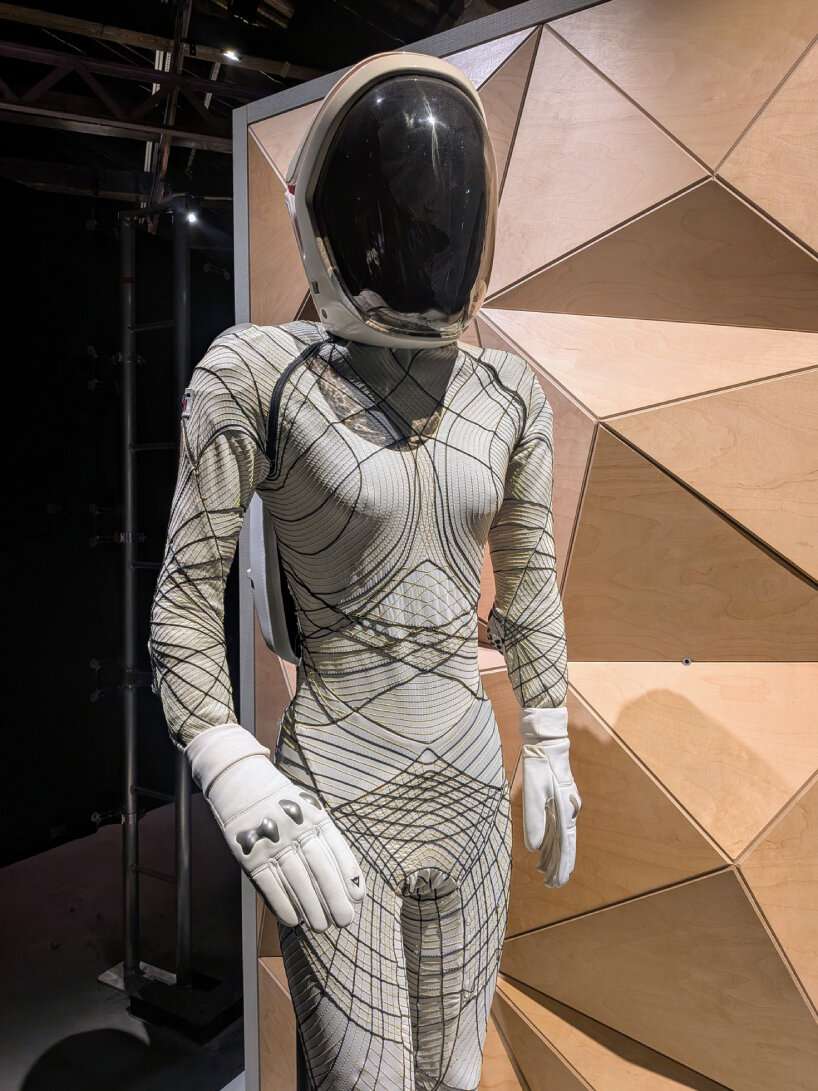
BioSuit by Dava Newman and Guillermo Trotti | image © designboom
Machines ‘help’ humans, not replace them
Robots and AI only take up a part of the Arsenale at the Venice Architecture Biennale 2025, but it’s enough to announce and remind people of their growing presence in people’s lives and the architecture industry. Bjarke Ingels Group, Laurian Ghinitolu, and Arata Mori, for example, present an installation where traditional Bhutanese woodworking is helped by a robotic arm. This six-meter, diamond-shaped wooden beam is partially carved by a human and partially by a robot using AI. The case isn’t to show that robots will replace humans. Instead, the installation demonstrates how we can fire up the robots for help, shouldering some of our workload.
There’s another pair of robots and AI at the Venice Architecture Biennale 2025 that exhibits how machines and humans can work together. That’s CO-POIESIS by Philip F. Yuan and Bin He. Here, the duo built a temporary pavilion for the two robots, made from salvaged timber and with robotic fabrication. The large structure hosts two wired robots with sensors: the one at the front plays the steelpan drum, while the one behind dances. Outside the installation, there’s another steelpan drum that visitors play. Once they do, the robot hits the same drum that the visitors strike, and soon enough, the second robot begins to dance.
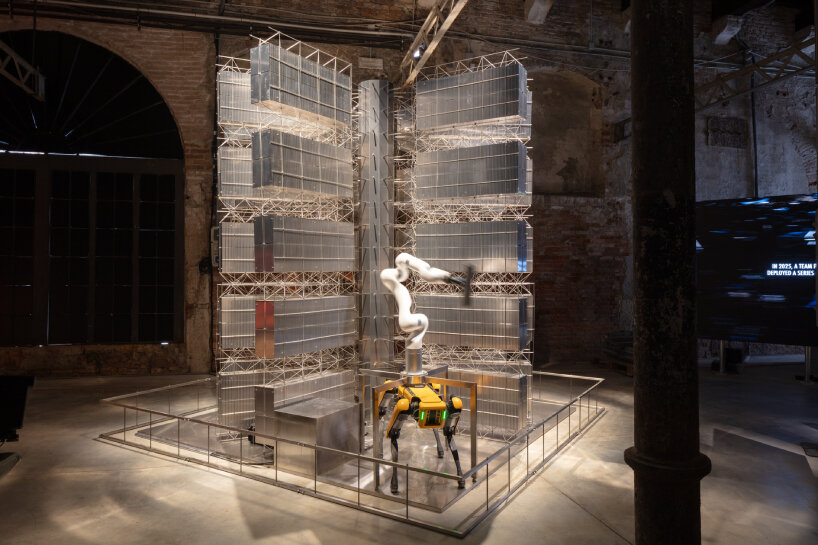
Lunar Ark by IVAAIU City | image courtesy of IVAAIU City
Humanoids can gain self-awareness over time
Can robots and AI gain self-awareness? During the Venice Architecture Biennale 2025, the installation Am I A Strange Loop? by Takashi Ikegami and Luc Steels attempts to answer the question. It features a humanoid robot called Alter3. It doesn’t have skin around its body, but the machine has a face and two hands, sculpted from clay-like material. The design team installs systems for perception, motion control, memory, and language processing.
This means that Alter3 can converse with visitors and move its hands and head as it talks using language models. There’s also Machine Mosaic by Daniela Rus, demonstrating the use of a humanoid robot in bricklaying and mosaic assembly. It has a computer vision system that enables the robot to sense and interpret its surroundings. Because of this, it can translate what it sees into action, mimicking it even. During the exhibition, the robot repeatedly assembles and dismantles components, showing how robotics can perform structured building tasks.
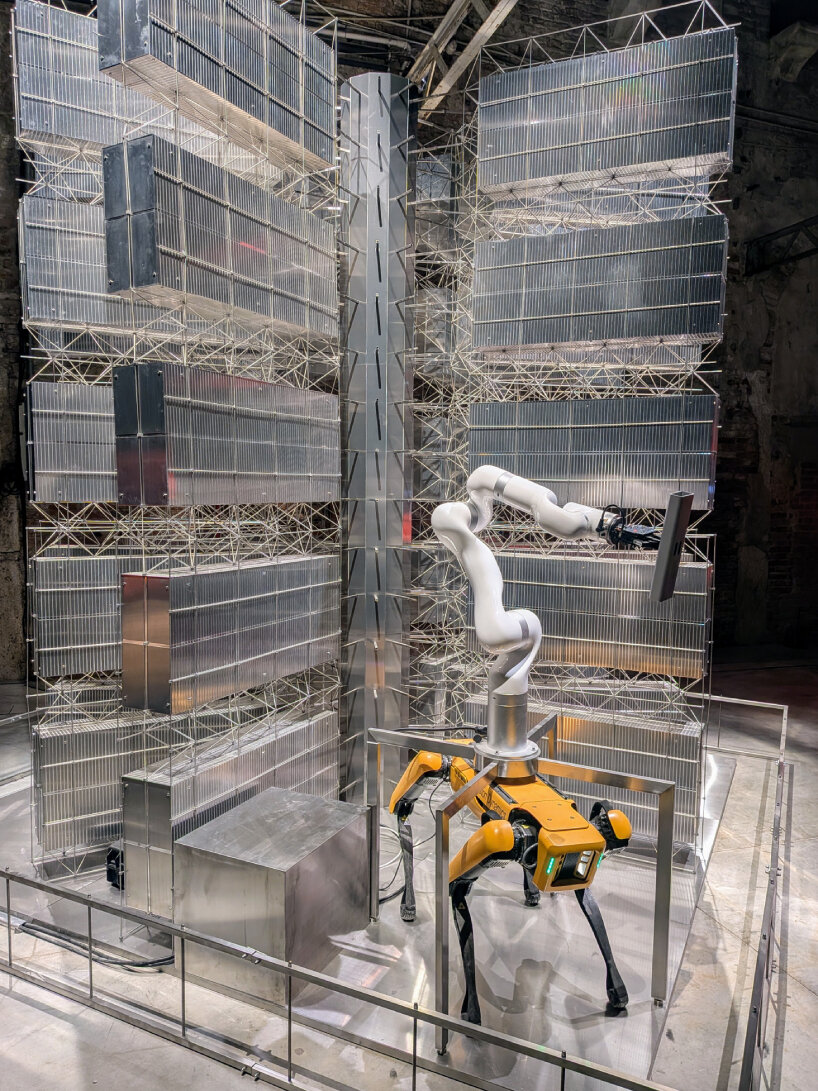
the installation significantly depicts a data center on the Moon using robotic systems | image © designboom
The experiment looks into robotic self-awareness. Researchers believe can develop when feedback loops connect a robot’s outputs to its inputs, creating a recursive cycle. These robots and AI at the Venice Architecture Biennale 2025 still mirror the already growing sphere of the machinery in space, architecture, Earth, and human lives.
Whether helping astronaut performance, constructing lunar facilities, assisting with craftsmanship, or testing theories of consciousness, robotics, and the people behind them, try to expand the boundaries of design, construction, and space exploration. These machines take on more functions in both land and extraterrestrial environments, and the international exhibition, which runs until November 23rd, 2025, spotlights the relationship between human activity and robotic support that’s becoming interdependent.
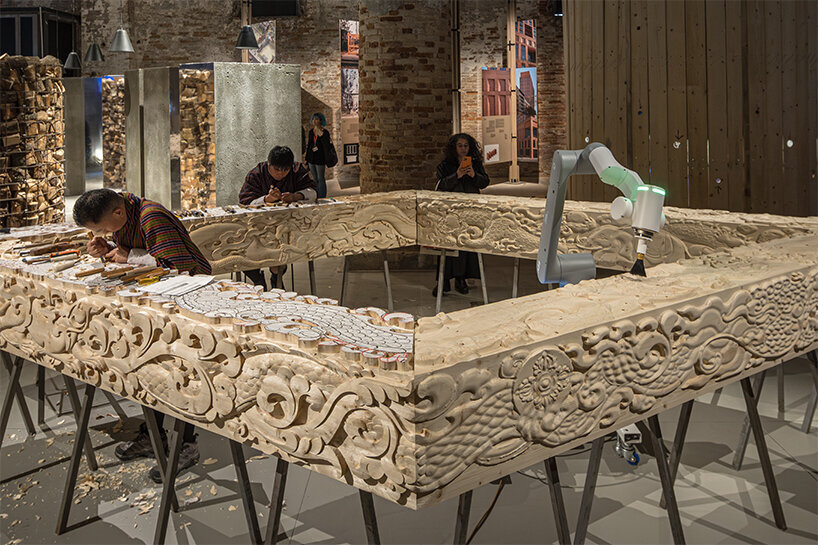
Ancient Future: Bridging Bhutan’s Tradition and Innovation by Bjarke Ingels Group, Laurian Ghinitolu, and Arata Mori | image courtesy of BIG
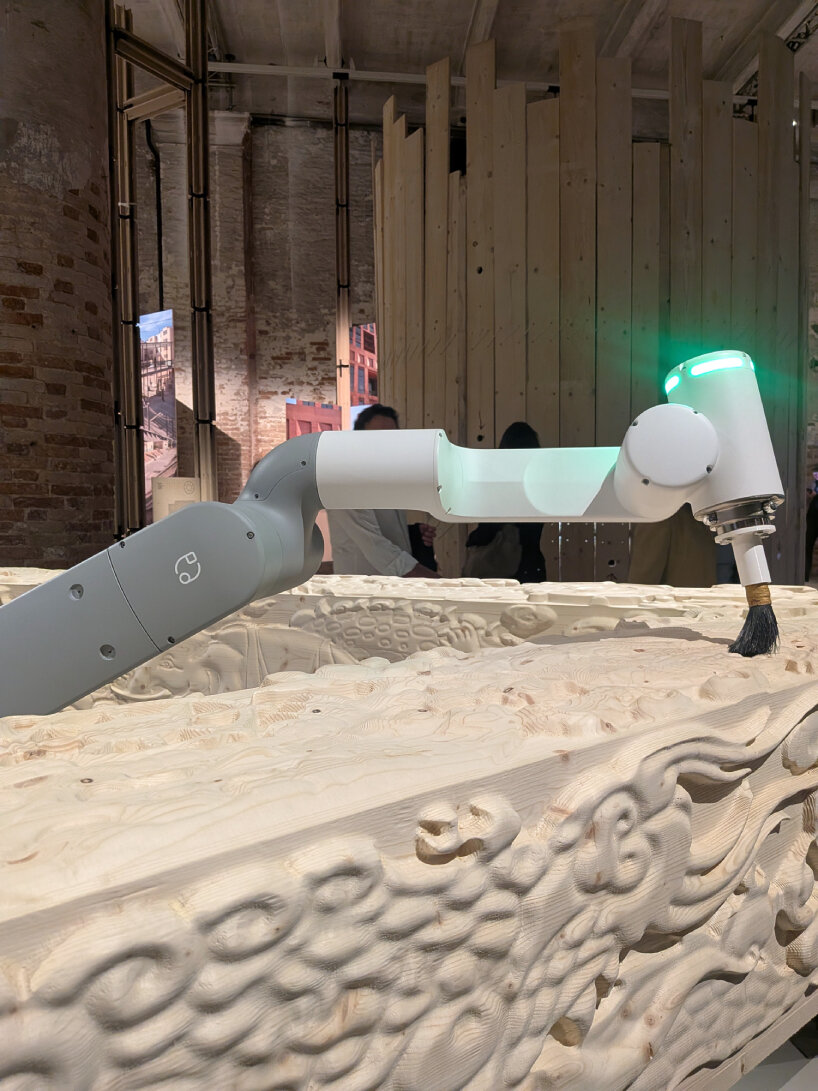
traditional Bhutanese woodworking evidently helped by a robotic arm | image © designboom
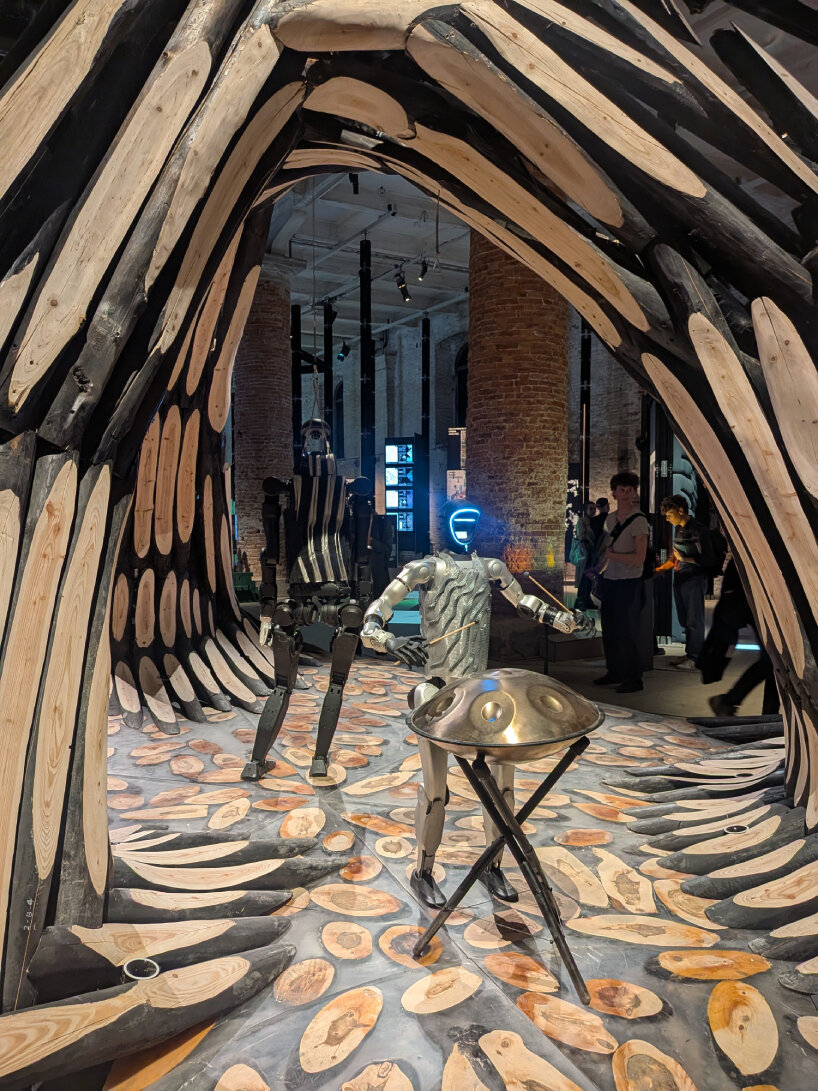
CO-POIESIS by Philip F. Yuan and Bin He | image © designboom


