|

ross lovegrove talks about using shock wave data from space mission to shape polarisgo chair

Ross Lovegrove shapes PolarisGo chair using space-mission data

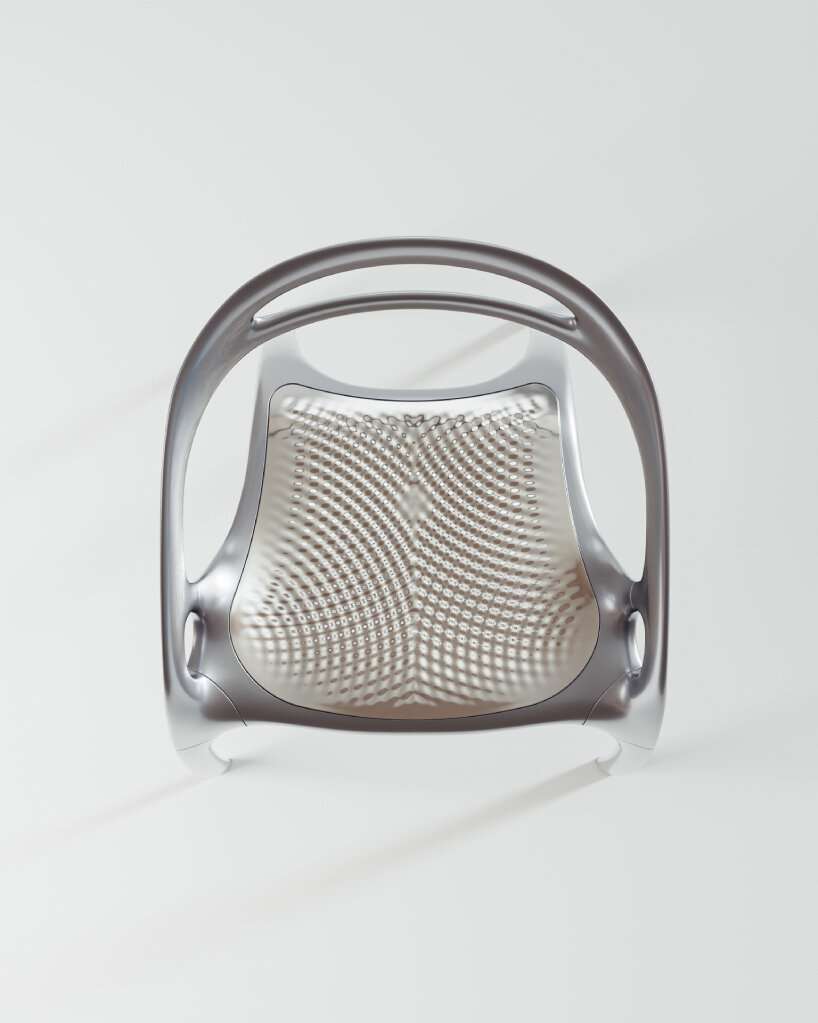
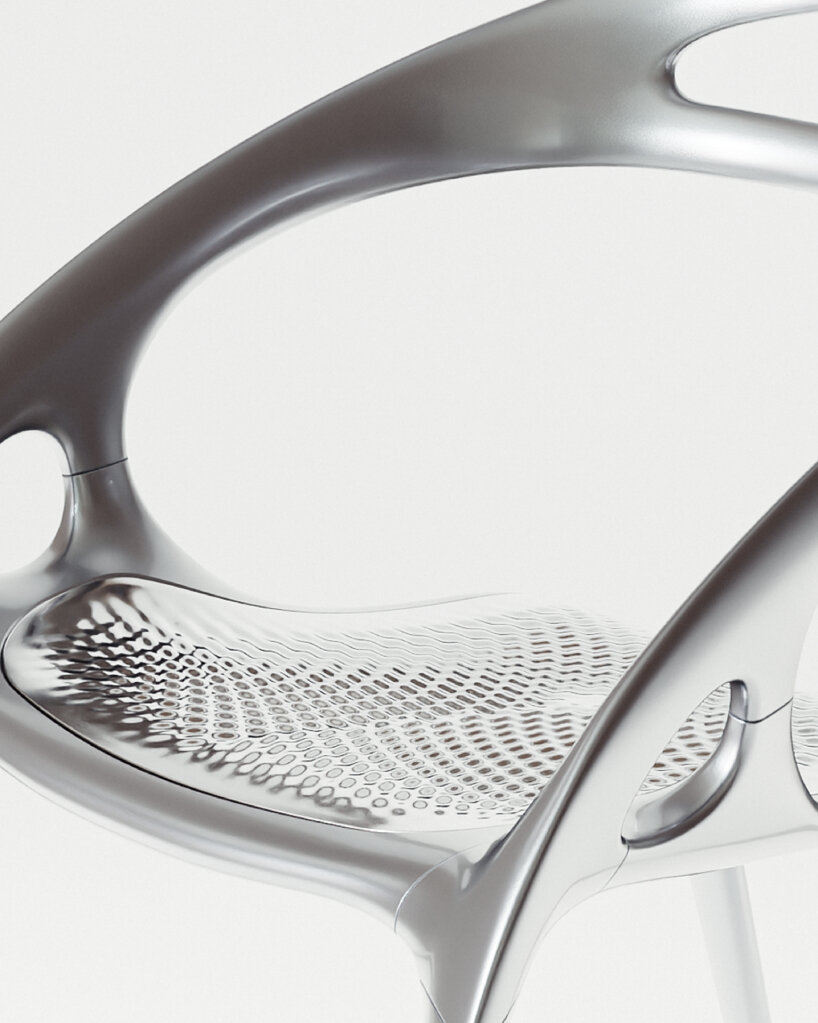
Ross Lovegrove shapes his PolarisGo chair using the data from the Polaris Dawn space mission and injected magnesium. Made of aerospace-grade aluminum alloy, the industrial designer draws directly from the shock wave data of the mission launch for the design of the seat, made in collaboration with CreativeWorkStudios. In an interview with designboom, Ross Lovegrove says he has access to the Polaris Dawn flight data and uses it as follows. ‘I have taken this data and translated it into a frequency that is passed through the frame of the GO Chair creating four distinct polarized focus points in each corner of the seat,’ the industrial designer tells us.

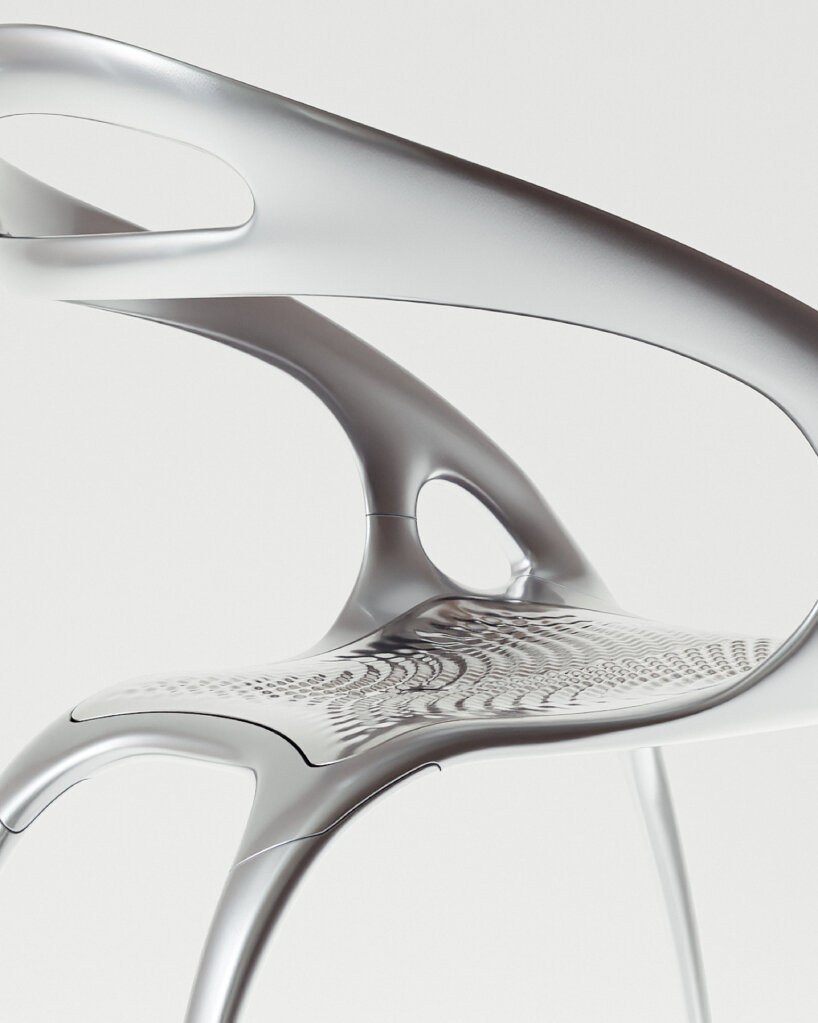
He’s talking about the main surface of the chair, which has ripples resembling the shockwaves from the space-mission data. ‘These four points then radiate waves that are arrested three dimensionally as they converge in the center of the seat pan and translated into a pressed metal alloy which becomes strengthened by the tessellated surface,’ Ross Lovegrove explains. These four-sided ripples converge in the middle. They also pay homage to the four astronauts in the Polaris Dawn space mission. ‘We have laser etched their names in each of the corners, creating an additional connection with history and space memorabilia,’ the designer adds.
chair space mission data
all images courtesy of Ross Lovegrove and CreativeWorkStudios

Injected magnesium to make a lightweight seat

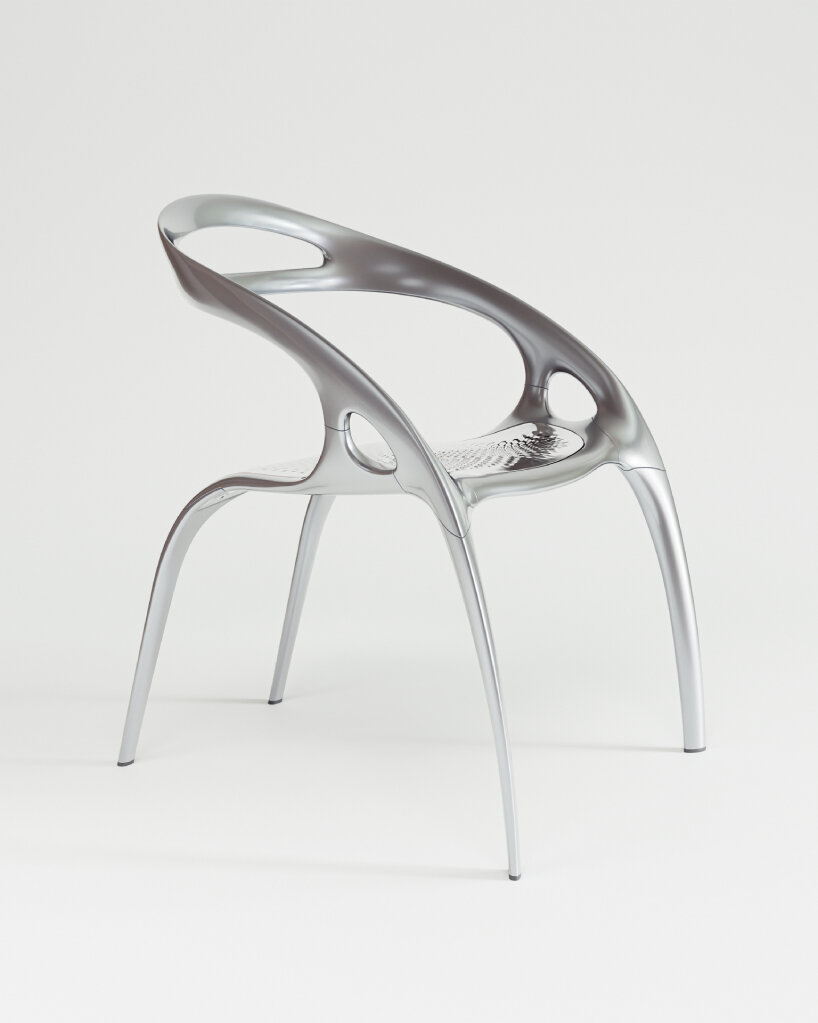
For the PolarisGo Chair, made in collaboration with the creative agency CreativeWorkStudios, Ross Lovegrove uses his iconic Bernhardt Go Chair as the base, which was launched in New York in 2001. ‘It was originally created in aluminum, but I felt it was too heavy and wanted to retain the physical anatomical mass of the chair’s lines,’ the industrial designer tells designboom. To make it lighter, he taps Audi’s advanced engineering unit in Ingolstadt, which pioneers magnesium to lighten car wheels. ‘The entire development program is then undertaken in Nurnberg. It results in a chair with a 30 percent reduction in its specific weight,’ says Ross Lovegrove. 

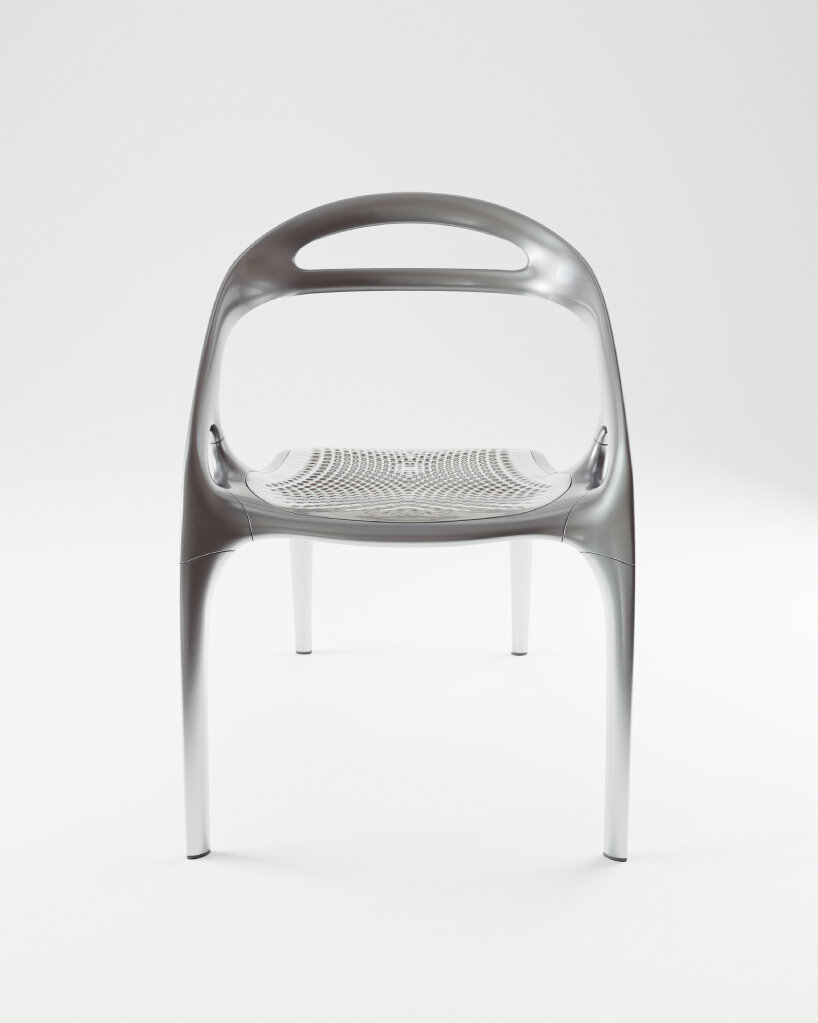
He injects magnesium into the aerospace-grade aluminum alloy to preserve the sculptural design of the chair made from space-mission data. The resulting seat is lightweight and malleable enough to take on a desired shape. There are only 210 units available for the model, each of which has injected magnesium. They also slightly differ from each other, depending on the data used from the Polaris Dawn space mission. So far, the chair is part of the permanent collections of the Centre Pompidou in Paris, the Philadelphia Museum of Art’s collection, and the Kirkland Museum of Fine & Decorative Art. The seat has also shown up at the Design Museum in London and the Guggenheim Museum in New York, with an established status as a significant piece in the history of modern design.
chair space mission data
Ross Lovegrove shapes his PolarisGo chair using the data from the Polaris Dawn space mission

Chair featured in sci-fi movies like Passengers

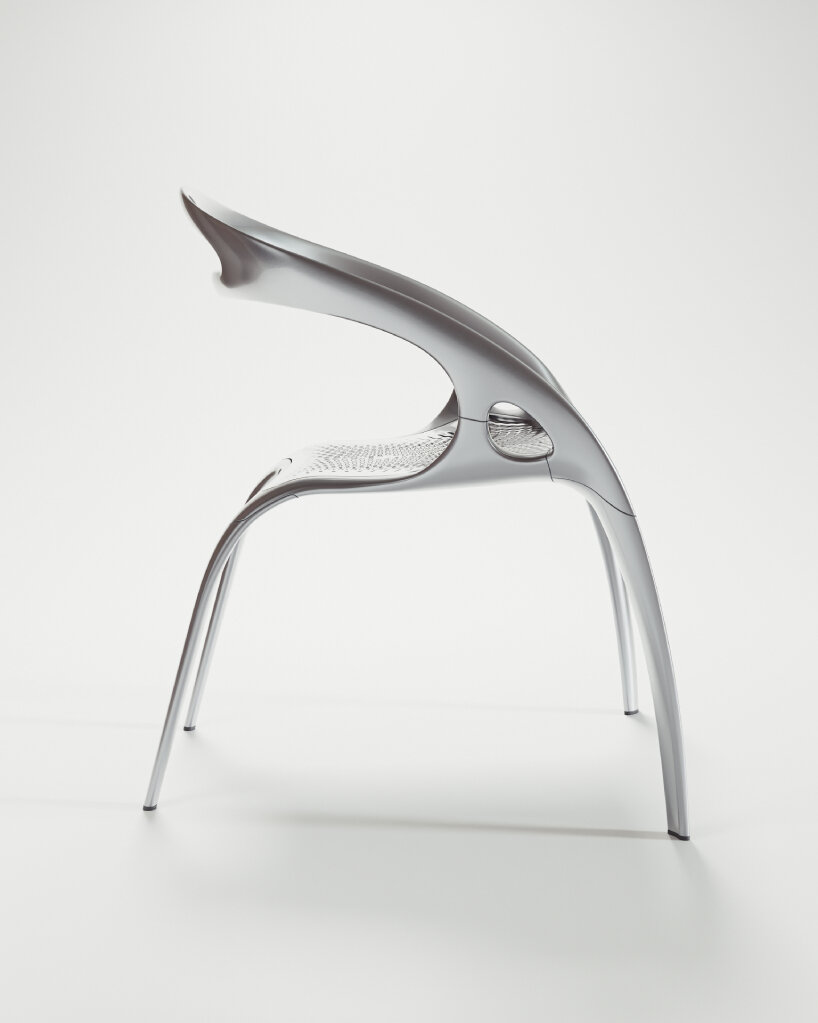
Design-wise, Ross Lovegrove leaves the huge part of the rear open. First, it allows for ventilation. Then, it mimics the shape of the windows around the aircraft used for the Polaris Dawn space mission. The industrial designer also creates a suspended look for the curved back of the seat, resulting in a singular look. He admits to us that using aerospace-grade aluminum alloy and injected magnesium can be challenging. The results, however, can be highly rewarding, too. ‘Space and aerospace,to my knowledge, do not employ biomaterials. Except possibly for selective interior parts,’ he answers when asked whether he has experimented with alternative components for the chair.

The rear legs of the chair made from space-mission data slope down. The seat curves and slopes throughout is reminiscent of the body forms of aliens in sci-fi movies. In fact, Ross Lovegrove shares with us that sci-fi movies like Passengers (2016) have featured the chair. These flowing designs also refer to some of the parts that make up the aircraft used in the 2024 flight. They also reflect the design principles of their maker, who tells us he sees himself as a sculptor of technology. ‘The lines of the products I design embody a sense of life force and motion,’ says Ross Lovegrove. CreativeWorkStudios says that a percentage of the proceeds from each Ross Lovegrove PolarisGo Chair goes to the St. Jude Children’s Research Hospital for cancer and disease research.
chair space mission data
the industrial designer draws directly from the shock wave data of the mission launch
chair space mission data
Ross Lovegrove says he has access to the Polaris Dawn flight data and uses it as follow
chair space mission data
the designer injects magnesium into the aerospace-grade aluminum alloy for the design of the chair
chair space mission data
the four-sided ripples that converge in the middle also pay homage to the four astronauts in the space mission

Similar Posts

  • House LV1 (house nanchi 1 y 2)

    CASA LV1 (casa nanchi 1 y 2)
    BRIEF DESCRIPTION OF THE CONSTRUCTION
    The Casa LV1 (casa nanchi 1 and 2), is a multi-familiar conformed by two houses constructed in the same land, the main material used for its construction was white striated concrete.
    DESCRIPTIVE MEMORY
    The Casa LV1 (casa nanchi 1 and 2) is a complex of two houses designed for a family an elderly couple, their young daughter and their granddaughter. Each house has the necessary privacy for each development, with the interrelationship and coexistence of the family; they are located in an irregular diamond-shaped land of approximately 250m2, a gradient over 10% with a view to the southeast.
    The Casa nanchi 1, on its main floor has: living room, dinning room, kitchen, bathroom, main bedroom with closet and its own bathroom, this floor is directly connected with the service area; the lower floor has a hall, two bedrooms with closet and its own bathroom; the upper floor has a roofed recreation room and a garden terrace. All the floors are connected by a stair, and has a parking lot. The total constructed surface is of 160 m2.
    The Casa nanchi 2 has on its main floor: living room, dining room, kitchen, bathroom and service area; on the upper floor it has: main bedroom with closet and its own bathroom, an additional bedroom with closet, a little play room and a bathroom; on the lower floor, where the entrance is, has: two parking lots and an exterior stair which is connected to the other floors. The total constructed surface of the house is 145 m2 excluding parking lots.
    Both houses share main entrance, service yard, green spaces and services.
    The houses are named after the nanchi tree (byrosonimacrassifolia) that is located in that land; it was respected and the project was adapted around it, to make it a natural decoration for the dinning room of the Casa nanchi 1. This house was designed for an elderly couple and it has a terrace in the upper floor, which is a recreational and relaxing space with a view of the surroundings to enjoy with the company of family, friends and guests. It has a double-height space which allows the development of the tree.
    The design of the Casa nanchi 2, which was designed for the daughter and granddaughter of the family, is inspired in the Brno chair, designed by the architect Ludwig Mies van ser Rohe, which not only allows a large volume, but also an efficient and free structural principle because with this solution is obtained an overhang of 4.85 m with a support of 2.85 m, generating a space without any support under the construction.
    The concept of the houses is derogates no only from the connection (interior-familiar, exterior-landscape), but also from the visual freedom that people perceive before entering in the house and also in the interior of them. This is fulfilled by the volumetric integration that defined the spaces of each house, both prisms have specific substractions that allow a formal integration of the two elements; in the Casa nanchi 1 the terrace is subtracted and in the Casa nanchi 2 the parking area is subtracted, transforming both elements without losing its integrity.
    The connection of both houses is so important that is not only achieved materially with the union of the two architectonic objects from the common entrance, connotating the link of the family, but also with the landscape, through the transparency in the facade of the two houses, which creates a visual freedom for the inhabitants. This gives a greater illumination of the spaces, producing a feeling of spaciousness and allows the air circulation due to the large windows that are handled by the users.
    The material, white striated exposed concrete and stone dust of the region, recalls the honesty of the materials, this simplicity benefits the environment, because it doesn’t use coatings in walls, fooors or roofs, contributing the less possible to the pollution. The exposed finishes means less production, transportation and utilization of pollutant materials. As said before, the free circulation of air allows a constant cleaning of the interior air which allows a natural regulation of the temperature, achieving termic comfort for the users and reducing the use of electronic devices that cools artificially the place. Besides, the same large windows avoid the unnecessary use of artificial illumination during the day allowing the entrance of sunlight in the morning.

  • Cozy House in Austria Combines Vernacular Design with Modern Comfort

    Bringing together vernacular design with contemporary aesthetics and comfort often leads to homes that are unique, smart and respond well to local conditions. Designed by Bernardo Bader Architekten, Haus am Moor is one such amazing residence where simplicity and rural Austrian charm are intertwined with smart modernity. The house on the outside has a silhouette […]

    You’re reading Cozy House in Austria Combines Vernacular Design with Modern Comfort, originally posted on Decoist. If you enjoyed this post, be sure to follow Decoist on Twitter, Facebook and Pinterest.

  • Accent Pillows in Multiple Colors: Must-Try Living Room Decorating Trend

    There are a few among us who are constantly worried about how we can improve our home and are more than happy to redecorate it in some small way all too often. Then there is the vast majority who just do not have the resources or the time to constantly change their home interior with […]

    You’re reading Accent Pillows in Multiple Colors: Must-Try Living Room Decorating Trend, originally posted on Decoist. If you enjoyed this post, be sure to follow Decoist on Twitter, Facebook and Pinterest.