|

Sweden Moves a Special 113-Year-Old Wooden Church to a New Home Miles Away

Moving of the Kiruna Church in SwedenMoving of the Kiruna Church in Sweden

Photo: Mammoet

In many places, historic architecture is sacrificed when the urban landscape changes, but not in Kiruna, Sweden. As the northernmost town in the Lapland province, Kiruna is known for many things, including a historically significant church. Built between 1909 and 1912, the wooden church was voted the country’s most beautiful building. So when LKAB mine needed to expand, putting at risk the church’s stability, special provisions were made.

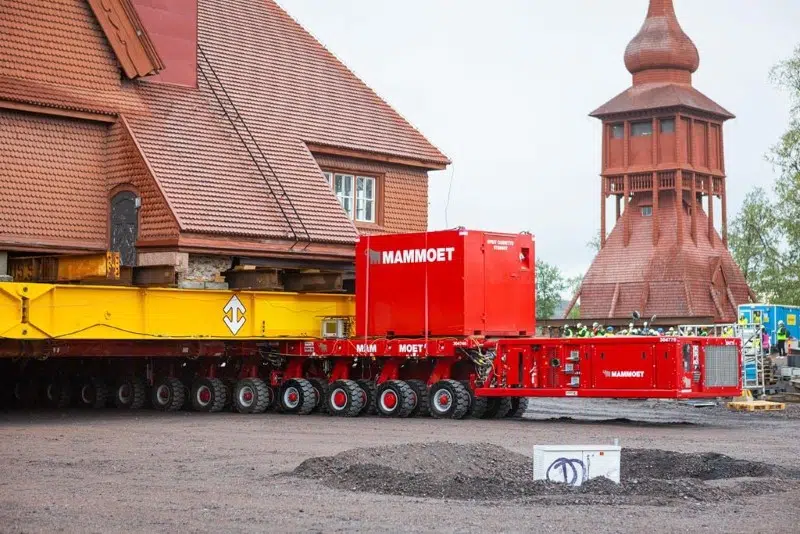
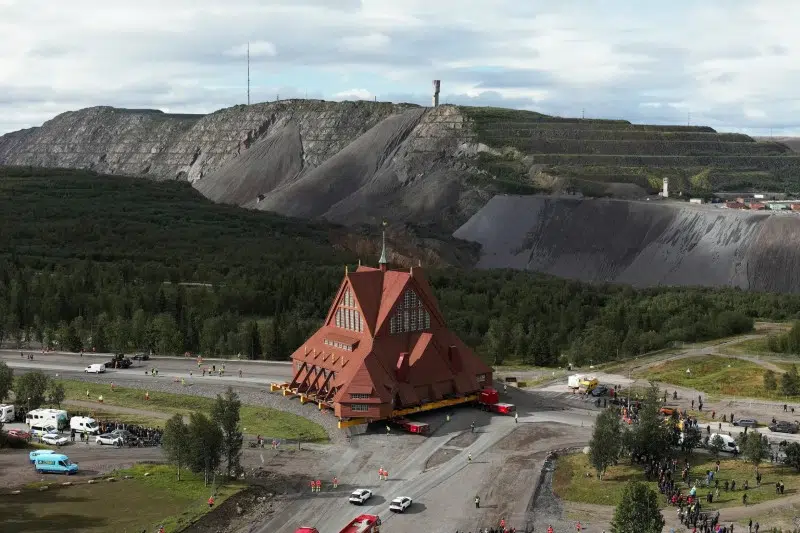
Over the course of two days, the extraordinary building, which is modeled on a Sámi hut, was relocated a little over three miles to a new city center. Incredibly, it was moved in one piece by Dutch logistics company Mammoet, which specializes in the transportation of large objects. Hired by civil engineering firm Veidekke and LKAB, Mammoet conducted extensive testing to ensure a smooth relocation of the 672-ton wooden church.

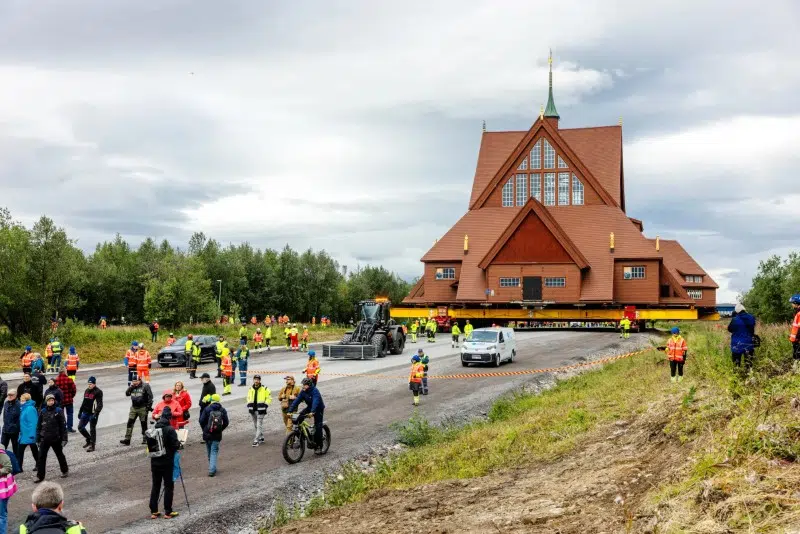
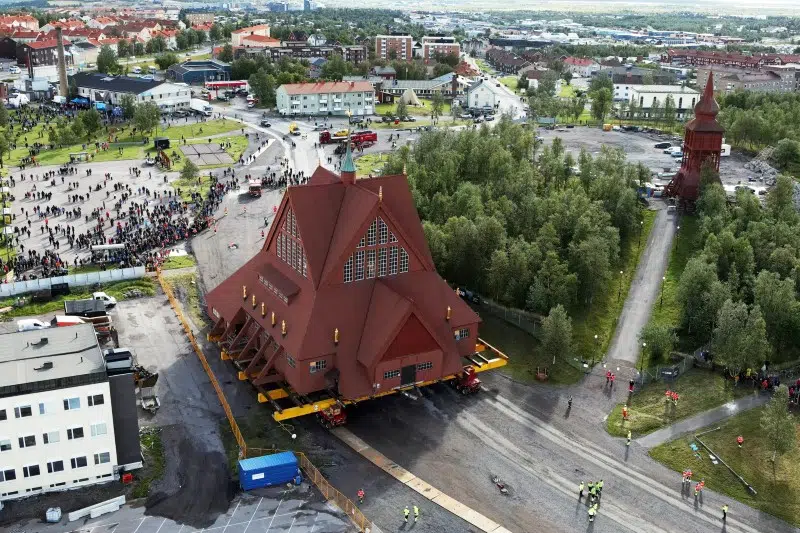
The move, timed for August so that the weather wouldn’t hinder the event, was a true spectacle. Thousands of spectators, including the King of Sweden, flood the streets along the route to watch this incredible process. Measuring 131 feet wide, the church was not easy to move, but thanks to careful planning, which included widening roads, it successfully made its way to its new home.

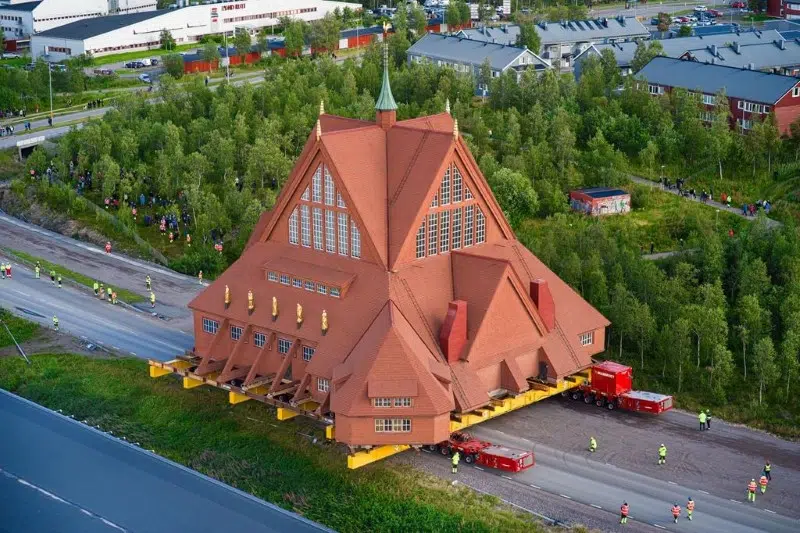
To make the move, Mammoet jacked the church up a little over four feet and placed it on steel beams, creating a sort of ultra-strong pallet. That pallet was then transported by two trains of 28 axle lines of Self-Propelled Modular Transporters (SPMTs). During the move, stability sensors ensured that the church was safe.

Once the Kiruna church arrived at its new home, the SPMTs lowered it onto its new concrete foundation. A few days later, Mammoet also moved the church’s 99-ton belfry. While Kiruna Church settles in, it remains closed to the public, intending to open as soon as possible so that people can continue to enjoy this important piece of cultural heritage.

While the planning was extensive, and the bill likely high, Sweden is setting an important example and sending a message. Historical architecture is not to be destroyed by modern growth; rather, with a bit of time and care, it can be integrated into something new and beautiful.

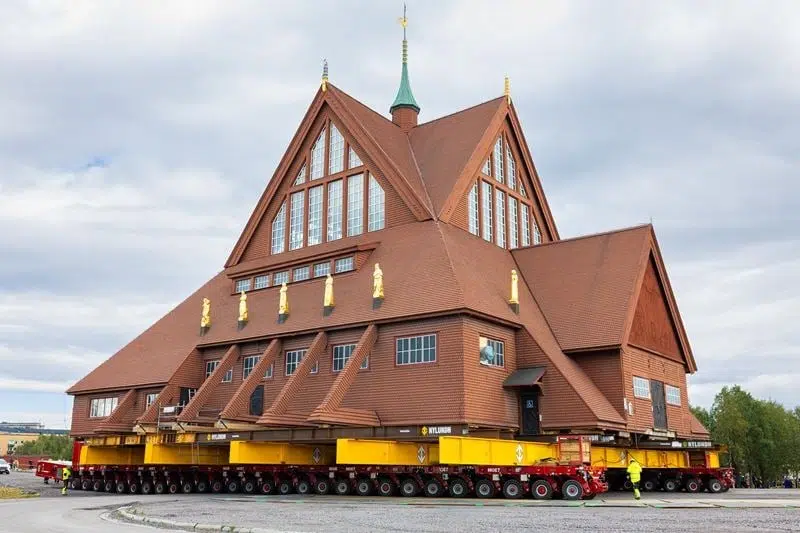
When a local mine needed to expand, officials decided to relocate a historic church in Sweden.
Moving of the Kiruna Church in SwedenMoving of the Kiruna Church in Sweden

Photo: Mammoet

Kiruna Church, a wooden structure built in the early 20th century, was moved three miles over the course of two days.
Moving of the Kiruna Church in SwedenMoving of the Kiruna Church in Sweden

Photo: LKAB

Moving of the Kiruna Church in SwedenMoving of the Kiruna Church in Sweden

Photo: LKAB

Thousands of spectators watched as the historic piece of architecture was moved to its new home.
Moving of the Kiruna Church in SwedenMoving of the Kiruna Church in Sweden

Photo: LKAB

Moving of the Kiruna Church in SwedenMoving of the Kiruna Church in Sweden

Photo: LKAB

Source: Mammoet Successfully Relocates Historic Kiruna Church in One Piece; The moving of Kiruna Church

Related Articles:

15 Different Types of Houses Found in Countries Around the World

Architects Reveal Plans To Turn an Old Dutch Church Into a Public Swimming Pool

Italian Church Design Is Stunning Dedication to the Episcopal Church’s Youngest Saint

The World’s Oldest Cat Door Has Been Letting Working Cats Enter the Cathedral Since the 14th Century

Similar Posts

  • Thai Home is a Relaxing Abode Covered by Forest Canopy

    It is one thing to go to relaxing, natural escape that takes you into the heart of a tropical jungle for an unforgettable vacation. It is a completely different experience when you bring home that tropical goodness and turn your own backyard into a stunning ‘forest’ of sorts. Designed by Studio Miti for those who […]

    You’re reading Thai Home is a Relaxing Abode Covered by Forest Canopy, originally posted on Decoist. If you enjoyed this post, be sure to follow Decoist on Twitter, Facebook and Pinterest.

  • Kahua Kuili Residence

    The Kahua Kuili residence is a modern interpretation of the classic Hawai’i summer camp. In keeping with the firm’s design philosophy, the warm yet spacious retreat was designed with longevity in mind. Kahua Kuili incorporates centuries-old indigenous design elements paired with contemporary attitudes to create a residence that will remain relevant for generations to come. Located within the dry portion of the Kona Coast at the base of the large cinder cone Pu’u Kuili, the property offers expansive views of the Pacific Ocean and Kua Bay as well as mountain views of Hualalai. Previously the site of a working ranch, the transition to residence became an opportunity to return the majority of the landscape to its natural state: a mix of lava and bunch grasses. Inspired by traditional Hawaiian architecture, the 5,590-square-foot residence is composed of multiple structures that simultaneously provide privacy through their scattered arrangement and community through the open spaces between them. The camp-like retreat’s focal point is the main hale (Hawaiian for house), which provides a central gathering place for family and friends. The main hale opens to ocean views and the central, protected courtyard, enabling activity to flow easily between indoor and outdoor space, including to the adjacent pool and tiki bar. The bar/lounge area spills over into the pool, complete with multiple lounge chairs and breathtaking ocean views. A barbecue/luau area allows for gatherings of family and friends who can picnic under the comfort and shade of a magnificent kiawe tree. Deep roof overhangs define the transition between inside and outside and offer shelter from sun and rain. Outdoor spaces link the separate structures—guest quarters, studio, wash house, garage—to one another. The use of simple, durable materials, such as board-formed concrete, western red cedar, large sliding doors, operable wood ventilation louvers, and rope lashing help reinforce the camp-like aesthetic. Western red cedar was selected for its resistance to termites and dry rot as well as for the beautiful way it patinas with age. Natural stone cowboy walls surrounding the property help create a sense of privacy from nearby houses. The interiors, by Marion Philpotts, were designed in a comfortable, contemporary aesthetic with bright colors and retro elements that tie into the modern theme of the structure. The expansive cedar-clad kitchen features a breakfast bar, dining table, and state-of-the-art appliances. Tall ceilings, large windows, and grand sliding doors that open to the courtyard contribute to the casual ease of the house. Intimate spaces, which include cozy reading nooks and relaxing sitting areas, are scattered throughout the home. Kahua Kuili is the quintessential destination for relaxation, where one can unwind comfortably and in style, all while enjoying the natural climate and landscape of Hawaii. Project team
    Architect: Walker Warner Architects
    Interior Designer: Philpotts Interiors
    Landscape: David Y. Tamura Associates
    Builder: Maryl Construction
    Photography: Matthew Millman